Tyre testing is stuck in the past but ECOLABEL's plan gives power to consumers
The ECOLABEL project is proposing bringing tyre noise and rolling resistance tests inside to more controlled and representative conditions

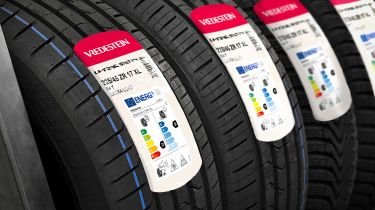
“Tyre labelling needs improvement, as it’s based on assumptions from the past century.” That's the view of one of the main figures behind a new project that could change the way car tyres are tested and labelled in the UK and Europe.
Led by the Swiss-Polish Cooperation Programme, which includes academics from the Gdańsk University of Technology, the ECOLABEL initiative aims to provide consumers with clearer and more representative information about tyres to help inform buying decisions. ECOLABEL, in case you are wondering, stands for Environmental Consumer-Oriented Labelling Advancement for Better tyre energy Efficiency and Lower external noise.

Lead investigator and project coordinator, Dr. Piotr Mioduszewski, explained to Auto Express that since the popularisation of EVs, “tyre rolling noise has become extremely important because in typical road conditions, this is the total vehicle sound”. On current European tyre labels, the volume of tyres is displayed in decibels, alongside elements such as wet weather performance and rolling resistance scores.
“In the case of rolling resistance we are primarily talking about money for consumers,” Dr. Mioduszewski continued, “because if they buy tyres with higher rolling resistance, they will spend more money on fuel or they will get a lower range in EVs.”
Currently, tyre sound is recorded in a coast-by test in which the vehicle travels past a microphone at approximately 50mph on a road constructed of Dense Graded Asphalt (DGA) Concrete and at an ambient surface temperature of 20 degrees Celsius. This, according to the ECOLABEL researchers, is not at all representative of a typical UK or European road.
“These surfaces are very quiet and bear no relation to the current pavements that are laid on the roads in Europe,” said Dr. Mioduszewski. The majority of European roads, including those in the UK, are instead constructed using much coarser, gap-graded asphalt. When testing on these surfaces as opposed to DGA, Mioduszewski said: “On average the difference is around five decibels, but it can be up to 10 or 11 decibels.”
The surface on which a tyre is tested is also an issue when it comes to how rolling resistance is currently ascertained. Contemporary regulations, which have been in place since the nineties, involve rolling a tyre on a metal cylinder, measuring the force required to keep the drum rotating.
Whilst such a drum might, at face value, provide a neutral and level playing field for tyres to be tested, the ECOLABEL team says that this can skew results and make the performance of some tyres appear greater than others.
“When we tested the tyres on different roads including the ISO reference surface, we obtained quite different results and even a different ranking,” Mioduszewski explained, “[as] the tyres behave in a different way on the very smooth surface [in comparison to] the more rough one."
The solution would be to create a representative texture of a European road in order to wrap onto the surface of the drum, thus establishing more realistic conditions for both rolling resistance and audible testing. This would be accompanied by a change in ambient testing temperature, which currently sits at 25 degrees centigrade – even for winter tyres.
“Imagine going to a store to buy a winter jacket to discover it was tested whilst camel riding in Saudi Arabia,” joked expert in rolling resistance at Gdańsk University of Technology, Prof. Jerzy Ejsmont. Like the change in surface texture, temperature can also impact the rolling resistance performance of a tyre, which is why the ECOLABEL project also suggests setting ambient testing temperatures at 15 degrees for summer tyres, five degrees for winter tyres and both for all-season offerings.
All of this, it’s hoped, will have several benefits besides lower overall testing costs. Mioduszewski says vehicle manufacturers have long been demanding more authentic data when it comes to tyre rolling resistance performance so as to calculate more accurate range and efficiency figures for cars. On the consumer side, more accurate labelling should hopefully not only give buyers greater insight, but subsequently drive competition between tyre manufacturers as what’s written on the label becomes more impactful on buying behaviour.
Any changes remain far on the horizon, though, as the project remains in its initial consultation stage, with any proposals to the EU Commission not expected before the end of 2028. Whether ECOLABEL’s final recommendations are actually put into practice will ultimately depend on the EU itself, although Mioduszewski doesn’t expect consumers to benefit from improved tyre testing and labelling before 2035.
Did you know you can sell your car through Auto Express? We’ll help you get a great price and find a great deal on a new car, too.