Best car tyres to buy now: top tyres tested and reviewed
Our previous winner, the Continental PremiumContact 7, faces a tough new set of challengers


The increase in new car wheel sizes shows no sign of slowing, but the biggest-selling tyre in the UK is still the relatively modest 205/55 R16. Three years since we last tested it, this size is the subject of our 2026 test.
Last time, the then-new Continental PremiumContact 7 emerged as the clear winner in this size – and tests of other sizes in the meantime suggest that it will still be the tyre to beat. The Bridgestone Turanza T005 was joint runner-up in our last test, but this time the company has chosen to supply another tyre from its portfolio, the Firestone Roadhawk 2, launched a couple of years ago.
Michelin and Pirelli finished in the mid-field pack three years ago and are back with new designs: Michelin has replaced the Primacy 4+ with the Primacy 5, while Pirelli is fielding the Cinturato C3 in place of the Cinturato P7. Falken will be hoping for a stronger showing this time from its new Ziex ZE320, and the same goes for Maxxis, which has replaced its Premitra HP5 with the HP6.
Hankook, Vredestein, Kumho and Goodyear all declined our invitation to take part this year because they have new designs due soon. But again, for perspective we’ve included a budget tyre to show how much performance you get for not a lot of money.
Used - available now

2025 Skoda
Fabia
40,625 milesManualPetrol1.0L
Cash £11,224
2024 BMW
iX3
71,332 milesAutomaticElectric
Cash £23,000
2023 Mercedes
EQC
72,049 milesAutomaticElectric
Cash £22,500
2022 BMW
3 Series
22,802 milesAutomaticPetrol2.0L
Cash £20,565This year’s test venue was the Continental Contidrom near Hannover in northern Germany.
What we tested
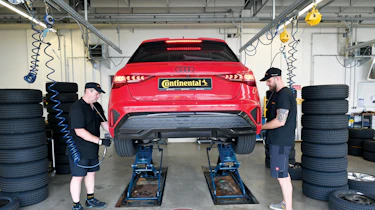
As usual, we purchased all test tyres from the open market via an independent wholesale supplier in Germany to ensure that the tyres we tested are consistent with any you can buy.
We let the manufacturers nominate specific variants, with all opting for a speed rating of V or W (149 and 168mph respectively), and a weight rating of 91 or 94, with two opting for XL – Extra Load.
EU tyre label ratings (self-certified by the maker) are included for fuel economy (RR – rolling resistance) and wet grip (WG). These range from A to E, with A being best, plus pass-by noise (N) that is measured in decibels, so the lower the number the better.
| Tyre | Ratings | Price |
| Continental PremiumContact 7 | 91V RR: C WG: A N: B (71) | £106.99 |
| Dynamo Street-H MH01 | 91V RR: D WG: C N: B (71) | £53.77 |
| Falken Ziex ZE320 | 91V RR: C WG: A N: B (71) | £79.99 |
| Firestone Roadhawk 2 | 91V RR: C WG: A N: A (67) | £87.97 |
| Maxxis Premitra HP6 | 94W XL RR: C WG: A N: B (70) | £63.50 |
| Michelin Primacy 5 | 91W RR: B WG: A N: B (70) | £107.99 |
| Nokian Powerproof 2 | 94V XL RR: B WG: A N: B (70) | £68.74 |
| Pirelli Cinturato C3 | 94W XL RR: C WG: A N: B (70) | £124.58 |
How we tested them
Wet
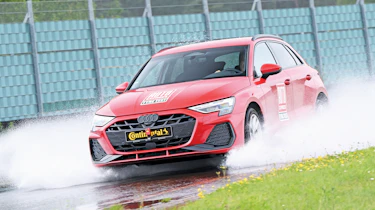
You’re most likely to find the limit of a tyre’s grip on wet roads, so our scoring places more value on performance in the wet tests. The crucial evaluation is straight-line wet braking, measured on an evenly wetted surface from 50mph to zero, the result being the average of seven runs with the outliers removed.
We also test wet cornering, taking the average time over a number of laps on a 50-metre wetted circle, plus a more challenging wet handling circuit in which we assess each tyre’s lateral grip, traction and dynamic balance. This is done up to and over the limits of grip, across demanding turns and sweeps.
There are also two aquaplaning tests. In the straight-line test we measured the speed at which each tyre was generating 15 per cent of slip in 9mm of water. Resistance to aquaplaning when cornering was tested by driving a curve flooded with 5mm of water over a speed range from 40 to 60mph and then calculating the average amount of residual lateral acceleration.
Dry
Straight-line dry braking performance was measured from 62mph to zero. We also took lap times on a one-mile, dry handling circuit that combined a range of turns, from traction-testing slow corners to sweeping bends and sequences that challenged each tyre’s grip, dynamic balance and traction, plus composure under braking, too.
Noise
New tyres carry an EU tyre label that includes a rating of the noise it generates, but this is an external, drive-by measurement. Instead, we use a meter to measure the level of noise the driver and passengers hear inside the vehicle over a variety of specially prepared smooth and coarse surfaces at a set speed.
Fuel economy
The energy required to simply roll a tyre over a surface – its rolling resistance – influences the fuel economy of your car. The tyre label carries the rating of the tyre from A (good) to E (poor), but these are bands and represent a range. We test the tyres to the same industry standard and deliver a more accurate result. As a rule of thumb, a four per cent change in rolling resistance is equivalent to a one per cent change in fuel consumption.
Prices
These are sourced from online retailer Blackcircles.com and show the cost of a fitted tyre at the time of writing. Price has a limited impact on the overall result to the tests, because tyres are a safety-critical item.
Calculating a winner
Half of the overall score is allocated to wet performance and 40 per cent to dry, with the emphasis on braking and handling in both instances. The remaining 10 per cent is shared among the other tests. The top-performing tyre in each criteria evaluated is scored at 100 per cent, with the others rated relative to this.