Honda Civic review
Tweaks for the latest Honda Civic hatchback make for an even stronger package

Our opinion on the Honda Civic
In the ever-decreasing pool of compact hatchbacks, the Honda Civic still makes a strong case for sticking with a traditional family car. It’s quick, rides well, and delivers decent handling, while the hybrid-only engine line-up offers seamless power delivery and excellent fuel efficiency without compromising your driving style. Overall interior space is good, though headroom in the rear is a little lacking, but this is made up for by excellent legroom. The main downside to the Civic is its price, because while the modest model line-up is well equipped, you pay more than you would for similar rivals.
About the Honda Civic
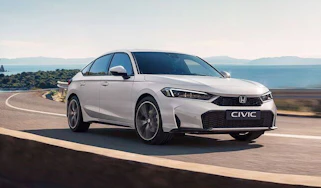
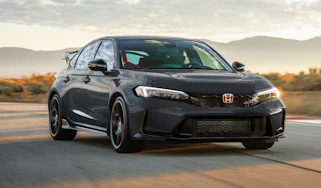
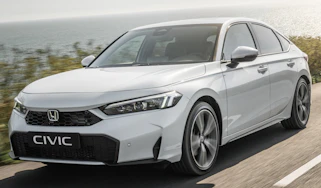
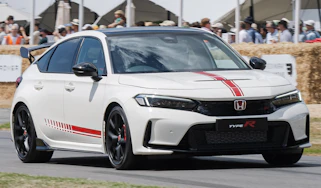
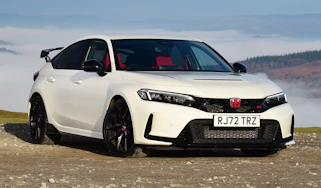
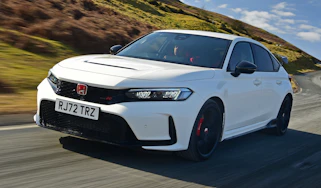
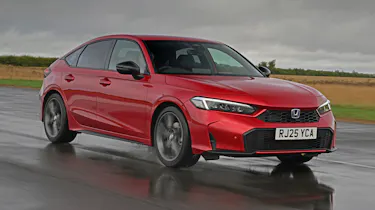
The Honda Civic has been a bastion of the Japanese firm’s range since it first arrived in 1972, and it has gone on to become one of the world’s best-selling nameplates. The current, eleventh-generation Civic arrived in 2022, and 2025 saw it benefit from a mild update. When we say mild, we mean mild, because the changes that Honda applied take a keen eye to spot. One of the most notable upgrades was improved LED headlights.
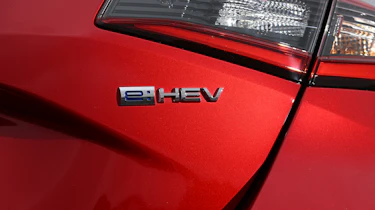
As before, the Civic range remains hybrid-only, like its Toyota Corolla rival. It comes in five-door hatchback form, so those looking for an estate will need to look at a Peugeot 308 SW, Skoda Octavia estate, Toyota Corolla Touring Sports, or Vauxhall Astra Sports Tourer instead. The trim range of the Civic is delightfully straightforward, made up of just three levels of Elegance, Sport, and Advance.
Used - available now

2018 Honda
Civic
50,593 milesManualPetrol1.0L
Cash £10,670
2021 Honda
Civic
27,000 milesAutomaticPetrol1.0L
Cash £12,499
2021 Honda
Civic
48,092 milesManualPetrol1.0L
Cash £12,720
2021 Honda
Civic
62,000 milesAutomaticPetrol1.0L
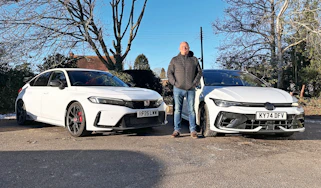
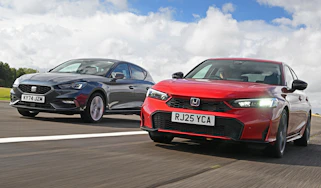
Cash £9,995We’ve been sure to put the latest generation model through its paces against the competition. We first put a Sport trim Honda Civic against the Kia Ceed and Toyota Corolla in a group test, and we've also put the facelifted Honda Civic against the SEAT Leon in a twin test. We've also run a Sport trim Civic as part of our long-term test fleet.
Honda Civic prices and latest deals
Pricing for the latest Honda Civic remains at a premium, with the entry-level Elegance starting from just under £34,500. Mid-range Sport comes in at around £36,000, while the range-topping Advance costs a little under £39,500.
You can save around £2,500 off the price of a new Honda Civic or find some great Honda Civic leasing deals through the Auto Express Buy a Car service. We have a number of affordable used Honda Civic models to choose from, and you can also sell your car with us.
Performance & driving experience
Pros |
|
Cons |
|
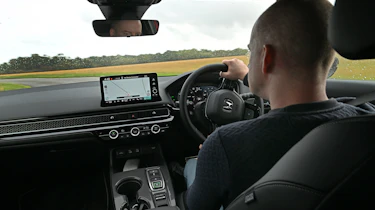
A supple yet agile chassis, slick steering and well-judged control weights all round mean that even though it’s not what we’d call thrilling, the Civic is one of the most accomplished cars in the segment to drive.
There’s only one powertrain available in the Civic hatchback, and it’s one that makes use of some fairly clever hybrid technology. While there’s a 2.0-litre four-cylinder petrol engine under the bonnet, it’s rarely used for driving the front wheels directly. Instead, it spends most of its time acting as a generator, with its energy converted to electricity that, via an inverter and a 1.05kWh battery, drives an electric motor that powers the wheels. In everyday driving, the hybrid powertrain works seamlessly, with only the merest hint of a vibration as the engine switches on and off, but the throttle response, acceleration and smoothness are as good as in most fully electric cars.
The one exception to this method is that once motorway speeds are reached, the petrol engine does drive the wheels directly rather than via the electric motor. Honda says this is the most efficient way of using the two power sources.
Performance, 0-60mph acceleration and top speed
All versions of the Honda Civic have a healthy 181bhp and 315Nm of torque, and initial shove from the motor is very lively, but the Civic’s 0-62mph time varies slightly depending on spec. The base Elegance model takes 7.8 seconds, the mid-range Sport takes 7.9 seconds, and the poshest Advance takes 8.1 seconds. That's pretty quick by sensible family hatchback standards.
At around 60mph the e:HEV’s acceleration starts to tail off somewhat, but it’s still more than strong enough for the class. Hard acceleration causes a swell of revs and a noticeable noise as the petrol engine works its hardest to send sufficient energy to the e-motor. To make the sound seem a little more natural, Honda has engineered artificial steps into the engine revs, mimicking the gearshifts of a conventional automatic transmission. It still feels a little odd, but it’s more pleasant than the CVT-style drone that many Toyota hybrids have given off in the past.
| Model | Power | 0-62mph | Top speed |
| Civic 2.0 eHEV Elegance auto | 181bhp | 7.8 seconds | 112mph |
Town driving, visibility and parking
The Civic is one of those rare cars which takes only a few yards to communicate to the driver that it’s very well engineered throughout. There’s a pleasing weight to the steering response and the brake pedal, meaning that the Honda is a fairly satisfying car to drive, even around town.
In the case of the brakes, a further bonus comes from the fact that the transition between deceleration via motor regeneration and through the mechanical brakes is as seamless as in any car on the market. Some rivals have a slightly tighter turning circle, but that aside, it’s a very easy car to move around at low speeds.
Country road driving and handling
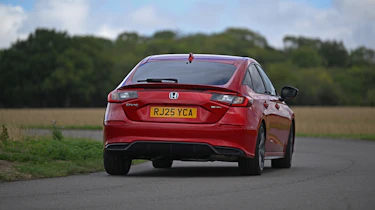
On more open roads, it’s easier to appreciate the breadth of the Civic’s ability. Here, the controlled yet forgiving ride presents itself; it deftly shrugs off bumps while keeping a confident control of its mass. That ability brings a bonus when negotiating a twisty road, because the Honda has only minimal body roll. Combined with agile handling, strong grip and a neutral, predictable balance, it’s among the best cars in its class to drive.
Motorway driving and long-distance comfort
High-speed stability is up there with the best in the segment, too. One of our main Civic gripes comes at higher speeds, though, and that’s road noise. Roar from the tyres is more noticeable here than it is in many of the Civic’s rivals.
MPG & running costs
Pros |
|
Cons |
|
The benefit of that clever hybrid tech is that the Civic is efficient. Our most recent test of the updated car saw us return just shy of 50mpg over the course of a week’s driving on mixed roads – a fine score considering the fairly strong performance that the Honda hatchback can offer up, too.
While some rivals will offer the option of plug-in hybrid power, the Civic is much cheaper than those alternatives, so even with regular charging to make the most of their EV ranges, it’ll take a long time to recoup the extra cost up front with fuel savings.
| Model | MPG | CO2 | Insurance group |
| Civic 2.0 eHEV auto | 56.5mpg | 113g/km | 27 |
Insurance groups
Depending on the trim level you choose, the Civic’s insurance groups range from 26 to 28. This is relatively high for a compact hatchback, because the Toyota Corolla has a top rating of Group 22 for the most expensive model in the range.
Tax
With the entire Civic range costing well below the £40,000 mark when the first year's vehicle excise duty (VED) and registration fee are discounted, none of its trim levels is subject to the additional luxury car tax levy.
Company car buyers will be better off opting for an electric car if they want the maximum reduction on Benefit-in-Kind (BiK) tax. Electric hatchback options include the Cupra Born, Peugeot E-308, Vauxhall Astra Electric, and Volkswagen ID.3.
Depreciation
Compared with its closest competitors, the Civic maintains its value well, which is useful because its on-the-road price is a little on the high side. Our market data shows that the Civic should retain between 47 and 49 per cent of its initial value after a period of three years or 36,000 miles. In comparison, a Volkswagen Golf manages 40 to 48 per cent, while the Peugeot 308 clings on to around 44 per cent of its original value.
Interior, design & technology
Pros |
|
Cons |
|
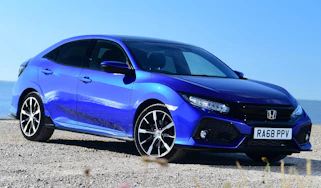
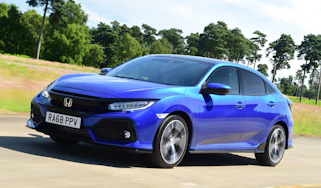
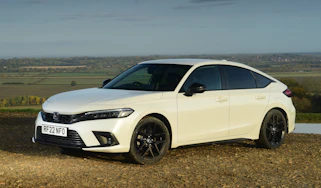
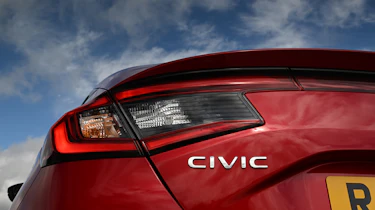
The designers of the latest Civic have tidied the front end, with a wider front air intake and slim vertical vents sitting to either side. The grille has also been altered, while a new alloy wheel design (18-inch items are fitted across Sport and Advance trims) and a fresh paint finish round out the exterior changes.
No version of the Civic is what you would describe as spartan, with the entry-level Elegance being so well equipped that it's our pick. It comes with:
- 17-inch alloys
- Keyless entry and start
- Front and rear parking sensors
- A reversing camera
- Dual-zone climate control
- Privacy glass
- Heated front seats.
Mid-range Sport adds a heated steering wheel, wireless phone charging, an auto-dimming rear-view mirror, and a 10.2-inch digital driver's display.
The range-topping Advance trim features an uprated 12-speaker BOSE audio system, leather trim, electrically adjustable front seats, ambient interior lighting, adaptive LED headlights, and a panoramic glass roof.
Interior and dashboard design
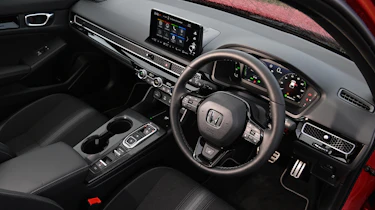
Honda has hit a sweet spot with the Civic’s cabin design. While there’s a touchscreen and a digital driver’s display (the latter on Sport trim and above) to make it feel fresh and modern enough, large physical buttons and dials remain. The climate controls are easy to use, and the rotary controls have a satisfying click in their operation. Beyond pure ergonomics, that tactile feeling is another thing that’s lost when manufacturers simply install a large touchscreen in the cabin.
Elsewhere, the dashboard is neatly laid out, and while it isn’t quite as stylised as the likes of the Peugeot 308, it’s tidy without being dowdy. The 2025 facelift has introduced some very subtle changes, with black headlining standard across the range, and there’s a new metallic finish for the air vent surrounds, too.
Materials and build quality
Fit and finish is hard to fault in the Civic, and any hard plastics that are present seem less obvious than in rivals from the Volkswagen Group. The seats, steering wheel, and switchgear all feel suitably well-finished, which is just as well given this car's premium pricing.
Infotainment, sat-nav and stereo
While we have no objections to the modest nine-inch size of the display, its graphics are a little blocky. The touchscreen is not that quick either, with loading and response times for the Honda Connect system both behind the class best. At least wireless Apple CarPlay and Android Auto are standard, should you wish to bypass the car's software and use apps from your phone instead.
Sport trim comes with a full digital instrument cluster, which, while not as easy to navigate or as configurable as the digital clusters in either the Audi A3 or Volkswagen Golf, gives the car a sharper look than a traditional analogue display. And if you're using an Android phone with Google Maps, the turn-by-turn navigation instructions can be shown in the cluster, leaving you to use the main touchscreen for a different app.
"The subtle facelift has, on the whole, made the Civic a cleaner, more handsome-looking car than it was, but there’s one detail which irritates. With the reshaped grille comes a new plastic surround that runs around its upper edge and above the headlights. On a light-coloured car, it looks really clumsy." - Alex Ingram, former chief reviewer.
Boot space & practicality
Pros |
|
Cons |
|
The Civic is a little longer than many of the conventional hatchback contingent, with a shape a little more reminiscent of a Peugeot 408 or a Skoda Octavia. That extra length compared with many of its more conventional rivals brings benefits to the Honda’s interior space, but in some areas, they aren’t as significant as we’d hoped for.
Dimensions and size
The Civic occupies a sizable footprint for a five-door hatchback. It has an increased wheelbase over the previous model to help create more interior space, while its overall height has been reduced to give a sleeker look.
| Dimensions comparison | |||
| Model | Honda Civic | Skoda Octavia | Toyota Corolla |
| Length | 4,560mm | 4,698mm | 4,370mm |
| Width | 1,802mm | 1,829mm | 1,790mm |
| Height | 1,408mm | 1,470mm | 1,460mm |
| Wheelbase | 2,734mm | 2,686mm | 2,640mm |
| Boot space | 415-1,220 litres | 600-1,555 litres | 361-1,052 litres |
Seats & passenger space
With the front seat and the steering wheel offering plenty of adjustment, almost any driver will find it fairly easy to find a comfortable driving position in the Civic. But most will struggle to see what’s going on behind. The rear hatch’s slanted angle means that, despite the decent size of the back window, the driver can’t see very much out of it. There’s a reversing camera to help with backing into tight spots, but its resolution is pretty poor compared with many rival systems we’ve tried.
Rear passengers who have long legs and short torsos are best suited to the Civic. That’s because although knee room is well above the class average, the space from the seat base to the roof lining is in relatively short supply. The seats are fairly comfortable, though.

Boot space
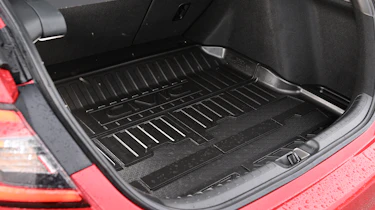
The Civic has a 415-litre boot, which is 34 litres more than you get from a Volkswagen Golf and 35 litres more than a SEAT Leon. However, a Skoda Octavia is 130mm longer on the outside, and it puts that length to good use, because it offers a vast 600-litre boot. The shape of the Civic’s boot floor is a little irregular, but the hatchback opening is huge, so it’s easy to load items inside. Fold the back seats down, and the total volume grows to 1,220 litres, highlighting the limitations of the Civic’s low roof line.
Reliability & safety
Pros |
|
Cons |
|
Honda has long held a reputation for reliability, and that’s reflected in how satisfied most owners are living with the brand’s vehicles. In the 2025 Driver Power customer satisfaction survey, Honda finished comfortably in the top half of the table, taking 10th place out of 31 manufacturers.
Euro NCAP tested the Civic in 2022, and it scored a maximum five-star safety rating. Forward-collision warning, lane-departure warning, lane-keeping assist and traffic-sign recognition are all standard, although switching off the likes of the lane-keep system is rather fiddly compared with some rivals.
| Euro NCAP safety ratings | |
| Euro NCAP safety rating | Five stars (2022) |
| Adult occupant protection | 89% |
| Child occupant protection | 87% |
| Vulnerable road user protection | 82% |
| Safety assist | 83% |
Buying and owning
Best buy: Honda Civic 2.0 HEV Elegance
With only one engine offered, it’s just the spec you need to choose. We’d stick with the entry-level Elegance because Sport and Advance trims only add a few bits and pieces over the base model and are quite a lot more expensive.
Honda Civic alternatives
As has been the way for decades, the Toyota Corolla and Volkswagen Golf are two of the Civic’s strongest rivals. The uber-practical Skoda Octavia beats the lot of them (including the Honda) for passenger and boot space, though. Other hatchback options to consider include the Mazda 3, Peugeot 308, SEAT Leon and Vauxhall Astra.
Alternatively, if you’re considering moving over to fully electric motoring, the Cupra Born, Kia EV4, Renault Megane E-Tech, Peugeot E-308, Skoda Elroq, Vauxhall Astra Electric, and Volkswagen ID.3 are all hatchback-shaped candidates that are vying for your attention.
Honda Civic pictures
Key updates of the Honda Civic review
2 June 2026: General update to include the brand's service-activated extended warranty.
25 March 2026: Updated to include the latest depreciation and taxation data.
Frequently Asked Questions
The Honda Civic requires servicing every 12 months or 12,500 miles, whichever comes first.
Deals on the Civic and alternatives