How Geely’s new £215m tech centre will make its cars safer
Auto Express was among the first people allowed into the world’s largest automotive safety centre

A new state-of-the-art safety and testing centre has opened its doors to any and all carmakers, thanks to Chinese colossus Geely, which spent 2 billion yuan (around £215m) building the facility that could potentially benefit motorists around the world.
Auto Express was among the first people granted access to the brand-new facility located in Hangzhou Bay, China, a few hours outside Shanghai. It opened late last year and has already set five new Guinness World Records, including the world's longest indoor vehicle crash test track.

Despite being one of the largest car manufacturers in China – plus the owner of Volvo, Lotus, Polestar and other brands – until it built this place, Geely had to rent other facilities to carry out vital vehicle testing.
But now it can do all it under one roof, from evaluating how new cars stand up to cyberattacks to their performance at high-altitudes. It’s able to operate 24/7 and other manufacturers are already seeking to use its specialised facilities, which bosses tell us was always the hope for the project.
“Safety is important for everybody,” project manager Ifan Gao says as he shows us around the hi-tech site, “and the investment needed for such a big facility is a lot of money and not everybody is willing to spend so much money. Plus good things should always be shared.”
This single facility offers 27 different testing capabilities for new passenger and commercial vehicles, and meets the safety regulation testing requirements not just for China, but Europe, the U.S., Southeast Asia and other regions.
With this facility open to all, Geely “aims to promote the establishment of more comprehensive industry standards, transforming safety from a single company's technological advantage into a shared asset for the entire industry.”
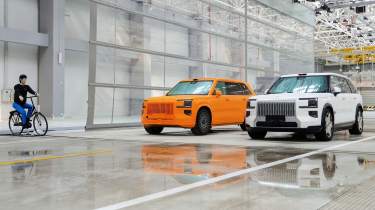
Crash safety testing beyond Euro NCAP’s standards
At 45,000 square metres, Geely’s gigantic crash safety lab covers about the same space six football pitches, providing more than enough space for the 293-metre long track which cars are hurled down at speeds of up to 75mph – more than twice the speed Euro NCAP tests at.
On this track, cars fired towards an enormous concrete block, which is movable so engineers can adjust the angle of the object it hits, including a full-frontal collision. Alternatively, they can use a ramp to simulate a rollover, add a barrier or replicate a car-on-car collision.
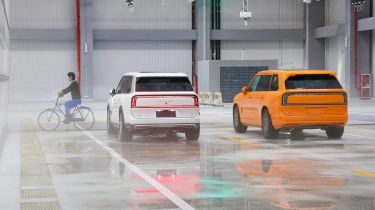
Sadly, we didn’t get to see a brand-new Geely or Volvo being pancaked during our tour, but we did get to see a test car going through the weather simulation area. The space produces artificial rain, snow or fog, as well as different lighting conditions, to assess active safety systems across different times of day and when someone steps in front of a car.
Fortunately the colossal three-tonne Zeekr 9X that the engineers sent through thick fog performed as hoped, and the dummy cyclist crossing its path remained unflattened.
Million-pound family of dummies
To collect all the vital data from the thousands of experiments, Geely has built up a family of more than 60 crash test dummies, some of which cost as much as £1.3million. There’s representations of men, women and children and, because standard dummies are based on European’s bodies, Geely worked with Hunan University to develop the first model designed to replicate Asian people’s bodies and provide more comprehensive data on the safety of its cars.
Cybersecurity and autonomous driving laboratories
But as well as cars’ passive safety (crash protection), Geely has also built labs tailored to testing their active safety features. Its ‘dataroom’ can simulate different safety scenarios on the road virtually, using maps to mirror genuine routes, giving the team a jump on real-world testing.
Another is dedicated to examining how new cars stand up to the increasing threat of cyber attacks. As Gao highlights; “cars are becoming more and more intelligent, and they’re more and more connected to data, not only to data from the internet, but also to your personal data.”

Cold and high-altitude weather testing, all in one place
Geely’s safety testing facility is just one building on its enormous campus; the other contains two wind tunnels. The main one is a climatic wind tunnel with a four-metre diameter fan that can replicate speeds of up to 155mph, creating temperatures from -40 to 60 degrees, and rain and snow, all in one room.
With this, “Geely can overcome the season change,” Gao explains. “If we want to do a test in summer or winter weather, we can do everything here.” He added, “before we’d have to wait for the winter to come along to do cold-weather testing, and sometimes the weather is unpredictable. [Real-world] tests aren’t repeatable 100 per cent of the time either, but they can be done with the climatic wind tunnel.”
Finally, next door to an altitude environmental wind tunnel. What does that mean? It allows Geely to simulate the altitudes up to 5,200 metres above sea level, which is about as high as some mountains in the Andes, to see how new cars’ powertrains and efficiency might be affected at those heights. And of course, being able to do this from the tech centre reduces the need for on-road testing so more development can take place behind closed doors.
Don't miss out! See more of Auto Express in your Google Top Stories. Click here...