Could your next car be designed by AI? Industry insiders reveal all…
Artificial intelligence is already being used in the car industry, but what do designers think of it and where do they see the tech going?

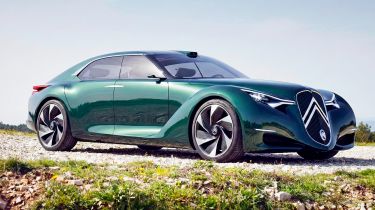
We’ve all seen the scarily realistic images created by artificial intelligence littering our social media feeds. But this got us wondering: could your next car be designed using AI? It turns out the answer is yes, at least according to automotive designers who revealed how they’ve embraced this potentially revolutionary (but also occasionally controversial) technology and how it could shape the cars of the future.
Pierre Leclercq – Citroen

Citroen design director Pierre Leclercq told us his team has been experimenting with AI as a way to inspire them, by feeding in images of all sorts of items, from a beautiful table lamp to sports-car cues, which it uses to churn out thousands of possibilities for new design details.
For security, the manufacturer doesn’t use an AI programme that’s connected to the Internet such as ChatGPT, Gemini or Grok. These are the tools that normal punters like us can play around with, which scrapes information from countless sources to feed itself, often without the creator’s knowledge or consent.
With a closed system like Citroen’s, the AI can only draw from whatever images and prompts the firm’s designers give it. Leclercq tells us this way “you feed the AI and then you get results that are yours. You're going to put the co-worker of that guy in this room, he is going to feed the AI completely differently, and he's gonna have different results. It's quite fascinating”.
The French company’s design chief says no AI-created design elements have made production yet, however it might not be long before the programme provides the seed for a small part of something we see on the road.
Flavien Dachet – Geely
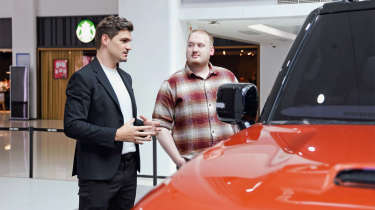
Chinese brand Geely has been exploring a different opportunity with AI, utilising its image-generating abilities to produce photorealistic renders and even 3D models that can be presented to company executives, rather than via a simple pencil sketch.
Flavien Dachet, head of the Geely’s design studio, says tasking AI with this saves valuable time because while a designer might need a day or two to create a highly detailed image by hand on Adobe Photoshop, the machine only needs a couple of hours. Although designers inevitably have to polish it up a smidge to make it perfect.
Much like Citroen, Geely’s designers don’t just stand back and let AI take the wheel. Creating anything with this technology, Dachet says, is like “ping-pong”. He explains: “We can point the AI where we want to go, it gives us some proposals, then we pick the one that we think should have potential, we can modify them, put it back into AI, and the proposal gets mature and gets more where we want to go.”
That all sounds rather tedious and time-consuming to us, but Dachet says it is indeed quicker and he’s adamant it doesn't steal the creativity from the designer. “We still need to think about what is happening, but it accelerates dramatically the speed and the quantity of proposals that we can make.
“Some people think you just type and AI does the whole job. It doesn't work that way. It creates very nice images, but it doesn't understand where we need to go," Dachet explains.
Jozef Kaban – MG
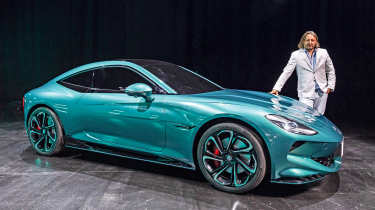
MG's design team is experimenting with AI for all aspects of styling, says the brand’s vice-president of global design, Jozef Kaban. He’s not shy about his enthusiasm for AI, telling us: “In my opinion, use AI as much as you can! And if you think it’s a lot, do more, because it's not going to disappear.”
He even tells us MG now has “people who come to work to feed the machine, giving it lots of tasks, lots of things, and teaching it. Because you have to teach AI as well; you have to work with it, you have to spend the time”.
He stresses that designers must recognise and understand what out of the “trillions of proposals” they get from AI will lead them in the right direction, and challenging what it does is also important.
Peter Stevens – McLaren F1 Designer

Some are still concerned about AI's involvement in this area. Peter Stevens, the legendary British car designer, former Lotus design boss and the man who penned the McLaren F1, tells us: “I always use a little ‘i’, which I think demonstrates there’s no intelligence involved at all.”
“I do have a feeling some people are using it out of desperation because with the torrent of inputs we get, it's very difficult to do something completely original,” he adds. “But if you're stuck for ideas, you're probably in the wrong job.”
A lack of vision is a crippling shortcoming of AI currently, reckons Stevens. “Citroen is a great example here. My feeling is that if you put everything that everybody has ever known or written or photographed about the Traction Avant (the Citroen 11CV) into AI, it would never come up with the Citroen DS,” its spiritual successor 20 years later.
We tried exactly that by giving what is considered the best image-generator programme a picture of the Traction Avant and a brief description of the Citroen DS that came after, to see what it could come up with. In mere moments it presented detailed, somewhat impressive designs but none that we could ever see on the road.
Worse though was the programme’s tendency to take inspiration from other places, despite requests to only base its design on the descriptions and images we gave it. That’s how we ended up with one design that looked like a mildly tweaked DS 9 saloon and another that was an obvious C5 X rip-off.
Despite its flaws, Stevens does encourage younger designers to at least experiment with AI, with the proviso: “I think people need to know about it, even if that's in order to avoid it.
“When I first went to art school, we had to do life drawing before we did anything else so we learned to draw, then we could choose to ignore what we've learned and develop some other way of expressing our ideas. To that extent, I think [AI] is quite useful.”

Similarly, while AI can’t be ignored by younger designers, like most offices, there’s always competitive drive within design studios to catch the boss’s eye. “The thing is to think very carefully and to not expect it to have any ideas,” Stevens explains. “A computer is just a box with wires inside it; it doesn't have any ideas. It's being cleverly manipulated to appear to be able to give you information and ideas.”
He’s wary about what AI could take away from the next-generation of designers: “What's a shame is that it means designers aren't developing their own skills and their own drawing language, which is tragic in the long term.”
He explains: “By using different materials in a different way, it’s how I managed to get away from the Lotus Esprit and into the Lotus Elan; by drawing in a totally different way. But once you get into the AI thing, and to a certain extent when you get into Photoshop as well, you end up with things that are actually rather similar. That does worry me.”
Other than a desire to be on the cutting-edge of tech, a driving force behind designers’ adoption of AI is the pressure to develop cars quicker. The faster they reach production, the sooner they’re earning their makers money, and it’s possible AI could help accelerate the design and development process.
“There is no doubt the financial pressures are absolutely huge and designers can't win those discussions unless they're old and take the mickey like I do,” he adds. “But they wouldn't dare do that or they'd get fired. To an extent, it is a pressure that's very hard, and I can see it's hard to escape from.”
Today, AI is a muse for car designers that saves them time, sparks inspiration and helps them present a vision to the executives in charge. There are still plenty of bugs, but that’s why there’s always a human hand guiding the artificial apprentice to get the best results and allow it to continually improve.
But it’s inevitable that AI will take on a bigger role in design. This could create a new wave of radical cars, or a deluge of ‘AI slop’ – generic, committee-approved cars that lack originality or soul. The challenge for designers is to embrace AI: use it, collaborate with it even, but not allow it to snuff out the creativity and vision that shaped some of the most awe-inspiring machines humanity has made.
Did you know you can sell your car through Auto Express? We’ll help you get a great price and find a great deal on a new car, too.