Best company cars 2026
We round up the finest company cars across six price bands
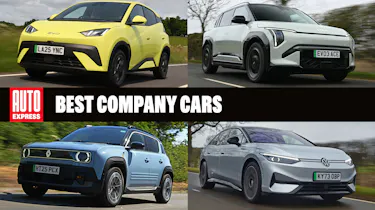
In 2026, the very best company cars offer all the practicality, comfort, affordability and efficiency that you should ever need, whether you’re undertaking the daily commute or taking your family out for the weekend. On top of this, these cars are also capable of providing huge Benefit-in-Kind savings on your company car tax.
As governments and carmakers continue the drive towards greener motoring, the lowest emissions make for the lowest BiK rates. This means electric cars now find themselves at the very top of the company car tree and, thanks to huge advancements in battery technology, the latest models are now a more practical option than ever before.
Of course, this doesn’t mean combustion-powered cars should be ignored, because optimisations for efficiency mean that many new models still make great company cars. It’s just that they no longer sit in such appealing tax bands as they used to.
Plug-in hybrids also benefit from emissions-based tax savings, with BiK rates based on a sliding scale that depends on how many miles a PHEV can officially cover on electric power, assuming they emit between 1-50g/km of CO2. These range from four per cent (as of April 2026) if the car can cover more than 130 miles on a charge, to 16 per cent if the car offers fewer than 30 miles of zero-emission range.
What is BiK and what will it cost me?
A company car is classed as a fringe benefit by the Government, so it incurs Benefit-in-Kind (BiK) taxation. Therefore, what you pay is based on a percentage of the car’s P11D value, which is its price including options, VAT and delivery charges, but not its registration fee or road tax. The BiK percentage you pay is determined by the car’s CO2 emissions, with its output falling into bands that are then linked to a percentage.

Depending on whether you pay Income Tax at the lower or higher rate – we’ve focused on 20 and 40 per cent Income Tax brackets here – the annual Benefit-in-Kind bill is then calculated at either this 20 or 40 per cent rate of the resultant figure.
As you’ll see from our lists, rule changes over the past few years mean that fully electric cars in particular are big BiK-busters, but plug-in hybrid models also receive favourable rates.
Time to go electric?
As a company car, an EV never used to be an obvious choice. They were held back by short range estimates and limited model choices, but now electric cars have become much more viable, offering greater ranges on a full charge in all sectors of the market, as well as faster recharging.
Given that any car that’s rated at 0g/km of CO2 – which is every EV on sale today – only attracts a four per cent Benefit-in-Kind tax rate, many of the best company cars on the market now come with a plug.
Best company cars by price bracket
- Best company cars under £25,000
- Best company cars £25,000 to £30,000
- Best company cars £30,000 to £40,000
- Best company cars £40,000 to £50,000
- Best company cars £50,000 to £60,000
- Best company cars £60,000 and above
Company car deals