Watchdog: Avoiding air-con faults
Air-conditioning faults are costly and all too common, but not if you follow some simple steps
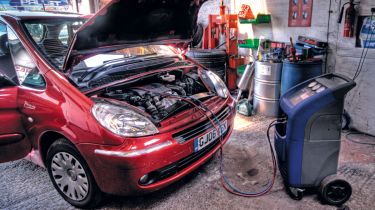
Staying cool comes at a high price. As we revealed a few weeks ago, British drivers spend around £102million a year fixing their cars’ air-conditioning units.
Why, you might ask – isn’t it just a fan blowing cold air around the cabin? Well, no, as we explain here, it’s far more complicated than that. And there are steps that you need to follow to keep it in top working order.
Air-conditioning works by drawing heat out of the cabin. When you turn the system on, the refrigerant – in cold liquid form – is piped through a device called an evaporator behind the dashboard.
A fan blows cabin air over the evaporator, and the air is cooled by the liquid refrigerant and passes back into the cabin. Effectively the liquid refrigerant absorbs the heat from the air and – because it has a very low boiling point – quickly changes into gas. Air-con is a closed-loop system – it can’t get rid of the gas – so it needs to remove the heat from the refrigerant so it can continue cooling the car.
To do this, the system first pipes the gas to a pump, where it is compressed to a high pressure. This gas is then piped to a condenser mounted close to the engine’s radiator.
The condenser works like the evaporator in reverse – air is blown over the condenser, but the air absorbs the heat and cools the refrigerant. The air carries the heat out of the car and the refrigerant converts back to a liquid, albeit at a high pressure.
The liquid is then sprayed back into the evaporator, which is a low pressure area, and the process of moving from high-pressure to low-pressure causes the refrigerant’s temperature to drop rapidly, allowing the process to start over again.
It’s important to use the system regularly – as often as once a week, but at least once a month, even during the winter – because the refrigerant contains lubricants that keep the system operating smoothly. A fault is likely to develop if the system is left unused for long periods of time.
You need to get the system serviced regularly, too, to get the various components checked, and ensure there’s enough refrigerant. If there’s not enough, then the system doesn’t get enough lubrication. It’s also easier for water to get in as condensation, which can freeze up and cause blockages.
Most car manufacturers recommend getting the air-con serviced three years from new, and then every two years after that – although some say even shorter intervals are needed. Halfords will carry out a service for £49, so it doesn’t have to be expensive to maintain.
Air-conditioning does have an impact on fuel economy – because the engine is used to power the compressor – but not as much as many people believe. At most it uses around 10bhp, and will sap the most power in the early stages, when it is working hard to reduce the cabin temperature. So on longer journeys, the drop in economy should be minimal.
Find a car with the experts