Audi Q5 vs Volvo XC60 vs Land Rover Freelander: 2008 group test
In a UK exclusive, Audi’s new Q5 and the Volvo XC60 meet Land Rover’s Freelander for compact SUV class honours.

In these turbulent economic times, the word ‘downsizing’ is becoming a part of our everyday vocabulary. But in the world of the SUV, it isn’t only the financial pinch that is driving the current trend towards smaller models.
High fuel prices, CO2-based taxation, plus environmental issues and the question of whether they’re socially acceptable all mean that large luxury off-roaders are no longer as fashionable as they used to be. It’s no wonder, then, that leading car manufacturers are racing to launch smaller all-terrain models. These new compact machines are designed to offer the same high quality and premium image as their bigger brothers, but are more efficient and promise to deliver sharper car-like handling.
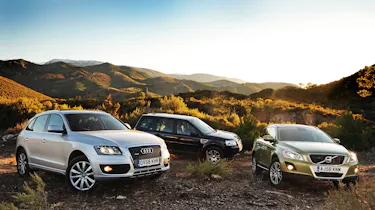
Leading the way in the expanding premium compact SUV segment are the latest newcomers from Audi and Volvo. These two companies took their first steps into the SUV market with large seven-seat models –the Q7 and XC90 respectively. However, both makers are ready to react to changing demands. In an exclusive test of UK-spec models, we have brought the new Q5 and XC60 together for the first time and lined them up against our current class benchmark – the Land Rover Freelander.
All three contenders are closely matched on price and performance, but which has the best blend of quality, practicality, comfort and image?
Verdict
All three compact SUVs in this test prove that unless you need seven seats, a smaller 4x4 can have all the premium appeal of larger and less efficient alternatives.
Used - available now

2025 Audi
A5 Sportback
37,194 milesAutomaticPetrol2.0L
Cash £19,320
2026 BMW
iX1
45,171 milesAutomaticElectric
Cash £22,648
2023 Audi
Q4 e-tron
31,441 milesAutomaticElectric
Cash £20,845
2021 Vauxhall
Corsa Electric
24,361 milesAutomaticElectric
Cash £10,314But which is the best? Volvo’s XC60 looks great and shares the cabin style and family friendliness of the bigger XC90. Unfortunately, the ride is unforgiving and the handling unresponsive, while the five-cylinder engine is gruff. The optional auto is sluggish, too, so the XC60 finishes third here.
Picking a winner is a tougher call. If you want genuine off-road ability, refined on-road manners and a truly versatile SUV, then the Freelander should remain your top choice. It’s not a cheap option, though, and poor residuals make it a costly ownership prospect.
The Q5’s styling, classy cabin and excellent quality are exactly what you would expect from Audi, yet it’s great to drive, too. The sharp handling means the Q5 stands out in this class, while the refined engine, strong performance, low emissions and composed ride complete the package. It carries a considerable price premium over the similarly spacious A4 Avant, but if you simply must have an SUV, the new Q5 is a winner.
First place: Audi Q5
Audi is a relative newcomer to the SUV sector, but the company is a world leader when it comes to four-wheel-drive technology.
Quattro drivetrains have appeared across the firm’s range since 1981, which makes it all the more amazing that the 4x4 know-how wasn’t applied to a fully fledged off-roader until the Q7 arrived in 2005.
The new Q5 demonstrates that Audi’s first foray into the rough wasn’t a one-off. Similar rear end styling to the Q7 means the newcomer retains a familiar look, but it is closer in size to an A4, and blends Audi’s chunky styling with a raised ride height. The looks aren’t groundbreaking, but the Q5 is smart and well proportioned.
Despite having the longest wheelbase in this test, space in the Audi’s cabin is far from class leading. Rear legroom is fine, but the large transmission tunnel limits comfort for passengers in the middle seat. Versatility is boosted if you choose the optional sliding rear bench. It splits 60:40, and both parts can be moved independently. This improves boot space, but the steeply raked rear window restricts ultimate practicality.
There’s little to fault up front, though, as the cabin looks great and is wonderfully put together. The dash is similar in layout to the A4’s, and features Audi’s MMI control system, an electric parking brake and a superb seating position. The Q5’s tall stance means visibility is first-rate, too. In fact, its excellent road manners mean that sometimes only the higher seating position reminds you that you’re in an SUV.
Body roll is better controlled than in its rivals and, thanks to positive steering, the Q5 turns in to corners with an accuracy that’s missing from the XC60 and Freelander.
While the ride is firm, it’s well damped and copes far better than the Volvo over bumpy surfaces. Add in strong brakes, and there’s little to fault about the Q5’s on-road ability.
Hill descent control is fitted as standard, while the stability control has an off-road setting, but the Audi is no rival for the Land Rover in the rough. However, it has enough ability to suit most drivers’ needs. Bosses predict that the majority of buyers will choose the optional S tronic auto, but the standard six-speed manual has a satisfying shift that complements the punchy and refined diesel.
The 2.0-litre unit is the smallest in this test, but it still offers gutsy performance. A 0-60mph time of 9.8 seconds is the fastest here, and is helped in part by the fact the Q5 has the lowest kerbweight. And despite having a 50Nm torque deficit, the Audi matches the Volvo’s in-gear pace. Throttle response is sharp, while refinement is impressive: the Audi recorded the lowest internal noise figures of this trio.
With the cleanest emissions, decent fuel economy and the best residual predictions, the Q5 is a convincing all-round package.
Second place: Land Rover Freelander
While Audi and Volvo are new to the small luxury 4x4 party, Land Rover is a veteran of the class. But don’t write off the Freelander as a pure mud-plugger, as the model which took the best compact SUV award at our 20008 New Car Honours is a great all-rounder.
It looks great, managing to be utilitarian and stylish at the same time. This classless appeal ensures it’s equally at home on the farm as it is in an upmarket urban street. The chunky detailing means that it’s unmistakably a Land Rover, too.
The interior is just as appealing. It doesn’t have the executive feel of the Audi or the minimalist design of the Volvo, but there’s no shortage of charm. The sensible layout, chunky switches and tough build quality mean it’s every inch the junior Range Rover. Finding a comfortable driving position is easy, and few cars offer such a relaxed cabin.
Passengers in the back fare well, too. Legroom is tighter than in the Audi, but the lower floor means the Freelander feels more spacious. The only drawback with the Land Rover is the boot – it’s shorter and narrower than its rivals’, and the space below the parcel shelf isn’t huge. Only when you fold the seats and load to the roof does the Land Rover have the biggest capacity.
Head off road, and the Freelander immediately has the upper hand. With the most ground clearance and Land Rover’s excellent Terrain Response system, the Freelander is truly talented in the rough stuff. Crucially, this doesn’t come at the cost of its ability on the road.
The British SUV isn’t as entertaining or as nimble as the Q5, but it’s accomplished nonetheless. Initial roll in corners is greater than in the XC60, but the light, accurate steering keeps you in touch with the road, while the damping maintains body composure. As a result, the Land Rover feels lighter on its feet than the Volvo.
What’s more, the Freelander’s ride comfort is far superior to the XC60’s. Supple suspension, a hushed cabin and a smooth-shifting auto gearbox mean the Freelander is as comfortable in the city as it is on the motorway. And while the 2.2-litre engine, which was co-developed with the diesel experts at Peugeot, is beginning to show its age, the unit is smooth and has decent throttle response.
However, it recorded the highest noise figures in our test, and while the auto box is less prone to unexpectedly shifting gear than the XC60’s, it can’t match the control of either the manual or S tronic auto in the Q5.
It isn’t as quick as the Audi in the 0-60mph sprint either, taking 10.1 seconds, but such is the broad spread of the Land Rover’s abilities that it doesn’t really matter. Blending great off-road skills with excellent tarmac comfort, few cars are as relaxing to drive.
All this comes at a cost, though. It doesn’t have a premium badge, but the Freelander is the most expensive model here.
Third place: Volvo XC60
The Q5 isn’t the only newcomer in the premium compact SUV class – the Volvo XC60 also aims to make an impression in the sector.
The Swedish model has stayed true to the original concept, which was revealed at the 2006 Detroit Motor Show. As a result, the production version is a real head-turner.
With its swept-back lamp clusters, shapely profile and high-stacked rear lights, it drew admiring glances on our test route, while the Audi passed by virtually unnoticed.
Inside, you get a typical Volvo cabin, with big, comfortable seats and a simple, modern layout. The ‘floating’ centre console dominates the dashboard, while white backlighting gives the dials a smart look.
Get behind the wheel, and you won’t enjoy the range of adjustment offered in the Q5, but the soft seats are very comfortable. It’s a similar story in the back. The XC60 has a shorter wheelbase than the Audi, but legroom is a close match and a flatter transmission tunnel means the middle chair is more accommodating. The rear seats split fold 60:40 – but they don’t slide – while the boot is wider and longer than the Q5’s. Other neat touches include illuminated door kick plates and a built-in child booster seat.
Unfortunately, the driving experience doesn’t impress as much as the cabin. The XC60’s chassis feels rigid and unwieldy, and it lacks the Audi’s body control and agility. It rolls more when cornering, and there’s greater weight transfer as you change direction.
Combined with the numb steering, this means the Volvo doesn’t inspire the confidence of its German rival on twisty roads. The suspension’s ample travel doesn’t stop nasty crashes entering the cabin, either, and on bumpy tarmac the XC60’s ride is unsettled. Even on the motorway, expansion joints can upset the otherwise impressive cruising refinement.
The combination of five-cylinder D5 diesel and optional Geartronic auto doesn’t gel, either. Despite having six ratios, the box searches for gears too readily, and has the annoying habit of shifting up as you lift off the accelerator. Manual mode gives you more control, but the changes don’t have the speed and accuracy of the S tronic gearbox that is offered with the Q5. And while the D5’s five-cylinder engine note
is unique, it’s gruff under load.
Despite a 50Nm advantage over the Audi, the XC60 doesn’t have the performance to match the Q5. This is largely due to the extra 97kg it carries, which certainly contributes to the car’s poor dynamics.
As you would expect, the Volvo is packed with safety features, and it feels solid and substantial. Hill descent control is standard, but the XC60 isn’t an accomplished off-roader like the Land Rover. Crucially, it isn’t as refined or relaxing as the British contender, either. Given that it falls short of the Audi for comfort and involvement on the tarmac, its impressive style, quality and design might not be enough to take victory.