What is ADAS? Advanced Driver Assistance Systems explained
Advanced Driver Assistance Systems are now mandatory on all new cars so let’s breakdown what they do and how they work

Since 2024, a new car can’t be sold in Europe unless it’s fitted with key standard safety equipment known as ADAS or Advanced Driver Assistance Systems. This is clearly a good thing with the noble aim of trying to cut needless road deaths: in 2025, 1,550 people lost their lives on UK roads, among 19,400 fatalities across Europe as a whole. Some 100,000 people were seriously injured.
Those figures were slightly down in 2024, but embracing new tech could supercharge this progress and cut accidents further. Automated emergency braking – a feature widely adopted long before it was mandated by the EU’s second Global Safety Regulation (GSR2) in 2024 – reduces collisions by 40 per cent. Kit that helps keep cars in lane or adhere to speed limits and alerts drivers when they’re tired or impaired can also help – but only if these systems aren’t switched off.
Yet that’s exactly what’s happening to poorly calibrated systems in some cars that bombard drivers with beeps, bongs and false positives, or corrupt the driving experience with over-zealous interventions. Some cars are better at this than others, which is why we ran our ADAS megatest, to see which brands are doing it right, and which need to work harder.
But what are the main types of ADAS you’re likely to encounter on a modern car and what exactly do they do? Read on, and we’ll explain all.
Lane support systems
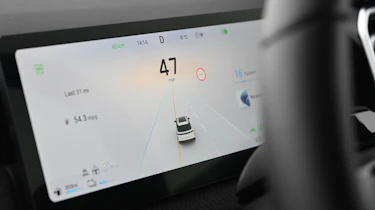
The most basic version of this is Lane Departure Warning or LDW, which involves an audible alert and/or a sensory prompt (e.g. a vibration through the steering wheel) if the car crosses a lane marking without it indicating. Lane Keep Assist or LKA turns things up a notch by actively steering the car to keep it centred in the lane, and Emergency Lane Keeping (ELK) will steer the car back into line if it's deemed to be going beyond a lane marking, to the edge of the road or into oncoming traffic.
Some systems work well enough that you’ll never need to turn them off, but others have a habit of identifying things as lane markings when they’re not – patched over sections of road surface, for example. On narrow roads, poor systems also have a tendency to steer the car towards the middle of the road just when you have moved to the right to make room for a larger vehicle coming in the other direction.
Should you have a car with a less-than-brilliant ELK system, to the point where you feel the need to switch it off, you might be annoyed to find it turned back on during the next ignition cycle. This is mandated by GSR2, which also prevents the system from being turned off with the short press of a button. That’s why you might need to either bring up a sub-menu first, or press and hold a dedicated button to switch it off.
Intelligent Speed Assist (ISA)
Another part of GSR2 is a mandated speed assistance system. Speed limits are usually detected using a combination of mapping data and a front-mounted camera on the car, although some just use a camera. The figures given aren’t always accurate – cameras can erroneously pick up speed limit signs from adjacent roads, for example, or the mapping data might be out of date. Temporary and variable speed limits also present these systems with a problem.
Straying over the limit picked up by the car, whether it’s right or wrong, will usually result in both a visual and audible warning. As with ELK, speed assist must default to on when the car is restarted and cannot be deactivated with a short, single button push. The nature of the alerts is crucial here, in some cars the warnings are loud and intrusive, others are better judged and allow you to manually adjust the volume.
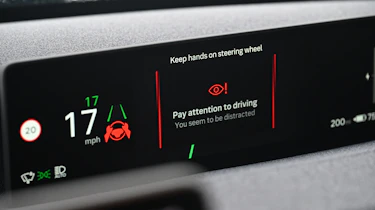
Driver State Monitoring
Usually referred to as ‘driver attention monitoring’ by manufacturers, this system normally uses an infrared camera either in the rear-view mirror, the instrument cluster, the top of the steering column, or the windscreen pillar. Some cars will use two cameras.
More basic systems merely check where your face is pointed, but the fanciest setups are also able to track your eye movements. If necessary, the car will provide an audible and visual warning telling you to pay attention to the road.
Again, how well this tech works can vary wildly from car to car. In some cases, the warnings will usually only sound when they arguably should. In others, we’ve had multiple alerts on short journeys for little reason, while some systems will sound for even the briefest look away from the road to use the infotainment system. We’ve also found issues with drivers wearing glasses where the technology thinks they are looking away from the road when they aren’t.
Autonomous Emergency Braking (AEB)
Mandatory on all cars sold since 2022, Autonomous Emergency Braking (AEB) uses sensors and, in some cases, cameras to detect obstacles ahead. There will usually be a visual warning, sometimes joined by an audible warning, before the brakes are automatically applied if the car deems it necessary.
This isn’t just about preventing the all-too common rear-end shunt – the better systems can pick up cyclists and pedestrians, even after dark, potentially avoiding serious injury to the most vulnerable road users. AEB defaults on at every start-up, but can be disabled. We wouldn’t recommend this, though. AEB is extremely effective. In our extensive testing, erroneous warnings from these systems are uncommon while actual triggering of the brakes has proven to be extremely rare.
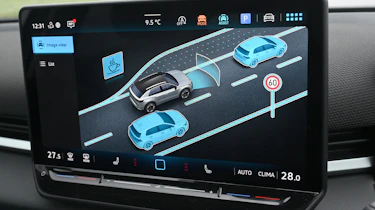
Adaptive cruise control
While regular cruise control can merely hold a car at a set speed, Adaptive Cruise Control (ACC) can maintain a set distance to the car in front, using sensors to slow the car down in line with the traffic ahead. Once the road clears, the car will gently and automatically accelerate back up to the set speed. How far the sensors look ahead can be chosen by the driver.
The most advanced ACC will also work together with lane assistance systems, enabling what’s known as Level 2 autonomy. In this state, the driver still has full responsibility for controlling the car and must keep their hands on the wheel, but the car will take care of the steering, acceleration, and braking.
More from our ADAS car safety special
- ADAS warning and safety tech tested (pt 1)
- Hands-free self driving systems tested (pt 2)
- Best and worst ADAS 2026/2027: megatest verdict
- What is ADAS? Advanced Driver Assistance Systems explained
- 2027 will be the UK’s year of the self-driving car
- Future of car safety: smart seatbelts, robotaxis and bringing back buttons
Don't miss the best of Auto Express on Google! Make us a preferred source. Click here...