Buying a new car? I bet you don’t know where it was built
Mike Rutherford thinks car manufacturers should adopt supermarket-style country-of-origin labelling so buyers know exactly where cars have been built.

Buy a car built in Japan or Germany and you won’t go far wrong. That’s long been my mantra after decades of work-related test drives in state-of-the-art vehicles from these two countries. I’ve also been a multiple, real-world buyer and owner of new and old, bog-standard, mid-range, high-performance or premium models from Nissan, Lexus, VW, BMW, Porsche and Mercedes.
But what you and I think of as cars ‘impeccably made in Japan by proud Japanese employees’ or ‘solidly built in Germany by efficient German workers’ might just be rolling off production lines in countries further afield that we don’t associate with the same levels of engineering brilliance.
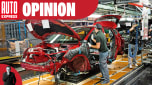
The international motor industry needs to – via its global trade bodies and related organisations – implement and manage a simple system that tells prospective buyers exactly where the cars they’re considering are built. Think stickers, immovable plaques, engravings and glass etchings stating the names of the factory and country of manufacture. Windscreens of unsold cars plus brand’s brochures should also prominently display such information.
Yes, yes, I know that if you give up valuable time doing the homework, before digging around for, locating and decoding some or all of this info, it can, eventually, be had. But it needs to be simpler, more conspicuous, consistent and clear-cut.
I’ve just strolled around a supermarket and been impressed by products costing a few measly pence telling customers much about their origins. I spotted a cheese that unequivocally stated ‘made in Italy with Italian milk’ on its packaging. A banana had a simple ‘produce of Dominican Republic’ sticker on its skin. Unlikely Malta claimed credit for producing bottles of quintessentially English brown sauce. The labels on a bag of vegetables screamed ‘British’, showed several images of the Union Jack, while also naming the farm, rural village, county and country that grew the products within.
If this is the type of comprehensive product detail can be offered to shoppers spending pennies on groceries, why on earth is something similar – and even better – not on offer to buyers spending tens of thousands of pounds on new cars in showrooms
These are rapidly changing automotive days, where caution is key. Increasingly presented to us are vehicles built by factories we’ve never heard of, in countries we didn’t even know had joined the car-building game. Nothing wrong with newcomers. But before placing our orders, we should be more clearly informed.
Would a customer in the UK buying a Kia via the franchised network want an example that’s made close to the firm’s world HQ in Seoul, South Korea? Or its satellite operation in Zilina, Slovakia? Having been to both plants, I know which I’d choose.
Want the latest car news in your inbox? Sign up to the free Auto Express email newsletter...