Regenerative braking: how does EV and hybrid car brake energy regeneration work?
Regenerative braking turns your electric or hybrid car’s kinetic energy into electricity to charge its battery and boost efficiency. Here’s how…
If you’re interested in buying an electric or hybrid car, you might have heard about regenerative braking or brake energy regeneration. But what does the term mean, and what’s it like to drive a car with a regenerative braking system?
It’s a useful system that can boost efficiency and even make driving easier when used correctly, so read on as we cover everything you need to know about regenerative braking.
What’s the difference between normal and regenerative braking?
When you push the brake pedal in a petrol or diesel car, hydraulic fluid is used to move the brake pads against your vehicle’s brake discs (or drums on older or sometimes cheaper models). The resulting friction works to slow the car down, generating heat and wearing away at the material on the pads and discs in the process.
Regenerative braking is a way of taking the kinetic energy from a car’s momentum and converting this into electricity when you need to slow down. This electrical energy can be used to recharge your hybrid or electric car’s battery. On a normal car, braking simply wastes energy, but with regenerative braking, some of this otherwise unharnessed energy is able to be reused.
Regenerative braking systems are common on many modern cars. On petrol and diesel models, it’s often used to charge the battery that runs various ancillary systems in the car, meaning less work for the engine and less fuel burned.
In these cars, the system is virtually imperceptible to the driver, but in hybrid and pure-electric cars regenerative braking takes a more active and obvious role. In these models, brake regeneration can help charge the big battery packs that supply electric drive motors with power.
How does regenerative braking work?
Regenerative braking works automatically when you lift off of the accelerator pedal to coast or when you press the brake pedal in a hybrid or an electric car.
When driving along, as you lift your foot off the accelerator pedal, the momentum of the vehicle turns the motor into a generator, inducing a current which is then fed back to the battery.
When you press the brake pedal, the electrical resistance of the motor is increased, slowing you down faster but also generating even more current to top up the battery.
What does regenerative braking feel like?
When the regenerative braking process kicks in, you’ll feel the car start to slow down, almost as if you are applying the brakes.
The strength of this sensation can vary between models, though, as some manufacturers will have pre-programmed how much regenerative braking occurs when you lift off the pedal.
A number of cars also allow you to set the strength of the regenerative braking system yourself. This is discussed in more detail below.
What are the different regenerative braking modes?
There are many cars with regenerative braking, and they all feel a little bit different to use. Thankfully, many electric cars allow you to tailor the way it feels to your own preference.
B-Mode
Some makes and models of hybrid and electric car have a dedicated regenerative braking mode, also known as B-Mode. B-Mode allows you to increase or decrease the strength of the braking system and this is usually done via a touchscreen menu or paddles attached to the steering wheel.
For example, you could choose to set the regen braking system to its maximum strength, meaning the car will brake very heavily and maximise the energy gain. Alternatively, you can even turn it off all together if you don’t like the feeling of the car braking itself when you let off the accelerator.
The advantage of the B-Mode is that you can engage it when desired. When the car is in its normal drive mode, regenerative braking is effectively off.
One-pedal driving
Some electric cars have a regenerative braking system strong enough to deliver ‘one pedal driving’. This is where the braking force is so strong that you don’t necessarily have to use the ‘normal’ brake pedal when driving along in normal road conditions. You simply modulate your right foot on the accelerator.
When driving in ‘one-pedal’ mode and you apply less pressure or lift off the throttle completely, the regenerative braking system will produce enough braking power that the car can slow itself quickly, eventually coming to a complete halt without the need for using the conventional brake pedal.
In most cases, a car’s brake lights will come on when lifting off the accelerator in the most aggressive regenerative braking setting, even if you’re not touching the pedal.
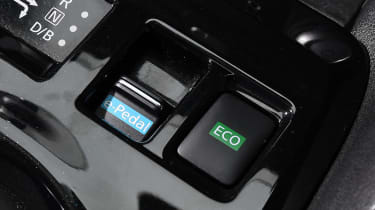
In the Nissan Leaf, for example, this is referred to as the e-Pedal mode, and it can be switched on and off using a button on the dash. In the Polestar 2, there is an option located on the touchscreen infotainment system that allows you to set the ‘One Pedal Drive’ system to off, low or standard. While the names of these systems can vary, they are all similar in operation.
In order to see how much power is being regenerated when you’re braking, most cars have a gauge or readout on the dashboard which displays this information. One-pedal driving is an effective way of recuperating energy and comes in particularly handy when driving in heavy traffic or around town.
Regenerative braking and cruise control
Some cars also have an automatic cruise control system that uses brake regeneration. The car in front is monitored by sensors and brake regen is used to match that car’s speed on the road.

What are the pros and cons of regenerative braking?
As with any new technology, regenerative braking has its own pros and cons. Here are some of the main ones…
Advantages of regenerative braking
- Ability to boost range: Kinetic energy is retained and converted back into electrical energy, charging the car’s battery, extending overall electric range or reducing fuel usage.
- Reduced wear of braking components: Cars with regenerative braking systems will still have traditional braking systems, but the brake discs and pads are used less frequently as the regen braking system does a lot of the work. This means the traditional braking components could last longer.
- ‘One-pedal' systems: These can make driving easier and more relaxing if calibrated well.
Disadvantages of regenerative braking
- An unusual sensation to get used to: Regenerative braking systems might feel different compared to traditional braking systems. More pedal pressure can be required to slow down and the initial push on the pedal can feel unnatural. Strong regenerative braking at higher speeds can also be annoying as the car slows as soon as you release the accelerator pedal.
- Efficiency gains can vary: You might see less benefit from regenerative braking systems if you are travelling at lower speeds, or when braking harshly or suddenly.
- Brake and accelerator pedal modulation: In some makes and models of car, it’s not always easy to modulate braking force. This can make the regen system feel jarring. When using the brake pedal you might need to apply more pressure, which could result in the car braking more aggressively and slowing down quicker than expected.
Frequently Asked Questions
While regenerative braking can boost efficiency and reduce wear on traditional braking components, the effectiveness and smoothness of these systems can vary between different cars. If you’re new to driving with regen, it can also be a bit unnerving to begin with - especially on the motorway where the car will slow quickly when you release the throttle.