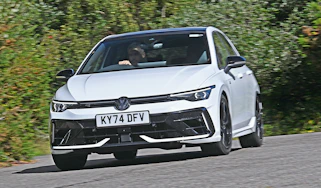
TVR Griffith back from the dead… again! Lotus’ Hethel factory to be new home
The Hethel Performance Hub has been announced as the new home for the revived TVR brand, which intends to launch the Griffith in 2028
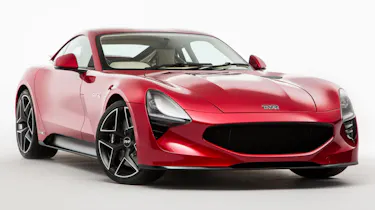
The unlikely revival of TVR is taking shape, after its new owner, the MOTV Group (formerly Charge Holdings), announced that it’s taken full control of TVR Automotive and outlined its plans to put the Griffith into production, with involvement from Lotus.
In late 2025, we first learned that TVR Automotive, a new iteration of the brand first founded in 2013, had become a subsidiary of Charge Holdings, which you won’t have heard of. However, the name Charge Cars might ring a bell. It created an electric reimagining of the iconic 1967 Ford Mustang and collapsed in July 2024, before being revived by its new owners.
TVR Automotive is to be based at Factory 3 in Lotus’s Hethel Performance Hub in Norfolk. The brand will be able to access Lotus development facilities, which will include Hethel’s famous test track.
MOTV Group has also assembled a new management team to work under CEO Paul Abercrombie, who also acts as boss of TVR. The CTO is Steve MacManus, former Tesla engineering VP, while the CCO has been named as former Lotus retail development chief Trevor Weller.
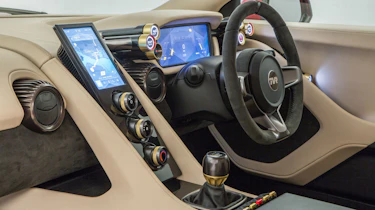
Included in the announcement is an image of a camouflaged prototype, which appears outwardly similar to the prototype Griffith first revealed way back in 2017, although it’s hard to know what it’s like under the skin. First customer deliveries are said to be planned for 2028, some 11 years on from the prototype’s reveal at the Goodwood Festival of Speed.
Paul Abercrombie said: “We are focused on three things: completing the development of the new Griffith, building it to the highest possible standards, and getting it into customers’ hands. Hethel gives TVR a proper home, with its own factory and a test track on the doorstep, right at the heart of British sports car engineering.
“Special, low-volume analogue sports cars that put the driver at the centre of the experience are exactly what enthusiasts want right now, and that’s what TVR has always done. The brand turns 80 next year and has never deserted those values. Now the world has come back round to TVR. With the backing of MOTV Group and the right people and resources in place, the timing has never been better for its return.”
Previously, we were told TVR will be “expanding into electrified platforms in the future”, but for now it remains focused on finally delivering the new Griffith to customers and “continuing its legacy of high-performance, internal-combustion sports cars”. How close the second-generation TVR Griffith planned to hit the streets will be to the car revealed nearly a decade ago is unclear at the moment.
It shouldn’t be too hard getting hold of the 5.0-litre V8 engine from Ford that was part of the previous Griffith plan. However, the car was supposed to use Gordon Murray’s iStream chassis technology, and the rights to that are now owned by Forseven – another automotive start-up that recently merged with McLaren. Meaning TVR may have to source a new platform.
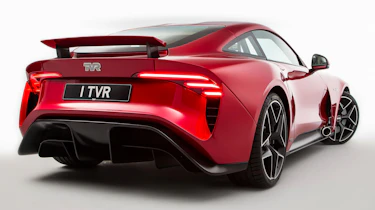
About the TVR Griffith design
The existing TVR Griffith design is for a sports coupe that measures 4,314mm long, 1,850mm wide and 1,239mm tall, making it roughly the same size as the Aston Martin V8 Vantage, but more compact than the Porsche 911 and Jaguar F-Type. Unlike these models, however, the Griffith was based around a carbon composite structure and said to weigh less than 1,250kg.
The plan was for it to feature a naturally aspirated 5.0-litre V8 and a traditional six-speed manual gearbox, sourced from Ford. The unit develops 500bhp – enough for a 0-62mph time of less than four seconds and a top speed of 200mph. TVR was also aiming for a power-to-weight ratio of 400bhp per tonne.
Because the engine is located behind the front axle, TVR said it was able to achieve a perfect 50:50 weight distribution with the Griffith. The sports car featured double wishbone suspension with adjustable coil-over dampers front and rear.
TVR also applied some clever engineering to the way the car carves up the air. Instead of fitting the Griffith with an enormous rear wing or a massive front splitter, the firm relied on ground effect aerodynamics - a completely flat floor which helps generate downforce at speed.
To further boost agility, larger and wider (20-inch) wheels were fitted at the rear than those at the front (19-inch). TVR also claimed that the Griffith uses “intelligent engineering over electronic driver aids,” although the car does feature ABS and traction control.
Don't miss the best of Auto Express on Google! Make us a preferred source. Click here...