Toyota Prius review
Toyota Prius is a stylish hybrid with sharper looks and a more enjoyable driving experience than ever

Our opinion on the Toyota Prius
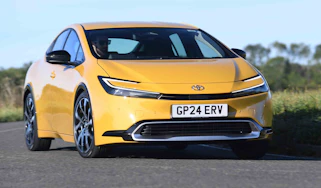
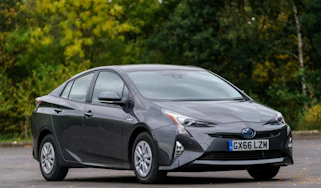
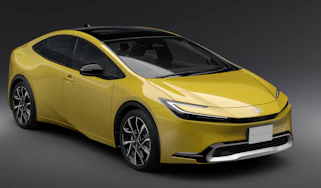
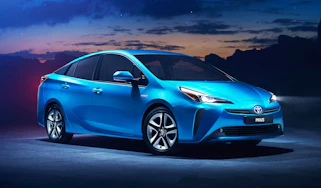
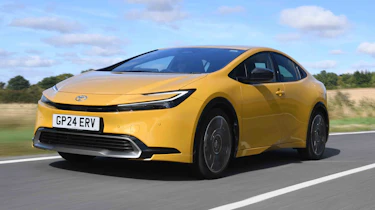
While the Toyota Prius started out with a ferocious focus on efficiency above all else, it has since been refined into a car that’s much more desirable than its predecessors. Not only is it distinctive to look at (especially in the optional Mustard paint), but there’s a surprisingly enjoyable driving experience to be found. It’s not perfect, though, because its streamlined shape limits space for rear passengers and there are plenty of EV alternatives that will be better value for money for company car drivers.
About the Toyota Prius
Ever since the first Toyota Prius arrived in 1997, over five million examples have been sold, and at one point, it even became a Hollywood must-have as celebrities tried to boost their green credentials thanks to this car’s fuel efficiency.
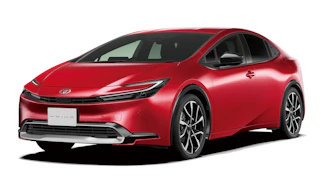
After a brief period away from the UK order books, the fifth-generation Prius arrived in plug-in hybrid form, sporting sharper looks than any of its predecessors and giving this latest version real kerb appeal. Going plug-in hybrid means the Prius no longer steps on the toes of the hybrid Toyota Corolla and Toyota C-HR, both of which share the same TNGA platform as the Prius.
Apart from having to plug in to recharge the battery, the rest of the tech is familiar to other Toyota models: an efficient four-cylinder engine, an electric motor, and a hybrid system that provides all-electric driving when needed.
Used - available now

2020 Toyota
Prius
42,384 milesAutomaticPetrol1.8L
Cash £16,620
2020 Toyota
Prius
17,000 milesAutomaticPetrol1.8L
Cash £16,999
2026 Toyota
Prius
8,878 milesAutomaticPetrol2.0L
Cash £24,295
2018 Toyota
Prius
50,000 milesAutomaticPetrol1.8L
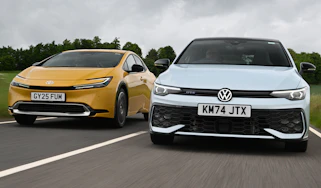
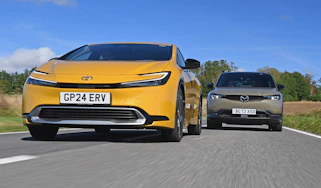
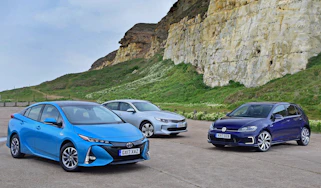
Cash £13,495Our road test team has tested the Toyota Prius extensively in the UK and in Europe. So far, it’s beaten the VW Golf GTE in a twin test, partly thanks to its newfound desirability and also eclipsed the Mazda MX30 when we put the cars head-to-head on UK roads. We’ve also run a Toyota Prius on our long-term test fleet.
Performance & driving experience
Pros |
|
Cons |
|
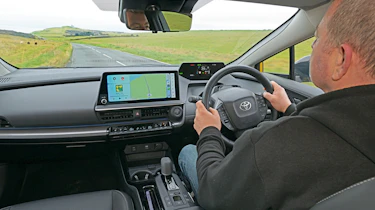
The latest Prius is almost as good to drive as it is to look at, and while it’s no sports car, as with other Toyotas developed off the TNGA platform, it does a fantastic job of balancing comfort and agility on all kinds of roads. You probably wouldn’t expect to hear that about a Prius, but it’s genuinely good fun to drive.
| Model | Power | 0-62mph | Top speed |
| Prius 2.0 VVTi Design | 220bhp | 6.8 seconds | 109mph |
| Prius 2.0 VVTi Excel | 220bhp | 6.8 seconds | 109mph |
Performance, 0-60mph acceleration and top speed
The electrical side of the Prius’s powertrain actually contributes more shove to the overall set-up than the 2.0-litre four-cylinder petrol engine; it’s 161bhp for the former versus 149bhp for the latter. These two elements never offer up their maximums at the same time, so the overall output is 220bhp. The petrol engine sends its drive through an e-CVT transmission.
Anyone used to a previous Prius will be fairly blown away by the straight-line performance, too. A 0-62mph time of 6.8 seconds is right on the money with the Volkswagen Golf GTE, and the initial response from the motor makes it feel every bit as quick as the numbers suggest.
Thanks to the generous electric contribution, the Prius feels responsive when moving off from a standstill; it’s more like a full EV than many of its hybrid rivals. When the petrol engine does need to help out – whether to charge the battery or to deliver more performance – its engagement is extremely smooth; only a gentle hum lets you know that you’ve started to burn some petrol.
Many previous Toyota hybrids start to sound a little unpleasant when you ask for full power; their CVT gearboxes cause a drone of revs that feels a little unnatural for anyone used to a conventional auto. However, Toyota has worked hard to banish this sensation.
Firstly, the e-motor makes enough power that the times when you need to work the engine hard are few and far between. Then there’s the fact that the petrol motor is fairly well insulated, so even when that drone starts to present itself, it’s a fairly distant noise.
Town driving, visibility and parking
The Prius is a little longer than some of its rivals, which means that it isn’t quite able to squeeze into as many tight parking spots, but at least a range of hi-res cameras makes it easier to manoeuvre.
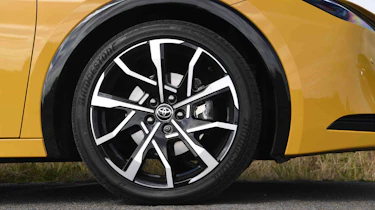
Despite some fairly sizable 19-inch wheels, the Toyota rides with plenty of composure. It feels fairly smooth at low speeds, with none of the fidget of other rivals on similarly sized wheels. There’s clearly sophistication here, which isn’t surprising considering that the Prius uses an advanced double-wishbone suspension layout for the back axle.
Country road driving and handling
As the speed increases, the Toyota begins to show some impressive body control, too – especially considering that it rides on passive dampers. The suspension remains firm enough not just to deal with road undulations and sharp direction changes, but also ensures the driver feels engaged in the action, too. While the Golf GTE’s electronic differential delivers better traction when accelerating out of a corner, the Prius is just as keen to change direction in faster bends.
Motorway driving and long-distance comfort
That slippery body shape means wind noise is extremely hushed at higher speeds, but it also makes the one source of rustle – around the door mirrors – even more noticeable. Road noise is also well contained, so overall the Prius is a very capable and composed cruiser.
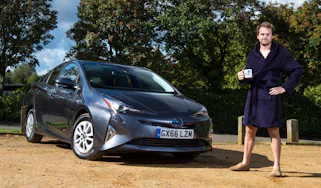
“I didn’t expect the damping to be anything like as good as it is. It’s proved to be a super-refined car to drive on the increasingly poor road surfaces of Brighton and Hove.” - Steve Sutcliffe, contributing editor.
MPG & running costs
Pros |
|
Cons |
|
The Toyota Prius plug-in’s economy stats are impressive. Even so, you’re unlikely to get close to the headline 176.5mpg, but you should still manage to achieve better fuel economy figures than you could in a traditional petrol or diesel car.
During his time with our long-term Toyota Prius Excel, contributing editor Steve Sutcliffe saw a consistent average of over 70mpg in mixed driving, along with a peak of over 87mpg. Yes, these figures fall well short of the official WLTP combined figure, but they’re still highly impressive compared to many rivals.
This demonstrates Toyota’s know-how in producing an efficient hybrid powertrain. There’s even a ‘Predictive Efficient Drive’ system that learns your route to work and optimises the powertrain for the best fuel economy.
A regenerative braking system helps to put electricity back into the battery when you’re away from a plug socket and comprises three modes – gentle, medium and strong. It doesn’t quite allow for one-pedal driving; up to 80 per cent deceleration is served up in the ‘strong’ mode.
| Model | MPG | CO2 | Insurance group |
| Prius 2.0 VVTi Design | 176.5mpg | 49g/km | 31 |
| Prius 2.0 VVTi Excel | 134.5mpg | 49g/km | 31 |
Electric range, battery life and charge time
It’s when you’re crunching the numbers that Toyota’s hybrid know-how really comes to the fore. While many PHEVs turn into overweight, inefficient petrol cars once their batteries are depleted, the Prius benefits from decades of petrol/electric experience to balance its power sources as efficiently as possible.
If you need the flexibility of a plug-in powertrain due to high-mileage use, there are few, if any, other PHEVs that come close to the Toyota’s efficiency. The Prius can charge at up to 11kW through its Type 2 socket, which means a full top-up of the battery will take around four hours.
If, like most drivers, you’re topping up from a typical 7.4kW home wallbox charger, you’ll be looking at around 2 hours for a full charge from empty.
| Model | Battery size | Range | Insurance group |
| Prius 2.0 VVTi Design | 13.6kWh | 47 miles | 31 |
| Prius 2.0 VVTi Excel | 13.6kWh | 52 miles | 31 |
Insurance groups
Both Prius trim levels fall into insurance group 31 out of 50 – ever so slightly higher than the Volkswagen Golf GTE, which sits in group 30. The Vauxhall Astra PHEV, meanwhile, is a tiny bit cheaper, sitting between groups 26 and 29.
Tax
Both the Design and Excel variants fall below the £40,00 luxury car tax threshold, so owners only need to pay the standard yearly VED road tax rate.
The plug-in hybrid powertrain does result in a lowered Benefit-in-Kind company car tax rate, but fully electric cars still offer significantly larger savings. If it’s a hatchback you’re after, we’d recommend looking towards the Renault Megane E-Tech, Vauxhall Astra Electric or Peugeot E-308. Toyota does have the Toyota C-HR+ and Toyota bZ4X, although the latter is much larger than the Prius.
Depreciation
According to our market data, the Toyota Prius is predicted to hold onto 46 to 47 per cent of its original value after three years or 36,000 miles of driving. This compares favourably with the closest rivals such as the Golf GTE, which holds onto 40 per cent, while the Astra PHEV only manages 30 to 40 per cent.
To get an accurate valuation for a specific model, check out our free car valuation tool…
Interior, design & technology
Pros |
|
Cons |
|
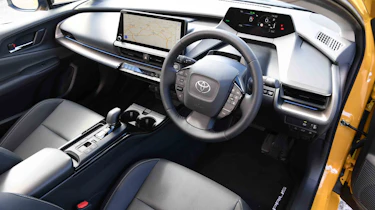
The Prius’s quirky yet well-built cabin looks like little else in the segment, but some might find the positioning of the seven-inch driver’s display up high on the dash to be a little odd, although it works well in practice. The steering wheel (which is wrapped in especially squidgy leather) is low enough for the screen to be easily readable, although the layout is a little cluttered with too much information in a confined space.
Below a large landscape central touchscreen, you’ll find a row of toggle switches for the climate control settings. We generally prefer rotary controls in cars, but having a bank of switches is still better than the touchscreen-only controls found in most rivals, simply because they are easier to access while driving.
The Toyota’s low-slung roof and steeply raked windscreen mean you sit a long way from the scuttle, resulting in a very long dashboard and a windscreen that seems very distant. Visibility isn’t great as a result, and while it’s not difficult to see out, it takes some getting used to, as does the fiddly driving display.
Interior and dashboard design
Toyota has created a space-age look for its cabin by installing a small steering wheel, whose upper edge sits beneath the main instrument binnacle. It’s similar in principle to Peugeot's i-Cockpit layout, and just as in that brand’s cars, it’s a divisive set-up; some testers got along with the layout just fine, but others didn’t take to it at all. It’s really worth trying for yourself before buying.
Visibility is a little compromised towards the back, too, where a large pillar restricts the view over the shoulder. The rear window itself is quite small, so there’s not too much to see in the rear-view mirror – especially when it rains, because there’s no rear window wiper.
Materials and build quality
Toyota doesn’t go in for the textured, soft-touch plastics that many European brands tend to furnish their cars with, but look beyond the sea of hard, matt-finish surfaces and the overall fit and finish is very good.
Our test car had no rattles, but one detail that let the side down slightly was a tinny sound when closing the door.
Infotainment, sat-nav and stereo
The 12.3-inch touchscreen on the dash is where most of the tech can be found, and it’s a responsive unit with clear menus and a modern-looking layout. Contributing editor, Steve Sutcliffe, found the tech on his long-term Toyota Prius Excel to be generally easy to use, despite the complexity of some of the car’s on-board systems. There’s wireless Apple CarPlay and Android Auto, as expected, plus built-in navigation, and it’s easy to use.
There’s also a row of climate control switches, which is good to see, and although there’s no wireless charging available, there are six USB ports in the Prius, including ones for rear passengers.
“I’m learning to like the small instrument display, but I wish it was a bit bigger, and a bit nearer. The 12.3-inch main central touchscreen is just fine otherwise, and appears to offer all the functionality you could want.” - Steve Sutcliffe, contributing editor.
Boot space & practicality

Pros |
|
Cons |
|
The Toyota Prius is longer than most of its plug-in hybrid hatchback competitors, but it’s narrower and lower due to its focus on reducing drag. The shallow windscreen extends forward with raked A-pillars, so there are relatively large blind spots up front. The view rearwards is also poor, with visibility from the rear-view mirror partially obscured.
There’s a decent level of kit, although while there are front and rear parking sensors and a reversing camera, a 360-degree camera is not an option – something we’d quite like, given the limited rear visibility.
Dimensions and size
The latest Prius is 46mm shorter than its predecessor and 50mm lower. While previous generations of Prius have been offered in a Prius+ MPV body style, Toyota has no plans to create a larger version of the current car.
| Dimensions comparison | |||
| Model | Toyota Prius | Volkswagen Golf GTE | Vauxhall Astra PHEV |
| Length | 4,599mm | 4,289mm | 4,734mm |
| Width | 1,782mm | 1,789mm | 1,860mm |
| Height | 1,430mm | 1,484mm | 1,441mm |
| Wheelbase | 2,750mm | 2,630mm | 2,680mm |
| Boot space | 284 litres | 273 litres | 352 litres |
Seats & passenger space
A steeply raked windscreen does wonders for aerodynamic efficiency, but it does present some minor issues elsewhere. Shorter testers found that the shallow angle of the A-pillar, combined with a seat rolled further forwards, created a fairly narrow gap for people to get in; several bumped their heads on the pillar when getting in or out.
Once inside, the Prius is a comfortable place to be. The seats have loads of adjustment, and it can be dropped down to a coupe-like position, which helps keener drivers feel more connected to the drive. Storage is okay, with two cup-holders in the centre console, a decent-sized bin beneath the central armrest, and a phone holder with USB ports. The door pockets are quite slim, though.
While front headroom isn’t an issue, taller passengers in the back will brush the headlining, especially with the backrests being fairly upright. There is plenty of knee room, however – more than in a Volkswagen Golf or Peugeot 308 – so shorter occupants will feel very well treated. The centre seat is wide and soft, too.
Boot space
At 284 litres, the boot isn’t very big for a car of this size, and while it marginally beats the Golf GTE for overall capacity, both the level of the boot floor and the load lip itself are higher. This means that the volume available is fairly shallow, and therefore not the most versatile for packing bulky items. The load cover feels very flimsy, too.
Open the hatch, and the most noticeable thing is just how high the boot floor is, and how shallow the loading area is as a result. You can’t fit large boxes in either, because of the low rear screen.
There’s no real underfloor storage – there’s a cubby for a tyre repair kit, and that’s about it. The loading lip is high, too, so lifting heavy items into the Prius might be an issue.
“It’s been said that the biggest problem with the Toyota Prius is its rear headroom. But I beg to differ. I’m five foot 10 and a bit, and there’s plenty of space between the top of my small brain and the roof.” - Steve Sutcliffe, contributing editor.
Reliability & safety
Pros |
|
Cons |
|
While the Prius didn't make an appearance, the Toyota brand finished in 19th place out of 30 on the most recent Driver Power best manufacturer scoreboard. While reliability is still a Toyota strongpoint - something which is backed up by numerous Toyota models racking up countless miles as taxis - owners appear to have been let down by their cars’ practicality, exterior styling and infotainment systems.
Euro NCAP hasn’t tested the Prius, so we’re yet to get a precise assessment on its safety credentials. But related models in the Toyota line-up perform strongly, and the Prius isn’t short on driver-assistance tech. All models have ‘Proactive Driving Assist’, which helps with corner braking and uses other systems, including cameras that add steering or braking input if they detect a possible collision. Adaptive cruise control and lane-departure alert are well implemented, and we found them more refined than in the Mk4 car.
Buying, prices and deals
- Best buy: Toyota Prius 2.0 VVTi Excel
Seeing as the Prius’s options list is comparatively tiny next to most of its rivals, investing an extra couple of thousand into the range-topping Excel trim will bag you plenty of extra luxuries for a reasonable sum. You’ll be looking at £40,000 for this model compared to £38,000 for the Design. There’s a slight advantage in terms of running costs and efficiency, too, as the Excel has the longer official fully electric range, if only slightly.
You can save on either variant by building your new Toyota Prius with the Auto Express Buy A Car service. We also have Prius leasing deals to choose from, as well as used Prius models in stock and ready to go.
Toyota Prius alternatives
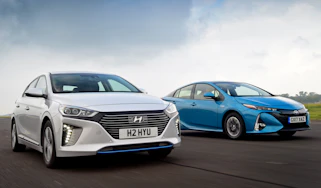
The Prius has tended to carve its own niche in the market, and the fifth generation’s swoopy styling means it looks unlike any other medium-sized family hatchback on sale. Its closest rivals are plug-in hybrid versions of conventional hatchbacks such as the Vauxhall Astra and Volkswagen Golf. The Peugeot 308 and SEAT Leon are also available with plug-in powertrains.
Alternatively, there are fully electric options to consider like the Cupra Born, Kia EV4, Renault Megane E-Tech and Volkswagen ID.3.
Toyota Prius pictures
Key updates of the Toyota Prius review
13 August 2026: Latest impressions from our long-term test.
Frequently Asked Questions
Toyota’s warranty runs for three years, but owners who take their car to an approved service centre for its scheduled annual maintenance will see their cover updated by 12 months or 10,000 miles each time. This can run up until the car is 10 years old or has covered 100,000 miles. At that point the cover can be described as the best warranty of any car maker for UK customers, which shows how confident Toyota is about its cars’ reliability – just so long as they’re maintained correctly.
Deals on the Prius and alternatives