Most economical cars 2026
Do you value fuel economy above everything else? Here’s a definitive list of some of the most economical cars currently on sale in the UK
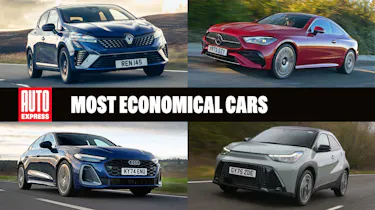
The high cost of petrol and diesel may mean that fuel economy and efficiency will play a larger part in deciding what your next new car will be. It’s a simple cost-benefit analysis – the more economical a car is, the more money you’re going to save each time you make a journey.
With high prices at the pumps being an ongoing issue for UK motorists, we explore the big fuel economy issue in detail below, identifying the most economical petrol, diesel and plug-in hybrid cars currently on sale. Alternatively, click the jump links in the table below to go directly to a specific fuel type
Most economical diesel cars
In the past 10 years, the number of diesel models on sale has more than halved as higher tax rates and incentive schemes for EVs and plug-in hybrids, not to mention the damage done by Volkswagen’s ‘Dieselgate’ scandal, have all hit the popularity of diesel-powered cars.
New small diesel cars are all but extinct from today’s market, with the fuel almost exclusively used for larger cars such the ones listed below. Considering the impact Dieselgate had, it’s an interesting twist of fate that three of the top five cars all come from the VW Group - in fact our entire top ten come from manufacturers within the VW Group or Mercedes.
While it might not be the most popular fuel, diesel power still has its benefits. Go for the cars listed below with comparable petrol engines and you’ll see less impressive fuel economy. Some people also find diesel cars easier to drive, because diesel engines typically produce much more torque than their petrol counterparts. Plus diesel cars tend to have excellent ranges – as evidenced by the Skoda Superb that made a record-breaking 1,759-mile trip on one tank in 2025.
Diesels might not be as popular as they were, but for high-mileage drivers they can still make sense. We’ve gone through all of the diesel cars on sale today to find out the most economical models you can buy right now.
Compare the most economical diesel cars
| Rank | Car | Miles per gallon | Buy |
| 1. | Skoda Octavia 2.0 TDI SE Technology | 65.8mpg | Latest deals |
| 2. | Mercedes CLE 220d AMG Line | 60.1mpg | Latest deals |
| 3. | Peugeot 308 BlueHDi 130 Allure | 59.6mpg | Latest deals |
| 4. | Audi A5 2.0 TDI 204 S Line | 58.9mpg | Latest deals |
| 5. | Audi A3 Saloon 2.0 TDI 150 Sport | 58.9mpg | Latest deals |
Click the jump links above or continue scrolling to learn more about the most economical diesel cars..
1. Skoda Octavia 2.0 TDI SE Technology - 65.8mpg
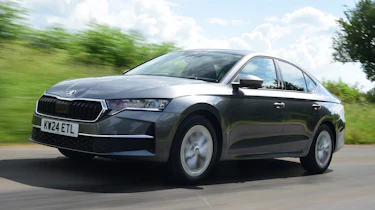
We’re big fans of the Skoda Octavia here at Auto Express. The current, fourth-generation model won our Car of the Year Award in 2020 before winning various categories in the following years. Something that has been consistent throughout the modern Octavia’s lifespan is diesel power and in 2026 it remains an excellent fit - whether you go for the hatchback or estate bodystyle.
To get the maximum possible economy in the Octavia – 65.7mpg – you’ll have to opt for the most basic SE Technology trim and a six-speed manual gearbox. It’s a fine combination, but for a car of the Octavia’s size, especially if you’ve fully loaded the massive 600-litre boot, the 114bhp unit is a little underpowered. If you’re willing to forgo a mere 1.6mpg (and spend a little extra) then you can get the 2.0-litre diesel with 148bhp and 250Nm - along with a smooth-shifting DSG automatic
2. Mercedes CLE 220d AMG Line - 60.1mpg
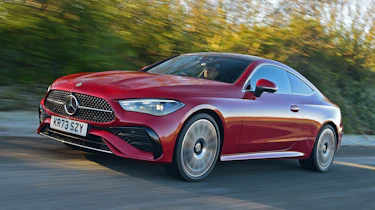
Squeaking in above the 60mpg mark is the Mercedes CLE, which proves you don’t have to sacrifice svelte looks for a diesel engine. An update is coming soon which will bring a new-look front end to the car and a stonking V8 engine for the AMG 63 variant. But we hope the diesel will be retained, because it’s excellent.
The CLE 220 d is sadly the only option – you don’t get the more powerful 300 d from the C-Class, which we think would have really suited the big Mercedes coupe. Fairly sluggish throttle response means the 2.0-litre diesel doesn’t make the CLE particularly fast, but there’s a satisfying rumble in the distance and enough torque going through the nine-speed automatic gearbox for the CLE to feel quick enough.
3. Peugeot 308 BlueHDi 130 Allure - 59.6mpg
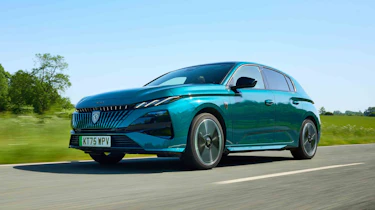
Diesel family hatchbacks have almost completely vanished from the market, but Peugeot is still holding firm, perhaps due to the enduring popularity of diesel in its home market. When the official figure is knocking on the door of 60mpg you can see why for some customers these cars still work better than any other fuel choice. With a 52-litre tank, a diesel 308 could theoretically cover more than 650 miles without refuelling.
Peugeot claims the same economy from the 308 BlueHDi in both Allure and sportier GT trim, though opt for the SW estate and that drops to 56.5mpg - still impressive. A 0-62mph time of 10.5 seconds isn’t startling, but the appeal of diesels has long been their mid-range performance, so in everyday driving the BlueHDi still feels peppy enough, and at a cruise any diesel noise fades into the background.
4. Audi A5 2.0 TDI 204 S Line - 58.9mpg
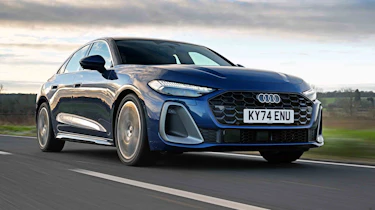
The Audi A5 replaces the old A4 - and yes, we’re aware that’s a little confusing, given an A5 used to sit alongside the old A4 as a coupe option. Ignore the name change though and the A5 has many of the virtues of its predecessor, including the availability of a punchy and efficient diesel drivetrain capable of returning usefully high economy figures. In this case, the latest iteration of the venerable 2.0 TDI delivers 58.9mpg.
It’s paired exclusively with an automatic gearbox, but it does have the option of quattro all-wheel drive to go with the standard front-wheel drive model. Opt for this and economy drops slightly to 55.4mpg, but that’s not a huge price to pay if you rely on the extra traction. It’s a solid performer on the road, not as quick as some models in the A5 range but unlikely to be inadequate, especially for motorway driving.
5. Audi A3 Saloon 2.0 TDI 150 Sport - 58.9mpg
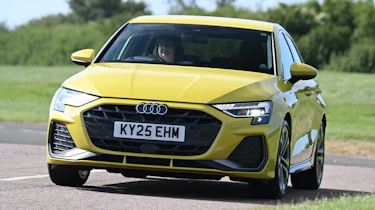
Another Audi rounds out the top five, in this case the smaller Audi A3 2.0 TDI - though interestingly, in saloon form rather than as the Sportback hatch. While the saloon achieves 58.9mpg, the hatch drops to 57.6mpg. Like the A5 above it’s auto-only and there’s no quattro available with this engine, while opting for S Line trim loses you 2.4mpg (as well as costing about £2,300 more to buy), so if you’re squeezing every penny then Sport trim is the one to go for.
If you’re familiar with your Volkswagen Group products then you’ll know the A3 is similar under the skin to the VW Golf (among others) but true to Audi’s past form the A3 does feel a little higher-quality. You’ll have to order one soon if you like buttons for air conditioning controls though, as a refreshed A3 is just around the corner and they’ve all been grouped into a screen on that one.
More economical diesel cars
If the economical diesel cars above don’t take your fancy, there are some good fuel-sipping alternatives.
6. Mercedes E 220 d Urban Edition - 58.9mpg
7. Audi A3 Sportback 2.0 TDI 150 Sport - 57.6mpg
8. Mercedes A 200 d Sport Executive - 57.7mpg
9. BMW X1 sDrive18d Sport - 57.6mpg
10. Skoda Superb SE Technology - 56.5mpg
Most economical petrol cars
If efficiency is your top priority, then diesel-powered cars were traditionally the answer. However, thanks to advances in engine management software, fuel delivery systems, turbochargers and hybrid technology, plus small diesels being killed off, petrol cars have now become even better than their oil-burning counterparts at sipping fuel. Here, we look at five great petrol-powered choices that are all supermini-sized or smaller, and utilise hybrid assistance to make their fuel tanks last longer.
A few of our entries top 70mpg (something that used to be the preserve of diesels), but it’s worth noting that while the WLTP figure is designed to replicate real-world driving, it’s best used as a guide rather than a guarantee. Long journeys tend to improve fuel efficiency, while short trips around town can see your mpg drop.
Compare the most economical petrol cars
| Rank | Car | Miles per gallon | Buy |
| 1. | Toyota Aygo X 1.5 Hybrid Icon | 74.3mpg | Latest deals |
| 2. | Mazda 2 Centre Line | 74.3mpg | Latest deals |
| 3. | Toyota Yaris Design | 70.6mpg | Latest deals |
| 4. | Renault Clio 1.6 E-Tech full hybrid 145 Techno+ | 67.3mpg | Latest deals |
| 5. | Renault Captur 1.8 E-Tech Full Hybrid 160 Techno | 65.7mpg | Latest deals |
Continue scrolling to learn more about the most economical petrol cars or click the jump links to go straight to a specific model..
1. Toyota Aygo X 1.5 Hybrid Icon – 74.3mpg
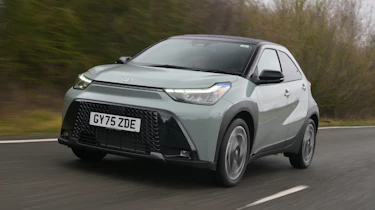
It’s fitting that the company that pioneered petrol hybrid efficiency with the Toyota Prius sits atop this list. With the Toyota Aygo X, Toyota already had a supremely efficient city car that could provide 58.9mpg thanks to its featherlight 950kg kerbweight and frugal 1.0-litre three-cylinder naturally aspirated engine. But in 2025, Toyota facelifted the Aygo X, which brought over the 1.5-litre full hybrid powertrain from the Yaris and a redesigned front end to fit it in.
A sizable uptick in performance was a welcome benefit (the hybrid Aygo X is a whole 5.7 seconds quicker to 62mph), but reaching 74.3mpg is no mean feat, either – this is a figure only matched by the Mazda 2. During our first drive of the Aygo X we even saw 86mpg from a combination of motorways, A-roads and urban driving, with this only dropping to 80mpg after leaning on the extra performance later in the day.
2. Mazda 2 Centre Line – 74.3mpg
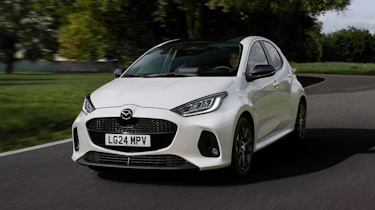
Considering it has the same hybrid powertrain as the Aygo X, it’s amazing the larger, heavier Mazda 2 matches it for efficiency. It’s perhaps even more bizarre that the Mazda 2 beats the mechanically and almost cosmetically identical Toyota Yaris by 3.7mpg.
The 114bhp unit is well suited to the Mazda’s size, despite the droning e-CVT gearbox doing its best to rid the driving experience of any fun. The 0.7kWh battery might be tiny, but up to 70 per cent of urban driving can be done on electric power, going some way to explain the car’s fantastic fuel economy. You can even forcibly run the Mazda in ‘EV mode’ at the push of a button, although the petrol unit will burst into life if you prod the throttle too firmly or go over 31mph.
3. Toyota Yaris Design – 70.6mpg
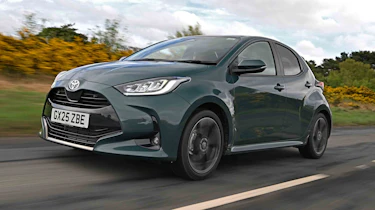
Even though the Mazda 2 edges the Toyota Yaris for outright efficiency, the latter is still an incredibly appealing supermini with more in its arsenal than you might think. Beyond the efficient 114bhp powertrain, Toyota introduced a 129bhp version of the same hybrid unit, which knocked half a second off the 0-62mph time – down to 9.2 seconds. It’s not like there was much of a penalty for the extra oomph either, as the more powerful Yaris could still return 67.3mpg on a combined cycle (plus the Mazda never got this option). During our tests, we saw the Yaris was almost true to its word, coming in with a 65mpg figure.
Another thing the Mazda doesn’t get is Toyota’s long warranty period – if you keep the Yaris serviced with a main dealer, the cover will be automatically extended each year up to ten years or 100,000 miles.
4. Renault Clio 1.6 E-Tech full hybrid 145 Techno+ – 67.3mpg
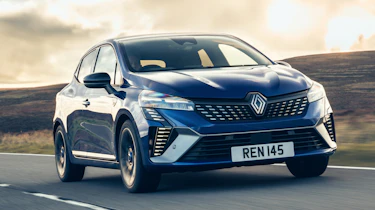
Along with a massive improvement in interior quality, the fifth-generation Renault Clio also offers the option of hybrid power, making it feel more grown-up than ever.
The Renault hybrid system is a little different from the one you’ll find in the Yaris. Instead of one electric motor, the Clio has two – one to help drive the front wheels and another, smaller one to fire up the engine and smooth out gearshifts. Power for the motors comes from a 1.2kWh battery. It’s a very slick set-up, and with a 1.6-litre four-cylinder petrol (as opposed to the Yaris’ three-cylinder), the Clio feels more eager, backed up by its 143bhp and 205Nm of torque.
Despite the decent levels of power, the Clio E-Tech really is excellent at maximising its fuel reserves. After more than 5,000 miles of real-world testing, our car returned a very impressive 63.4mpg.
5. Renault Captur 1.8 E-Tech Full Hybrid 160 Techno – 65.7mpg
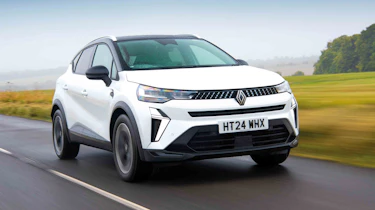
The Renault Captur has long been a popular choice in the compact crossover class, and it’s always offered some fairly frugal powertrains too – it debuted when diesel was still offered in cars like this, and promised (albeit on the older NEDC test cycle) economy in the 70mpg range.
Hybrid power is now the way to get the most economical Captur, and with a recent facelift there’s been a small uptick in fuel efficiency, with the 1.8 full hybrid now achieving 65.7mpg combined, a mile and a half to every gallon more than before, and enough to knock the Suzuki Swift into sixth place on this list.
It functions very similarly to the hybrid system in the Clio, but benefits from a slightly larger petrol engine to help shift the Captur’s extra kilos. Given the Captur is larger than the Clio and presents a bigger frontal area to the airflow, getting within a few mpg of its smaller sibling isn’t bad going, and it’s the only SUV in the top five as a result.
More economical petrol cars
The cars below couldn’t quite hit the same figures as our top five, but shouldn’t cost you that much more at the pumps.
6. Suzuki Swift Mild Hybrid Motion – 64.2mpg
7. Renault Symbioz 1.8 E-Tech FHEV 160 Techno 5dr Auto – 64.2mpg.
8. MG3 1.5 Hybrid SE 5dr Auto – 64.2mpg.
9. Nissan Qashqai e-Power Acenta Premium – 64.2mpg.
10. Toyota Corolla 1.8 Hybrid Icon 5dr CVT – 64.1mpg.
Most economical plug-in hybrid cars
Plug-in hybrids can be the ideal solution for people who aren’t ready for an EV but want to make fewer trips to their local petrol station. They offer enough pure-electric range for buyers to complete their commutes (and then some), while a petrol or diesel engine provides the flexibility to tackle long journeys without the need to stop and charge.
However, a common complaint with PHEVs is they rarely deliver the extraordinary fuel economy advertised. The good news at the start of 2025 the EU changed the testing standards for PHEVs to provide buyers with more realistic efficiency figures.
The bad news is these rules aren’t mandatory in the UK until April this year. This explains why the plug-in hybrid Range Rover P460e can supposedly return up to 386mpg here, but only about 100mpg over in Germany.
That’s not to say, if charged whenever possible, PHEVs can’t be very frugal. But due to the inconsistencies in the mpg numbers available to us in the UK right now, we’ve based our list of the most economical plug-in hybrids on the pure-electric range they offer, on the basis the more time you spend driving in EV mode, the more efficient you’ll be.
Compare the most economical plug-in hybrid cars
| Rank | Car | Max. electric range | Miles per gallon | Buy |
| 1. | Omoda 9 SHS Noble | 93 miles | 201.8 mpg | Latest deals |
| 2. | Volkswagen Golf eHybrid Match | 88 miles | 256.8mpg | Latest deals |
| 3. | Audi A3 TFSI e Sport | 88 miles | 709mpg | Latest deals |
| 4. | Chery Tiggo 9 CSH Summit | 87 miles | 470.8mpg | Latest deals |
| 5. | Skoda Superb Estate iV SE Technology | 85 miles | 783.4mpg | Latest deals |
Continue scrolling to learn more about the most economical plug-in hybrid cars or click the jump links to go straight to a specific model..
1. Omoda 9 SHS Noble - 93-mile EV range, 201.8 mpg
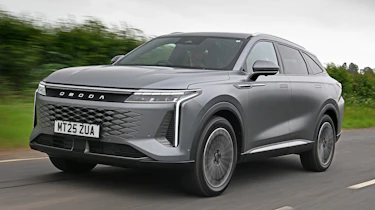
With a pure-electric range of 93 miles – which is further than the original Nissan Leaf EV could manage – the Omoda 9 SHS can go further than any other plug-in hybrid without using a drop of petrol. The Chinese brand’s flagship SUV achieves this feat by using a massive 34.5kWh battery – also bigger than the Mk1 Leaf’s.
That huge zero-emissions range should cover most people’s commutes with ease, maybe even twice, and means the Omoda 9 can cover more than 700 miles without stopping. The car’s so-called ‘Super Hybrid System’ consists of a 1.5-litre turbocharged petrol engine, paired with that battery, a three-speed hybrid transmission and two electric motors.
With all those elements working together, the 2.2-tonne SUV gets 443bhp on tap, a 0-62mph time of less than five seconds and can officially average up to 201.8mpg. On top of that it’s also impressive value for money, when you consider the amount of kit it comes with and that fact that prices start from less than £45k
2. Volkswagen Golf eHybrid Match - 88-mile EV range, 256.8mpg
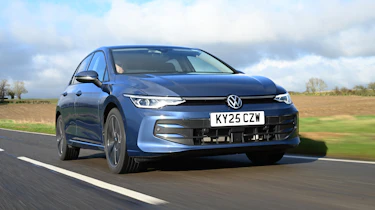
The Volkswagen Golf has been the benchmark for family hatchbacks for more than 50 years, and although this version might not be at the top of the class, none of its direct rivals can touch the 88-mile electric driving range offered by plug-in eHybrid version.
VW added its new second-generation PHEV set-up to the Golf during its mid-life facelift in 2024. The biggest upgrade was to fit a much larger 25.4kWh battery (up from a 13kWh unit before), which feeds a single electric motor integrated into a six-speed automatic transmission; the engine is a 1.5-litre four-cylinder petrol.
The new powerpack doubled the car’s EV range, however it does eat up more than 100 litres of the hatchback’s boot capacity, leaving a more supermini-sized 273 litres. Thankfully, in return the Golf eHybrid can officially average up to 256.8mpg, emits just 25g/km of CO2 and can reach motorway cruising speeds in EV mode. Plus prices start from a little over £29,000.
3. Audi A3 TFSI e Sport - 88-mile EV range, 709mpg
The Audi A3 is the humble Golf’s more refined, more upmarket brother from another mother, so unsurprisingly it’s available with the same plug-in hybrid powertrain. In the A3 TFSI e, it offers the same 88-mile EV range as the VW, sips just as little petrol and features DC fast charging at up to 50kW, which not every PHEV can do.
Rather cleverly, the system in the A3 ensures there’s always enough energy in the battery for the car to work like a traditional hybrid, so even when you think there’s no charge left, you can drive around town at low speeds without needing assistance from the 1.5-litre engine.
Audi also tuned the suspension to counteract the extra weight of the battery, which is located under the rear seats, so the plug-in hybrid delivers the same controlled yet comfortable driving experience as any other A3. The cabin is nicer than in the Golf – and the tech is better too – but the A3 also costs £10,000 more, because prices start from over £39,000.
4. Chery Tiggo 9 CSH Summit - 87-mile EV range, 470.8mpg
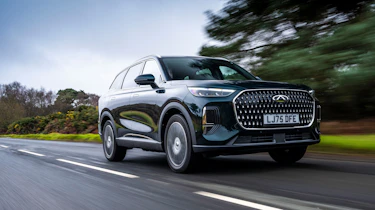
Depending on how much you’ve been following the arrival of new Chinese car brands to the UK, you might be surprised to learn that the Chery Tiggo 9 Super Hybrid is the less sleek, but more practical, sister car of the Omoda 9 above.
So the seven-seat family SUV features the same ‘Super Hybrid’ set-up with that whopping 34.5kWh battery that here offers a pure-electric range of up to 87 miles. And we found the Tiggo 9 does indeed feel like an EV when you’re driving – that’s how little involvement the 1.5-litre petrol engine can have.
But while the Chery’s zero-emmissions range is slightly shorter than its sibling’s, the Tiggo 9 is supposedly even more efficient, capable of returning up to 470mpg. It’s a little expensive however, with prices starting from £43,105, but offers up to 2,021 litres of luggage capacity, which is particularly impressive considering how much space that battery and third row of seats take up.
5. Skoda Superb Estate iV SE Technology - 85-mile EV range, 783.4mpg
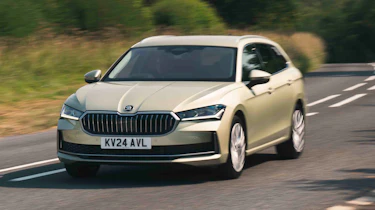
If you want a comfortable, practical, well equipped and rather handsome family car that’s not an SUV, the Skoda Superb Estate is our pick of the bunch. It’s so good, in fact, that it won the Auto Express Estate Car of the Year award in 2024, 2025 and 2026, and the plug-in hybrid is especially impressive.
It uses the same 25.7kWh battery pack as the Golf and A3 (above), and in the Superb Estate iV it delivers up to 85 miles of pure-electric range. In official tests, that allows the family wagon to return up to 235mpg – about four times as much as the equivalent diesel.
The battery pack is located under the Octavia’s rear seats, so its luggage capacity does take a hit, but even so the 510 litres on offer is more than you get in a Nissan Qashqai and should be plenty for family use. When you need even more space, folding the rear seats down opens up an excellent 1,770 litres to play with. .
Latest Skoda Superb Estate deals
More economical plug-in hybrid cars
Some of the cars above couldn’t quite challenge the cars above when it comes to all-electric miles, but they’re not far off.
6. Geely Starray EM-i - 84 miles, 201.8mpg
7. Volkswagen Passat eHybrid Match - 83 miles, 217.3mpg
8. Cupra Leon V1 1.5 E-Hybrid - 81 miles, 706.2mpg
9. BYD Seal U DM-i Comfort - 78 miles, 706.8mpg
10. Volkswagen Tiguan eHybrid Life - 77 miles, 174.7mpg
How to choose an economical car
Until recently, diesel cars were seen as the automotive silver bullet with their combination of good fuel economy, performance and low CO2 emissions. However, the popularity of diesel has been in serious decline since details of the Volkswagen emissions scandal surfaced back in 2015 and questions were raised about emissions of nitrogen oxides (NOx) and particulate matter from diesel cars.
Despite this, new diesel cars are very clean and the fuel still makes a good choice for those who regularly cover long distances, as most modern diesel engines will easily return upwards of 50mpg on the motorway. Diesel buyers just need to ensure that they cover enough miles in a year to offset the extra upfront cost of a diesel engine, and the additional cost at the pump, with fuel savings.

All the most economical diesel cars listed below comply with the latest Euro 6 emissions standards and are Ultra Low Emission Zone (ULEZ) compliant – so they’re amongst the cleanest cars on sale today.
Sales of diesel cars in the UK have been in serious decline for some time now and for many buyers petrol cars may be a more cost effective solution. Hybrid technology has boosted the efficiency of many modern petrol models and plug-in hybrid cars provide the added benefit of a decent electric-only range.
Be warned, however, that the impressive official combined cycle economy figures for plug-in hybrids (PHEV) are often difficult to replicate in the real world, especially on longer journeys where they’re forced to rely on their internal combustion engines. If PHEVs are charged regularly and used for shorter trips, (where they can take advantage of their electric-only ranges), they can be extremely fuel efficient. Finally, we’ve ignored electric cars for the purposes of this page but that’s not to say you should, our most economical electric cars list will give you all the guidance you need to pick the right one.
All of the vehicles listed here have been subject to the latest WLTP test programme, which is more stringent and accurate than the NEDC system it replaced. The aim is to provide consumers with information more representative of real world driving and it’s the basis for all the MPG figures listed.
Get even more from Auto Express, follow our channels...
• Google
• Reddit
• Whatsapp