Mitsubishi Evo X vs Audi S3 vs Subaru Impreza WRX STI: 2008 group test
Just how good is the new Mitsubishi Evo X? We took it to Wales with the latest Subaru Impreza STI and Audi S3 for a sizzling shoot-out to remember.

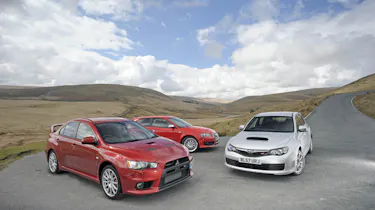
Meet the Mitsubishi Revolution X – sorry, Evolution X. In reality, the first version is probably the more accurate: this car isn’t simply an update of previous models – it’s all-new from the ground up.
The firm has been working on the model since before the launch of the Evo VIII in 2003, and it has plenty of innovative touches – not least a double-clutch gearbox, stiffer chassis, overhauled 4WD, more torquey engine and better handling than ever. In Mitsubishi’s own words the Evo X “takes things to a whole new level”.
So what is Subaru’s answer? A deadly rival for the last 15 years (the first Impreza Turbo and Lancer Evo I were launched within months of each other), it has taken an equally radical approach with its latest model by making a hatchback.
On paper these two are very evenly matched, but the Impreza is nearly £7,000 cheaper. Does that mean this test is over before the cars have even turned a wheel?
Not if the Audi S3 has anything to do with it. Mitsubishi is claiming to have moved the Evo upmarket, but it’ll be pushed to prove as well built and good to live with as the S3, which may just have a surprise in store for its two opponents.
Used - available now

2023 Mercedes
GLA
34,433 milesAutomaticPetrol1.3L
Cash £27,554
2023 Mercedes
GLC Coupe
40,640 milesAutomaticPetrol2.0L
Cash £26,697
2023 Tesla
Model 3 Performance
27,526 milesAutomaticElectric
Cash £23,997
2024 Mercedes
EQB
50,747 milesAutomaticElectric
Cash £21,497All have strong rally heritage, hi-tech 4WD systems and punchy turbo engines. Is this the perfect recipe for driving fun? We took them to mid-Wales to find out...
Verdict
The Mitsubishi Evo X is staggering. Not because of its power, but the way it handles. Its chassis and suspension deliver taut driving manners, as well as acceptable comfort and refinement. It may not be raw enough for some Evo fans, and it’s expensive to run, but we think that’s a price worth paying.
While Mitsubishi is chasing premium brands, the Impreza is the down-to-earth choice. It’s just as fast as the Evo, but is cruder, although it’s still enjoyable.
The Audi S3 wasn’t overshadowed here. It doesn’t generate the excitement of its rivals, but in one or two areas, especially running costs, it proved superior to the Subaru. That was enough to give it second spot.
First place: Mitsubishi Evo X
One thing hasn’t changed with the arrival of the latest Lancer, and that’s Mitsubishi’s liking for long and convoluted names. Luckily, if you simply utter the words ‘Evo X’ any car enthusiast will know exactly what you’re on about.
Although only officially on sale in the UK since the Evo VIII arrived in 2003, the Lancer has quickly built a strong reputation, based on the car’s incredible roadholding and brutal power. Now Mitsubishi is tampering with that formula, trying to take the Evo upmarket and improve refinement without spoiling its addictive personality.
That’s a tough task, but the Japanese firm means business – witness the strong new shape. It looks great in the metal – much more modern and dynamic than the Impreza. It’s just a shame that Mitsubishi didn’t go the whole hog and ditch the rear spoiler in favour of something more subtle. The bulky wing blocks rear visibility, too.
Nevertheless, we don’t think Mitsubishi will have any trouble shifting a projected 1,250 Evos in the UK this year, 65 per cent of them with the grandly titled Twin Clutch Sport Shift Transmission (SST) tried here. This is only available in top-spec GSR trim, and although it’s pricey at £31,999, there’s plenty of kit on offer inside, including standard sat-nav with a 30GB music hard drive.
The rest of the interior is less inspiring. OK, the hooded dials look good and the small-diameter steering wheel is lovely to hold, but cast your eye around and you’ll notice the cheap plastics, nasty orange lighting and downmarket switchgear. Even though it’s well assembled, the Evo X is a long way from luxurious when compared to the S3.
Rear seat space is generous – the Evo is the longest and widest car here – but the shallow boot doesn’t look anything like as big as the 400 litres Mitsubishi claims, and there’s no split-fold option. That’s because the engineers wanted to strengthen the frame as much as possible. And it’s worked, as the Evo X is 56 per cent stiffer than the Evo IX.
However, as a result it’s 190kg heavier than its predecessor at 1,590kg, and that gives the engine a lot to do – economy and performance both suffer. The SST doesn’t allow such an aggressive launch as a manual gearbox, so the Lancer’s 0-60mph time of 5.2 seconds lagged half a second behind the Impreza’s, although from 30-70mph there was little to separate them. Short ratios gave the Evo X an advantage in-gear, but on the road it simply doesn’t feel as punchy or rapid as the Impreza. What’s more, the four-cylinder turbo unit sounds rather flat and dreary – quite a lot like the rotary-engined Mazda RX-8, in fact. It’s effective, but not that charismatic.
The same applies to the SST gearbox. It’s more like a fast automatic than a snappy manual. Even in the most aggressive of the three gearbox modes, the shifts are slightly slurred – very smooth, but in a car like this you expect them to pop home instantly. If this is indicating that the Evo isn’t as hardcore as it once was, then you’d be right. From the word go it feels more refined, secure, solid and stable. Noise levels are lower – although tyre roar remains excessive – and it’s a much easier car to live with on a daily basis.
But the Evo’s real genius lies in its suspension. The ride is no longer crashy, and although not plush either, it never jars or jolts – unlike rivals.
It has been perfectly honed. There’s barely any roll or suspension movement, yet we can’t think of another car that glides as effortlessly or flows better over the rough roads of mid-Wales. It’s also beautifully balanced, has a sublime 4WD system, scalpel-sharp steering and stunning body control. Expensive? Yes. Worth it? Absolutely.
Details
- Price: £31,999
- Model tested: Evo X SST FQ-300
- Chart position: 1
Economy
The engine has been updated, but it’s still thirsty. It averaged 17mpg, and the Evo’s modest 55-litre tank means you’ll be filling up every 200 miles – far more often if you have a heavy right foot. On one tank it returned less than 10mpg.
Residuals
Mitsubishi is anxious to take the Evo X further upmarket and distance it from the Subaru. However, the market analysts aren’t convinced the firm will succeed – its retained value of 46.7 per cent is only three per cent up on its predecessor.
Servicing
Older Evos were notorious for their hopeless 4,500-mile intervals and costly maintenance. The new model doubles that to 10,000 miles and introduces a £400 Service Plan that covers 30,000 miles of motoring.
Insurance
Under the latest 50-band insurance groupings, the Mitsubishi comes out the worst of this trio, its group 42 position resulting in a £1,043 annual bill. That’s not the only hefty cost involved – overall running costs are the highest here at 118 pence per mile.
Second place: Audi S3
In this company, the Audi S3 is the odd one out. The German firm has distanced itself from rallying since the glory days of the Quattro in the Eighties, and the S3 doesn’t quite enjoy same cult following as its two rivals.
It’s a more low-key car which makes less of a song and dance about its abilities. But can it keep pace with its rivals where it counts? Visually, it’s certainly not as striking. With a squat stance, it isn’t that pretty and relies on its bright red paint, silver mirrors and chrome trim to stand out.
The compact frame is well enough packaged, though, managing to cram a 281-litre boot and adequate space for four into a 4,214mm overall length. But what really sets the S3 apart in this company is the look and feel of the cabin. Mitsubishi has taken the Evo slightly upmarket, but its interior design and plastic quality aren’t in the same league as the Audi’s.
The leather clad gearknob and steering wheel are very tactile and the switches have been painstakingly shaped and laid out, rather than scattered carelessly around. We’re less convinced by the indented leather on the seats, and there are fewer toys to play with, too. The Audi isn’t that well equipped as standard – our car had more than £4,500 of options – and there are no 4WD, gearbox or throttle controls, either.
That doesn’t hold the Audi back in a straight line. At 261bhp and 350Nm, it gives away 31bhp and 57Nm to the Evo X, but at 1,455kg, it’s 135kg lighter. As a result, its power to weight ratio is virtually identical. Longer gearing meant it wasn’t quite as quick as the Mitsubishi from 0-60mph with a time of 5.6 seconds, but better aerodynamics ensured the Audi was only a tenth of a second behind when they passed 100mph, recording 13.8 seconds. So the S3 is much quicker than you might expect.
Despite the addition of beefed up mechanicals over the standard 2.0 TFSI used by the Golf GTI, the engine still doesn’t come alive until past 3,000rpm. But there’s little lag, so it’s great for overtaking, with a relatively sharp throttle response. An addictive turbo whistle once past 5,000rpm means it sounds rorty, too. Unlike the Evo X, the S3 isn’t available with a double-clutch gearbox, instead making do with a six-speed manual. It offers a smoother, slicker shift than the Subaru’s, but with a lack of mechanical feel it comes across as more remote.
That applies to the driving experience, too. The S3 is sharp and well engineered, but unlike the honest, if agricultural, Impreza and honed Lancer, the Audi isn’t that engaging to drive.
For instance, you never really feel the 4WD system working. The S3’s natural stance is to understeer once the limit of grip is reached, while the brakes are a touch snatchy.
However, as long as you don’t drive too hard, the S3 is impressive, composed and relatively well damped. It has been lowered by 25mm over the standard A3, so doesn’t have as much suspension travel as the Impreza, and can’t handle rough roads quite as well. But it makes up for that with faster reactions, a more nimble chassis and crisper steering.
The S3 is missing the fun factor, but as a car to live with, it’s easily the most accomplished. Audi is a desirable brand which ensures good resale and low running costs, plus as it isn’t focused purely on driving thrills, the S3 fares better in day-to-day situations. A figure of 69dB at 70mph was three decibels quieter than the Japanese cars, while the 4WD system is happier during low-speed manoeuvres. It’s not cheap and is a very different car to its rivals, but still a tempting prospect.
Details
- Price: £27,000
- Model tested: Audi S3
- Chart position: 2
Economy
It has the best claimed figures, lowest emissions and the S3 is the only one not to sit in the top bands for road and company car tax. It managed 23.7mpg, meaning you pay less to cover 20,000 miles than it would cost to travel 12,000 miles in the Evo.
Residuals
The S3 holds on to 10 per cent more of its value than the Evo. So although it’s £5,000 cheaper initially, it’s likely to be worth more in three years’ time, having lost £11,853. This excellent result highlights the desirability of the Audi badge.
Servicing
A variable schedule means the Audi should be able to go further between visits to a service centre – around 17,000 miles, we reckon. But be warned that when the time does come, maintenance isn’t cheap at £1,040 for three visits.
Insurance
It’s cheaper to insure than its rivals, costs less to tax, is lighter on fuel and wears an Audi badge, so it’s no wonder the S3 has by far the lowest running costs. 77.1 pence per mile is only fractionally more than the lower-spec Impreza WRX.
Third place: Subaru Impreza WRX STI
It took Mitsubishi a long time to realise how well suited the Evo would be to UK roads, but Subaru was much more aware of the benefits of a compact frame, four-wheel drive and a meaty turbo engine. The first Impreza caused a sensation, turning Subaru from a farmer’s favourite into a brand with a loyal and passionate sporting fan base.
But what will they make of the latest version? It’s a curious looking thing, with the curved bonnet and roofline giving it a rounded appearance. The gaping bonnet scoop is a direct link to Subaru’s rally heritage and does serve a purpose, as it channels air into the engine’s intercooler. The flared arches are also functional, as they add 55mm to the Impreza’s width, which promises to improve stability and grip.
Aficionados of the brand may be unable to resist the option of WR Blue paint with gold wheels, but we think the Impreza looks more cohesive and upmarket in silver. However, this hint at quality doesn’t continue when you open the door.
The STI costs upwards of £25,000, but the interior design and material quality are no better than on a £10,000 supermini. Cheap plastics and flimsy trim abound, although like the Evo, it gets the basics right. It also adds steering reach adjustment – which the Mitsubishi doesn’t have –offers excellent all-round visibility and has a decent amount of cabin stowage.
Following the practicality theme, there’s plenty of headroom throughout, and the Impreza’s five-door hatchback layout makes it the most versatile of the models on test.
It’s the fastest, too. The larger 2.5-litre flat-four develops 296bhp, which is 5bhp more than the Evo X, and an identical 407Nm of torque – albeit 500rpm further up the rev range at 4,000rpm. However, on the road it’s the Subaru that pulls better from low revs – although neither really gets going until the needle passes 3,500rpm.
But with a kerbweight of 1,505kg – some 85kg less than the Lancer – the Subaru gained a slight acceleration advantage, and its flat-four engine had a much more characterful growl, too. The Si-Drive system alters the engine mapping to improve throttle response, although the Subaru always felt lazier to respond than the Mitsubishi and the Audi. But the main impression you get from the STI is how mechanical it seems.
Where Mitsubishi has thrown electronics and technology at the Evo, Subaru has stuck to tried-and-tested mechanical systems. The six-speed manual has a tight shift and weighty clutch, while the four-wheel-drive transmission uses limited-slip differentials front and rear, which allow torque to be distributed to the wheel that needs it most.
That’s just as well, because the steering is a disappointment. Not only is it too light, but it’s not direct enough, so the nose is vague and agility suffers in comparison to the Evo X. A lower centre of gravity – the engine has been dropped 22mm in the frame – means that although the chassis isn’t anywhere near as stiff as the Lancer’s, it manages to be stable on rough roads.
And it’s absorbent, too. Compared to the Evo, the Impreza has long suspension travel and is softly set-up. That means it copes with B-roads well, although it still fidgets over motorway expansion joints and is just as noisy as the Mitsubishi.
Against its rivals here, the Subaru feels almost rough and ready. But although it’s flawed and comparatively crude, it has plenty of character, and that alone helps make it enjoyable to drive. What’s more, from point-to-point it’s just as quick as the Evo, but costs £7,000 less. Is that enough to give the STI victory?
Details
- Price: £25,095
- Model tested: Impreza WRX STI
- Chart position: 3
Economy
As with the Evo, the STI runs on super unleaded – so expect to pay about £1.15 a litre, rather than £1.07. Cover 12,000 miles a year, and you’re looking at a £3,230 fuel bill. That’s still £340 less than the Evo, though.
Residuals
No figures are available for the Subaru yet, but given the car’s lukewarm reception, we think residuals will be similar to its predecessor, which held on to about 43 per cent of its price. Expect to lose around £14,000 over three years.
Servicing
It’s not as cheap as the Evo X, but the Subaru’s first two check-ups are well priced. Watch the steep third service, though. The dealers have a good reputation, taking third in the Driver Power 2008 report free with this issue.
Insurance
Weaker residuals account for the Impreza being 20 pence per mile more expensive to run than the Audi. The fact it’s thirstier, costs over £200 more per year to insure, and has a £400 tax disc doesn’t help matters, either.