Renault Clio vs Fiat Grande Punto vs Mazda 2: 2007 group test
Do turbocharged engines make sense in superminis? Fiat thinks so, and has just fitted one into its latest Grande Punto. We see how it fares against Renault’s Turbo Clio – and our current class leader, Mazda’s normally aspirated 2

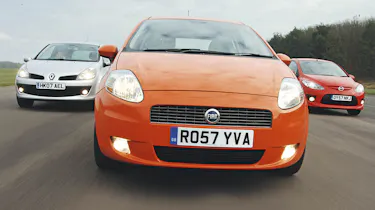
Say ‘turbo’ to most people, and images of huge bonnet scoops and loud exhausts spring to mind. But while turbochargers were once the preserve of performance cars, they are now appearing on small-capacity engines – and not just to increase power and torque. Economy and emissions can also be improved with forced induction – very desirable, given rising petrol prices and tax calculated on CO2 output.
But are the latest machines really all they’re cracked up to be? Don’t forget, there are plenty of first-rate normally aspirated engines fitted in small cars, too. To find out, we’re pitching two new turbocharged superminis, from Fiat and Renault, against a standard rival in the shape of the new Mazda 2.
The Grande Punto’s new 1.4-litre T-Jet boasts a generous 120bhp and 206Nm of torque, giving it strong performance credentials and making it the fastest model in this line-up. Meanwhile, the Renault Clio’s 1.2-litre TCE (Turbo Control Efficiency) unit has been designed to deliver excellent refinement and economy, and although it develops 20bhp less than the Fiat, it produces more torque lower in the rev range than our final contender, the Mazda.
But the Japanese five-door won’t be a pushover. It’s our current supermini champ, and here we’re testing the top-of-the-range 1.5-litre Sport, which develops 102bhp and 137Nm of torque. But will the 2’s reign be over before it’s scarcely even begun?
That’s what both turbocharged Europeans hope, as the trio meet on British roads for the first time. Which will emerge victorious?
First place: Mazda 2
With its boxy shape and awkward design, the old Mazda 2 was a million miles away from the dynamic edge the Japanese firm promotes. But the company has come back into the supermini market with a real bang, thanks to its replacement. The 2 couldn’t be further removed from its predecessor – its athletic look rivals the Grande Punto in the styling stakes.
It’s the shortest of our trio and has the smallest wheelbase, but there’s no compromise in terms of passenger space, although it doesn’t feel quite as airy as the Clio. There are no complaints with the faultless cabin design. It’s simple and attractive, and takes sporty cues form the MX-5 roadster, including a similar gearlever and steering wheel.
Despite having the largest capacity engine here, the Mazda can’t match its two turbocharged rivals for torque. A low kerbweight helps make up for this, however, and the engine is energetic, especially in the mid range. A 0-60mph time of 10.0 seconds couldn’t compete with the Fiat’s, and the Mazda was only quicker than the Clio in fifth gear, but in real-world conditions it feels much faster than the figures suggest.
The peppy engine gives the Mazda a go-kart like nature, and this is backed up by the handling. The Grande Punto is more grown up, but the 2 is more likely to put a smile on your face. The payoff is a slightly firm ride – the Clio is more comfortable.
At £11,799, the 2 is slightly more expensive than the Renault, but the Mazda is closer to the Punto when it comes to standard kit. Cruise control and an MP3 player connection are included for a price that’s £200 less than the Fiat’s.
Economy
We were impressed by the Mazda’s fuel sipping ability. During its time with us, it averaged 37.0mpg. This was helped by its low kerbweight, but it proves that normally aspirated engines can be as economical as turbocharged units.
Residuals
With fresh new styling and plenty of driver appeal, the 2 is set to be a strong contender on the used market. After three years, this range-topping 1.5 Sport will be worth 43.4 per cent of its list price, which is £5,121.
Servicing
The new Mazda proved the cheapest when it came to servicing. Three dealership visits come to a reasonable £470, while the dealers finished a strong 14th in our annual survey, ahead of marques such as VW and Mercedes.
Tax
The normally aspirated Mazda emits 3g/km more CO2 than the Renault, but this makes no difference in company car tax. And with a similar list price to the Clio, the 2 is only a few pounds more expensive, at £389 a year.
Second place: Fiat Grande Punto
There's good news if you’re a fan of Italian cars, because Fiat is on a roll. The maker’s resurgence has been nothing short of astonishing – it’s even starting to lose its reputation for poor reliability and iffy build quality. And looking at some of the models it’s produced recently, such as the Bravo and the wonderful 500, it’s not hard to see why.
Of course, the brand has never been found wanting in terms of style – and the Grande Punto illustrates that perfectly. It looks best in Sporting trim, but the standard car still features the same neat lines and distinctive looks. In the current crop of superminis, the Fiat is one of the few that manages to stand out.
The same could be said of its predecessor, but that car was badly let down by a low-rent interior. Thankfully, this third-generation model has a much improved cabin, with neatly laid out controls and an excellent driving position. However, it doesn’t feel as solid as the Mazda, and it’s a shame that there are some average quality plastics.
Unlike the other Sporting versions (the 1.9-litre Multijet and standard 1.4-litre), the T-Jet comes in both five and three-door bodystyles. We think it looks better with fewer doors, but for family buyers the former is a much wiser choice – access to the back seats in the latter is quite tricky.
The real highlight of the Punto is the 1.4-litre T-Jet unit. The 120bhp output is impressive for an engine this size, but it’s the 206Nm of torque that makes the biggest difference, particularly to in-gear pace. The Italian recorded a time of 8.6 seconds from 50-70mph in fifth, well over five seconds faster than either rival. It’s a great engine to use because there is barely any turbo lag, and the acceleration doesn’t drop off, even when you near the red line. Witness the fact that it polished off the 0-60mph sprint in only 8.7 seconds, a time which puts the Punto firmly in the warm hatch league.
But as it’s geared towards pace rather than economy, the engine puts out the most CO2 (155g/km), which means it will cost £25 a year extra in road tax compared to both rivals. It proved the least economical, too, achieving 31.4mpg. It’s clear that Fiat is using the latest technology to add more excitement to its range rather than enhancing its green credentials.
There are a few disappointments with the driving experience, though. The clutch is wooden and the throttle is slow to pick up, while the five-speed gearbox is slack compared to the Mazda’s. The steering is also a little too light, so the Punto isn’t quite as responsive as the 2. But that’s not to say the driving experience is detached – far from it.
With precise turn-in and a well balanced chassis, the Fiat remains composed in corners and feels as sure-footed as the Mazda, particularly in the wet, thanks to its grippy tyres. It’s not quite as agile as the Japanese machine, though, and more concerningly, the ride is poor. The suspension crashes over potholes and on uneven tarmac it can become uncomfortable and noisy. Still, this doesn’t prevent it from being entertaining on country lanes and, thanks to its raspy exhaust note, it’s an enjoyable experience.
It represents good value, too. It is £200 more expensive than the Mazda, but its T-Jet engine makes this model the fastest Grande Punto in the range. And not only do buyers get a sporty bodykit and alloy wheels as standard, but also stability control, Bluetooth, reach-adjustable steering and an MP3 player input.
Economy
Considering it has the most powerful engine, it’s no surprise that the Punto proved to be the thirstiest car on test. It returned 31.4mpg on our route, giving it the shortest range at 311 miles. However this figure went up to around 38mpg on motorways.
Residuals
Because the 1.4-litre T-Jet engine has only recently been introduced to the Punto range, our experts have yet to calculate residual values. However judging by other models, buyers can expect a respectable figure of around 41.0 per cent.
Servicing
Fiat offers a servicing scheme where you pay up front for three years’ maintenance, but the £608 cost was only slightly cheaper than our £630 total for three individual quotes. The 18,000-mile intervals are the longest here, though.
Tax
As with economy, the Punto’s powerful engine harms its CO2 emissions. At 155g/km, it sits three tax brackets higher than both of its rivals, and standard-band earners will pay nearly £100 more a year in tax.
Third place: Renault Clio
It’s such a common sight on our roads that it’s easy to overlook how neatly styled the Clio is. A huge step forward over its predecessor, both inside and out, it could be argued that it’s not particularly striking, but the well proportioned shape and smooth lines mean it’s easy on the eye.
The interior is the Renault’s strongest point. It has a premium feel that belies its budget price, and helps the driver get instantly comfortable behind the wheel. The driving position is a little high and the stereo seems low-rent compared to the rest of the controls, but that doesn’t detract from the overall quality ambience that it exudes.
Initially that same positive impression extends to the new 1.2-litre TCE (Turbo Control Efficiency) engine. It’s basically a replacement for the old 1.4-litre naturally aspirated unit, but has more torque available lower down the rev range than its bigger predecessor. However, it barely feels like it’s turbocharged at all. It’s rather sluggish in this company, and that means it has to be worked harder, which raises fuel consumption.
It also lacks refinement at motorway speeds. The engine is adequate around town, but thanks to the Clio’s kerbweight of 1,090kg – 130kg more than the Mazda – it was the slowest at the test track, despite producing more torque lower in the rev range. There’s better news in terms of handling, as the steering is responsive, if a little over sensitive. The Clio has good body control, grip and a smooth ride, too, although it lacks the Mazda’s nimble behaviour.
The Renault is the cheapest model here at £11,715, but equipment isn’t particularly generous, and it’s the only car that doesn’t have electronic stability control as standard.
Economy
With the smallest engine and the best claimed economy figh hopes for the Clio. But a figure of 35.9mpg is well short of the expected 48.7mpg, although a large 55-litre tank gives the Renault easily the best range.
Residuals
It has an upmarket feel, but the Clio doesn’t perform as strongly as either rival on the second-hand market, and the new engine fails to boost its appeal. Over three years, the Renault retains 39.0 per cent of its list price.
Servicing
At £675 for the first three services, the Clio is the costliest to maintain. This was reflected in our annual Driver Power survey – Renault finished 30th out of 32, just one place above Fiat, with poor value as a major complaint.
Tax
Lower-band owners will pay an annual bill of £387 if they opt for the Clio. Although it’s slightly cleaner than the Mazda, it sits in the same tax band, so there’s little difference between the two for company drivers.
Verdict
So are turbo engines better than normally aspirated ones? The jury is still out on that. The Clio isn’t at its best in turbo petrol guise, and finishes third. It’s by no means disgraced, but while the 1.2-litre engine is smooth, it’s lethargic in comparison and the steering is over assisted. It’s comfortable, though, and the neat interior has the most premium feel of the three.
While the Fiat’s T-Jet engine impressed us, the economy figures didn’t. That doesn’t prevent it from being the best engine here, though. Peppy, urgent and rev happy, it’s the powerplant the Punto has been longing for. It’s enjoyable to use and makes the Italian supermini more desirable than ever.
But that’s not enough to give Fiat victory – overall it can’t match the excellent Mazda. The 1.5-litre engine doesn’t have a turbo surge, but it’s still great to use. Combined with a slick gearshift and well weighted steering, the 2 is a joy to drive.