Ford Fiesta ST vs Peugeot 208 GTi vs Renault Clio RS: 2013 group test
You wait ages for a new hot hatch, then three turn up together... But which from the Clio, Fiesta or 208 should you buy?

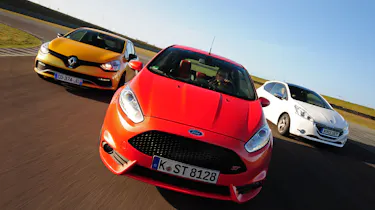
Welcome to the hot hatch showdown of the year. After months of anticipation, the Ford Fiesta ST, Peugeot 208 GTi and Renaultsport Clio 200 have all landed on British soil. And we’ve put them to the test on the road and at the challenging Anglesey Circuit in North Wales to find out which one takes the pocket rocket prize.
The long-awaited Fiesta ST is the cheapest of the trio, while Peugeot hopes its stylish 208 GTi will reignite the excitement of its eighties performance icon, the 205 GTi.
Completing our line-up is the Renaultsport Clio 200. This ditches the hardcore character of its predecessor in favour of a more hi-tech approach – it’s the only car here to feature a paddleshift gearbox and pre-programmed driving modes.
All three are powered by 1.6-litre turbocharged engines and produce close to 200bhp, so this is sure to be a close battle. But which of our contenders will emerge triumphant?
Verdict
With this trio arriving in quick succession, supermini hot hatch buyers have never had it so good. All three are fast and capable, yet each takes a different approach to creating the perfect pocket rocket.
Renaultsport has long been the king of this class, but while the new Clio is fast, it lacks the fun factor the best hot hatches require.
Used - available now

2024 BMW
2 Series Gran Coupe
16,989 milesAutomaticPetrol1.5L
Cash £19,250
2024 Vauxhall
Mokka
22,726 milesManualPetrol1.2L
Cash £13,295
2024 Audi
A3 Sportback
120,530 milesAutomaticPetrol1.5L
Cash £11,995
2020 Peugeot
2008
42,140 milesAutomaticPetrol1.2L
Cash £11,995Pipping the Clio to second place is the 208 GTi. It’s the best fast Peugeot for years, with an upmarket cabin, composed handling and punchy engine. But in this tough test there’s a clear winner – as few cars of any kind can beat the ST for smiles per mile.
With sublime handling, perfectly weighted controls, plus a tuneful and punchy engine, it’s a joy to drive every time you get behind the wheel.
First place: Ford Fiesta ST
The ST is a car you feel at one with – its steering is sharp and perfectly weighted, and body control is excellent. It’s agile, alive and entertaining on a twisty road, while the manual box is lovely to use. The engine sounds great and the ride isn’t too bad, either.
Ever since the latest Fiesta made its debut in 2008, fast Ford fans have been crying out for a hot hatch version. The standard model has all the right ingredients for a thrilling performance car, with its agile handling and rakish looks. So, does the new ST live up to these expectations?
First impressions are good – the ST sits 15mm lower than the standard Fiesta, while the unique grille, rear diffuser and edgy side sills add just the right amount of extra aggression.
Our car featured the £275 Style pack, which adds red brake calipers and 17-inch alloys painted gunmetal grey. The £725 Molten Orange paint stands out, too, but it’s arguably the £16,995 price tag that will get people’s attention the most.
Even the £17,995 ST-2 tested here is £1,000 cheaper than its nearest rival in this shoot-out and comes with heated seats, privacy glass and a DAB radio.
Meanwhile, the solid and likeable Fiesta cabin is brightened up with metal pedals, ST-branded floor mats and leather trim on the steering wheel and gearlever.
The comfortable and supportive part-leather Recaro seats really set the ST’s interior apart from its rivals, and the driving position is perfect. Overall, the Peugeot feels a little more upmarket, but the Fiesta’s plastics and trim quality are a step ahead of the Renault’s.
Rear passenger room is similar to both rivals, although you have to pay £50 for a third rear headrest. Plus, the Fiesta has only three doors to the Clio’s five – that puts it at a slight practical disadvantage, as does its 290-litre boot, which is 10 litres down on the Renault’s.
However, these small differences aren’t the deciding factors in a hot hatch test – what matters here is the driving experience, and on paper the ST looks good. The 1.6-litre EcoBoost turbo produces nearly 20 per cent more power than the last-generation Fiesta ST’s 2.0-litre engine, while Ford’s enhanced Torque Vectoring Control (eTVC) electronic differential set-up delivers excellent traction.
On top of that, the chassis has been treated to increased roll stiffness, revised damping and faster steering. But in an age when so many cars have sport or dynamic buttons, the Ford is refreshingly free of adjustable driving settings. And this beautifully engineered simplicity makes it very rewarding to drive.
The positions of the brake and accelerator pedals are ideal for blipping the throttle as you downshift, complementing the slick six-speed gearbox. The standard car’s superb steering is even better in the ST, too, with a faster ratio for sharper response.
On a twisty road, the car entertains for corner after corner. Turn-in is accurate and fast, and the nose tells you precisely how much grip is on offer, while body control is superb. It’s easy to tighten your line and, although the rear of the car feels alive and involved, it’s never snappy or unsettling.
To help you feel the chassis’ mechanical magic, the stability control can be placed in a limited intervention mode or disengaged altogether. And with the help of the eTVC, traction is superb across the board, with little wheelspin or torque steer. The ST also resists following cambers in the road, feeling very stable under hard acceleration.
Which is just as well, because the punchy EcoBoost engine produces 240Nm of torque at 1,600rpm, while an overboost facility briefly lifts this figure to 290Nm for overtaking. A slight power deficit means the ST trails its rivals by a fraction from 0-60mph, completing the sprint in 7.5 seconds.
Yet out on the road, the sharp throttle and responsive engine make the Ford feel like the quickest car to react here, while it lapped the Anglesey Circuit in 68.7 seconds – that was a full second faster than the new Clio, and matched the time we set in the previous Clio Cup.
The ST is also just as easy and relaxing to drive slowly as any other Fiesta and, while the ride is firm, it’s never uncomfortable. Plus, despite a clever sound symposer, which channels a snarl from the engine into the cabin, it’s not noisy on the motorway.
As the fastest car on track and huge fun on the road, the ST is going to take some beating.
Second place: Peugeot 208 GTi
Peugeot has done a good job with the 208 GTi. The engine is strong and the chassis is well sorted, but it’s not quite as much fun as the Ford. It also costs a lot more, while ergonomic flaws ruin its otherwise pleasantly upmarket cabin.
The success of the 205 GTi has left every subsequent Peugeot hot hatch with some very big shoes to fill. And it’s fair to say the 206 and 207 GTis were some way from pulling it off. So can the new 208 GTi live up to the legend? And more importantly, does it do enough to humble the Ford and Renault?
Thanks to its compact wheelbase, the 208 sends out all the right messages when stationary. It’s classy rather than aggressively sporty, with chrome door mirrors, a unique GTi grille, subtle wheelarch extensions and a double tailpipe helping to give off the same sort of grown-up hot hatch vibe as the more expensive VW Golf GTI.
The upmarket feel continues inside, where our car’s £400 glass roof lets plenty of light into the elegant cabin, which immediately feels a step above its rivals in terms of quality and ambience.
Smart red stitching traces its way around the curved dash, and red flashes brighten up the seats, trim and gearlever. There are some neat touches, too, such as the strips of red LEDs that frame the rev counter and speedo – although some of our testers found the high-set instruments were obscured by the steering wheel rim.
This ergonomic flaw aside, the 208’s solidly built cabin is great. There’s lots of adjustment for the comfortable part-leather seats, while the chunky steering wheel and metal gearlever feel good. DAB radio, a multifunction touchscreen and dual-zone air-con also add to the upmarket tone.
At £18,900, the 208 is £905 more than the Fiesta ST-2, but you do get a bit more power for your money. The 1.6-litre THP engine produces 197bhp – that’s 17bhp up on the Ford – and gets an extra 35Nm of torque.
So, helped by a dry test track (the ST’s figures were recorded in the damp), it was three-tenths quicker from 0-60mph, with a time of 7.2 seconds, and its in-gear response feels stronger. But on the road the 208 doesn’t feel quite as eager as the Fiesta.
Find an empty stretch of tarmac, and the Peugeot’s chassis comes alive, delivering fast turn-in, good body control and plenty of grip. The ride height is 8mm lower than the standard car’s, while the track is wider front and rear. A stiffer front sub-frame, plus thicker front struts and rear torsion beam, all help the GTi to feel sharper, tauter and more agile than a conventional 208.
With a lively rear end, there’s a hint of the old 205 magic, but it never feels edgy and remains stable at speed. It rides well for a hot hatch, too, and excellent refinement helps the car feel surprisingly sensible.
For some, this broad spread of talents is a plus point, but the trade-off is that the chassis lacks sparkle at lower speeds. While the Ford is fun all the time, the Peugeot feels a little inert unless it’s being thrashed.
At the track, the 208 was just three-tenths slower than the Fiesta ST, setting a 69-second lap time, although its brakes soon started to fade. But it was faster than the Renault and the precise six-speed manual box offers the involvement that the dual-clutch Clio lacks.
But it’s the upmarket feel that separates the 208 from previous hot Peugeots – it’s a performance car you could live with every day.
Fixed-price servicing and decent residuals help running costs, too, while generous standard kit goes some way to offsetting the price premium over the Ford. The 208 still doesn’t have the raw thrills to match the old 205, but it fully deserves its GTi badge and represents a stern test for its rivals here.
Third place: Renaultsport Clio 200 EDC Lux
It's been a long time since a hot Clio has finished third in a group test. But while the performance is strong, the latest car’s dual-clutch gearbox and inert chassis take away driver engagement. Plus, it’s a little too expensive.
The outgoing Renaultsport Clio was the default choice of the hot hatch purist. The focused driving experience and racy looks meant it stood head and shoulders above its rivals. So while all the cars in this test have been eagerly awaited, arguably it’s the Renault that comes with the greatest weight of expectation.
However, you only have to look at the spec sheet to see that it’s a very different car to its predecessor. The old rev-hungry 2.0-litre engine is gone, replaced by a 1.6-litre turbo that develops exactly the same 197bhp, but with torque that climbs 25Nm to 240Nm.
The most dramatic change, though, is that the newcomer is only available with a six-speed EDC dual-clutch gearbox – there’s no manual.
Renault is also hoping a more subtle look will win people over. While the F1-inspired blade in the front bumper, wider side sills, rear diffuser and twin exhausts add some spice, the newcomer isn’t as overtly sporty as the last car. For starters, there’s no three-door version of the latest Clio, so the Renaultsport now has five doors for the first time.
Our Lux trim test car benefited from the £650 Cup chassis upgrade, which lowers the ride height by 3mm, adds 15 per cent stiffer springs and dampers and 18-inch gloss black wheels, while the £1,300 Liquid Yellow paint brings a much-needed dose of kerb appeal.
Inside, however, things are very different. In line with the standard Clio, the large gloss black centre stack and chrome-surrounded dials aim to give the cabin a smart air, while orange flashes in the trim and seats ensure the RS’s sporty roots are never far away.
Lux-spec cars also get Renault’s R-Link multimedia system, with navigation, Bluetooth and smartphone app functionality – although we found its complexity made simple tasks like tuning the radio frustrating. Worse still, despite the attempted move upmarket, there are too many flimsy fixings and disappointing plastics.
On the plus side, the seats are supportive and comfortable. With a greater range of steering wheel movement than in the old car, the driving position is better, and overall practicality is helped by the 300-litre boot.
The six-speed dual-clutch gearbox also adds to the car’s everyday usability, making the RS no more demanding to drive than a normal Clio. But you can shift gears yourself with either the gear selector or the aluminium paddles that are mounted on the steering column. Using the silver RS switch between the front seats, you can also activate three driving modes – Normal, Sport and Race.
Race deactivates the traction control and limits the gearbox to fully manual operation, complete with 150 millisecond-faster shifts. There’s even a launch control function, which at the test track helped the Renaultsport to out-sprint its rivals and go from 0-60mph in 6.7 seconds.
However, away from a drag race, there’s a bit too much of a delay between pulling the paddle and the next cog engaging. There’s also a big drop-off in revs as the next gear engages, and overall the experience lacks the engagement of its manual rivals.
But it’s the handling that will disappoint enthusiasts. While there’s lots of grip and good body control, the steering is short on feel and, despite being 36kg lighter than before, the 1,204kg Clio is the heaviest car here.
As a result, it feels nose-heavy in corners and the front end washes wide earlier on the track. And despite the RS diff, which mimics the effect of a limited-slip differential, the Clio torque steers over uneven tarmac and squirms unnervingly under hard braking.
Two-stage dampers deliver a more forgiving ride, but as welcome as this extra comfort is, the newcomer sorely misses some of the old car’s sense of agility and fun – especially as the Ford offers these by the bucketload. And with the Fiesta ST-2 weighing in at £17,995, the £18,995 entry-level Clio is left looking expensive in this company, which could really hold it back.
Facts and figures
| Ford Fiesta ST-2 | Peugeot 208 GTi | Renaultsport Clio 200 Lux | |
| On-the-road price/total as tested | £17,995/£19,795 | £18,900/£20,265 | £19,995/£21,945 |
| Residual value (after 3yrs/30,000) | N/A | £9,129/48.3% | N/A |
| Depreciation | N/A | £9,771 | N/A |
| Annual tax liability std/higher rate | £677/£1,354 | £711/£1,423 | £792/£1,584 |
| Annual fuel cost (12k/20k miles) | £2,788/£4,647 | £2,281/£3,802 | £2,788/£4,647 |
| Ins. group/quote/road tax band/cost | 30/382/E/£125 | 30/£383/E/£125 | 30/£391/F/£140 |
| Cost of 1st/2nd/3rd service | £163/£205/£286 | £16.99pcm (3yrs/30k) | £125/£155/£125 |
| Length/wheelbase | 3,975/2,489mm | 3,962/2,538mm | 4,063/2,589mm |
| Height/width | 1,456/1,787mm | 1,460/1,829mm | 1,448/1,732mm |
| Engine | 4cyl in-line/1,596cc | 4cyl in-line/1,598cc | 4cyl in-line/1,618cc |
| Peak power | 180/5,700 bhp/rpm | 197/5,800 bhp/rpm | 197/6,000 bhp/rpm |
| Peak torque | 240/1,600 Nm/rpm | 275/1,700 Nm/rpm | 240/1,750 Nm/rpm |
| Transmission | 6-spd man/fwd | 6-spd man/fwd | 6-spd auto/fwd |
| Fuel tank capacity/spare wheel | 42 litres/sealant | 50 litres/full size | 45 litres/sealant |
| Boot capacity (seats up/down) | 290/974 litres | 285/1,076 litres | 300/1,146 litres |
| Kerbweight/payload/towing weight | 1,163/412kg | 1,160/490kg | 1,204/507kg |
| Turning circle/drag coefficient | 11.4 metres/0.33Cd | 10.4 metres/0.29Cd | 11.0 metres/N/A |
| Basic warranty (miles)/recovery | 3yrs (60,000)/1yr | 3yrs (60,000)/1yr | 4yrs (100,000)/4yrs |
| Service intervals/UK dealers | 12.5k miles (1yr)/781 | 20k miles (1yr)/300 | 12.5k miles (1yr)/248 |
| Driver Power manufacturer/dealer pos. | 23rd/26th* | 31st/19th* | 21st/23rd* |
| Euro NCAP: Adult/child/ped./stars | 91/86/65/5 stars | 88/78/61/5 stars | 88/89/66/5 stars |
| 0-60/30-70mph | 7.5/6.4 secs | 7.2/6.1 secs | 6.7/5.8 secs |
| 30-50mph in 3rd/4th | 3.2/4.7 secs | 3.2/4.4 secs | 3.0/4.5 secs |
| 50-70mph in 5th/6th | 6.0/7.9 secs | 6.2/7.4 secs | 6.3/8.2 secs |
| Top speed/rpm at 70mph/lap time | 139mph/2,600/68.7s | 143mph/2,500/69.0s | 143mph/2,500/69.7s |
| Braking 70-0/60-0/30-0mph | 52.2/37.8/9.5m | 47.2/34.9/9.3m | 45.0/32.0/8.8m |
| Noise levels outside/idle/30/70mph | 64/48/65/73dB | 71/46/66/71dB | N/A |
| Auto Express econ (mpg/mpl)/range | 27.0/4.9/249 miles | 33.0/7.3/363 miles | 27.0/4.9/267 miles |
| Govt urban/extra-urban/combined | 35.8/58.9/47.9mpg | 34.4/60.1/47.9mpg | 34.9/55.4/44.8mpg |
| Govt urban/extra-urban/combined | 7.9/12.9/10.5mpl | 7.6/13.2/10.5mpl | 7.7/12.2/9.9mpl |
| Actual/claimed CO2/tax bracket | 242/138g/km/19% | 198/139g/km/19% | 242/144g/km/20% |
| Airbags/Isofix/rear parking sensors | Seven/yes/DFO | Six/yes/yes | Six/yes/£315 |
| Automatic box/stability/cruise control | No/yes/no | No/yes/yes | Yes/yes/yes |
| Climate control/leather/heated seats | £275/part/yes | Yes/part/£130 | Yes/£1,250/£1,250^ |
| Metallic paint/xenon lights/keyless go | £495/no/yes | £495/no/no | £495/no/yes |
| Sat-nav/USB connection/Bluetooth | £400/yes/yes | £400/yes/yes | Yes/yes/yes |