Skip advert
Advertisement
News

MG reveals why range-extender hybrids won’t work in the EU, and the reason might surprise you

MG’s technical boss explains why Chinese range-extenders won’t work in Europe

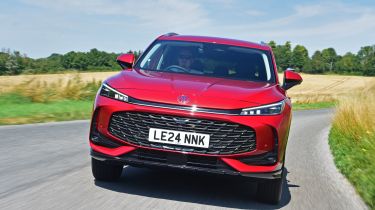
MG HS - front action

You might have heard of ‘Range Extender’ hybrids and wondered why they’re still not prevalent in Europe. In theory, they propose a near-compromise-free combination of EV-like electric range with a small ICE engine that can keep the batteries topped up – but, as MG’s boss of R&D has just explained, there’s a problem. 

Advertisement - Article continues below

Qiu Jie told Auto Express: “It’s very difficult to make range extenders Euro 7 compliant. A range extender won’t pass Euro 7 [emissions regulations], but a PHEV will.” If this initially seems confusing, it has to do with how range-extenders work – and a quirk of the Euro 7 testing procedure that uncovers a gap in this type of powertrain’s eco-credientials. 

Firstly, to be considered a ‘range extender’ hybrid, the car must work largely as an EV, with a correspondingly large battery pack. In certain Chinese-market models, this often sits between 40kWh and 80kWh. When the battery is depleted, it calls on a small petrol engine to generate power for the batteries in order to drive the wheels. There is no physical connection between wheels and petrol motor, but it’s at this operating phase that the issue arises. 

Qui Jie explained that with a low state of charge in the battery, a petrol engine has to work very hard to ensure that it’s producing more power than the electric motors are calling for. Although some owners won’t often find themselves in this situation, the assessment for Euro 7 regulations includes emissions testing for hybrids with a low state of charge, and it’s in this operating phase that it could be very hard to satisfy the Euro 7 rules. 

Many range-extenders have limited emission-control devices due to the cost of implementing a large battery pack, electric motors and a combustion engine plus all its ancillaries. 

Plug-in hybrids are different, because their combustion engines generally play a more active role in the car’s general running cycle, and therefore come with more emissions-related tech. Plus, with the engine being directly connected to the car’s wheels, PHEVs are also generally more efficient in their pure petrol modes, in effect acting as an overweight full-hybrid car.  

Don't miss out! See more of Auto Express in your Google Top Stories. Click here...

Skip advert
Advertisement
Senior staff writer

News editor at Auto Express, Jordan joined the team after six years at evo magazine where he specialised in news and reviews of cars at the high performance end of the car market. 

Skip advert
Advertisement

Recommended

New MGS9 2026 review: the largest MG ever is great value for money
MGS9 - front

New MGS9 2026 review: the largest MG ever is great value for money

The new seven-seat MGS9 will appeal to many family buyers thanks to its price and space, but it's far from perfect
Road tests
19 Mar 2026
New MG 4X revealed with semi-solid state batteries, but don’t get too excited about the range
MG 4X

New MG 4X revealed with semi-solid state batteries, but don’t get too excited about the range

Semi-solid-state batteries are coming to MGs and the 4X could be among the first to use them
News
11 Mar 2026
New MGS9 7-seat PHEV SUV arrives to take on the Skoda Kodiaq
MGS9 - front angled

New MGS9 7-seat PHEV SUV arrives to take on the Skoda Kodiaq

MG’s first seven-seat SUV offers a pure-electric range of up to 62 miles, and is available to order now
News
11 Mar 2026
Could your next car be designed by AI? Industry insiders reveal all…
AI Gemini designed DS

Could your next car be designed by AI? Industry insiders reveal all…

Artificial intelligence is already being used in the car industry, but what do designers think of it and where do they see the tech going?
Features
2 Mar 2026

Most Popular

Stansted Airport blames new £28 drop-off fee for drivers on ‘sustainability’
airport parking

Stansted Airport blames new £28 drop-off fee for drivers on ‘sustainability’

The price of a 15-minute drop off now costs £10, while a 30-minute stop incurs a £28 charge
News
20 Mar 2026
New speed cameras without flash or road markings arrive to catch more motorists
Speeding camera

New speed cameras without flash or road markings arrive to catch more motorists

The new type of radar-based speed cameras are currently being trialled in London
News
19 Mar 2026
10 coolest SUVs coming soon: new models aim to take the 4x4 market by storm
Coolest SUVs coming soon - March 2026 header image

10 coolest SUVs coming soon: new models aim to take the 4x4 market by storm

These are fresh SUVs we can’t wait to arrive, from Skoda’s butch baby electric SUV to McLaren’s loftiest creation ever
Best cars & vans
20 Mar 2026

Find a car with the experts