Which electric car’s batteries last longest? Global EV study uncovers the truth
EV batteries are lasting longer than you might have thought, but charging habits and capacity can have an impact on a battery’s State of Health

Which EVs are best able to stave off the issue of battery degradation? That’s what the world’s largest independent electric car battery study has revealed as tests of over half a million cars across the world shine a light on how frequent charging can take its toll on crucial (and expensive) components.
Austrian EV battery diagnostics firm, AVILOO, compiled data from more than 500,000 battery State of Health (SoH) tests conducted across North and South America, Asia, Australia and Europe, between 2022 and 2026. The data was drawn from 20 of the most popular EV models.
All batteries degrade over time, but these tests determine how much of a battery’s original capacity remains. If a battery is at 80 per cent SoH, it’s only capable of 80 per cent of its original maximum range.
EV batteries last longer than expected
Results showed that electric car batteries are lasting a lot longer than some sceptics may have envisioned. None of the 20 EV models tested showed a median drop in SoH of more than 10 per cent in the first 50,000km. The study did show significant variations in performance between the batteries in individual car models, but also similarly big variations in different examples of the same model.
“Yes, EV batteries are ageing better than the ‘they wear out fast’ myth suggests – but that's not the most useful thing this report tells you.” said AVILOO’s CEO, Marcus Berger. “What matters is that battery health varies significantly between models, and even more between individual cars of the same model.”
| Rank | EV | Lower Bound | Median SoH | Upper Bound |
| 1 | Hyundai Ioniq 5 | 91.67% | 97.13% | 99.15% |
| 2 | Mercedes EQA | 91.30% | 96.56% | 98.67% |
| 3 | Hyundai Kona | 90.71% | 96.27% | 99.12% |
| 4 | Audi Q8 e-tron | 90.04% | 95.71% | 98.16% |
| 5 | BMW i4 | 90.61% | 95.60% | 98.04% |
| 6 | Volkswagen ID.4 | 88.88% | 95.24% | 97.87% |
| 7 | Volvo XC40 Recharge | 90.06% | 95.15% | 98.22% |
| 8 | Skoda Enyaq | 89.19% | 95.14% | 97.84% |
| 9 | Ford Mustang Mach-E | 89.46% | 95.09% | 97.81% |
| 10 | Audi Q4 e-tron | 88.41% | 95.04% | 97.85% |
| 11 | Polestar 2 | 89.85% | 94.96% | 98.10% |
| 12 | Cupra Born | 89.59% | 94.76% | 98.57% |
| 13 | Volkswagen ID.3 | 89.29% | 94.57% | 97.69% |
| 14 | Tesla Model Y | 89.04% | 94.42% | 97.19% |
| 15 | Peugeot E-208 | 88.18% | 94.15% | 97.10% |
| 16 | Vauxhall Corsa Electric | 88.16% | 94.14% | 97.09% |
| 17 | MINI Cooper SE | 87.03% | 94.11% | 97.41% |
| 18 | Tesla Model 3 | 87.51% | 93.77% | 96.91% |
| 19 | Renault Zoe | 86.28% | 91.64% | 94.96% |
| 20 | Nissan Leaf (ZE1) | 85.41% | 91.23% | 95.39% |
Charging patterns crucial to battery health
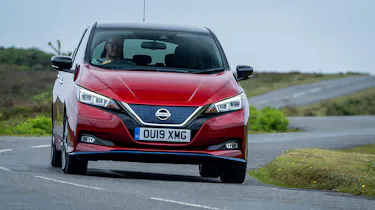
As a general rule, AVILOO found that cars with smaller battery packs tended to show the greatest levels of degradation; the Nissan Leaf (ZE1) and Renault Zoe, for example, both have comparatively small battery packs and showed the greatest level of degradation over 50,000km. The Leaf recorded an average SoH of 91.23 per cent and the Zoe managed 91.64 per cent. The reason for this is that smaller batteries will need charging more frequently, with the charging cycle causing wear that gradually reduces overall capacity.
At the other end of the scale, the Hyundai Ioniq 5, which can be specified with large batteries in excess of 80kWh, achieved the highest median SoH at 50,000km with 97.13 per cent.
There are some outliers to the big-battery rule; the Tesla Model Y, which has long been the UK and the world’s best-selling electric car, actually performed poorly in comparison to other large-battery EVs, alongside the smaller Model 3; the pair returned a median of 94.42 and 93.77 per cent respectively. Such a finding somewhat contradicts Tesla’s own studies in which it claims it would take 20 years and 200,000 miles for their cars’ batteries to lose 15 per cent capacity. The firm did admit to Auto Express, however, that drivers will see an “initial drop” in SoH over the first few thousand miles before the curve flattens off.
| Rank | EV | Lower Bound | Median SoH | Upper Bound |
| 1 | Hyundai Ioniq 5 | 89.10% | 95.27% | 98.42% |
| 2 | Mercedes EQA | 89.20% | 95.01% | 97.80% |
| 3 | BMW i4 | 88.79% | 94.34% | 97.33% |
| 4 | Hyundai Kona | 88.22% | 94.31% | 98.30% |
| 5 | Volvo XC40 Recharge | 87.88% | 93.66% | 97.08% |
| 6 | Ford Mustang Mach-E | 87.06% | 93.45% | 96.69% |
| 7 | Polestar 2 | 87.54% | 93.36% | 96.93% |
| 8 | Audi Q8 e-tron | 86.61% | 93.13% | 96.53% |
| 9 | Cupra Born | 87.02% | 92.95% | 96.96% |
| 10 | VW ID.3 | 86.86% | 92.83% | 96.33% |
| 11 | Skoda Enyaq | 86.19% | 92.67% | 96.12% |
| 12 | VW ID.4 | 85.88% | 92.54% | 96.07% |
| 13 | Audi Q4 e-tron | 85.55% | 92.35% | 96.04% |
| 14 | Peugeot E-208 | 84.40% | 91.98% | 95.89% |
| 15 | Vauxhall Corsa Electric | 84.38% | 91.96% | 95.86% |
| 16 | Tesla Model Y | 85.51% | 91.89% | 95.62% |
| 17 | Tesla Model 3 | 83.32% | 90.81% | 95.23% |
| 18 | MINI Cooper SE | 82.24% | 90.12% | 95.49% |
| 19 | Renault Zoe | 82.36% | 88.87% | 92.98% |
| 20 | Nissan Leaf (ZE1) | 80.91% | 88.27% | 93.82% |
Big variances in examples of the same model
On top of all this, it’s worth considering the sheer variation in battery condition within individual models themselves; the aforementioned Leaf, for example, saw the widest variation, with SoH readings ranging from 85.41 per cent to 95.31 at 50,000km and even more as the mileage increased.
The Volkswagen ID.4, another popular EV, saw between 11-14 per cent variation in SoH at higher mileages, something a spokesperson for VW said “is influenced by a wide range of factors including charging behaviour, usage patterns, climate and software status, so individual vehicle results will naturally vary."
Nevertheless, Berger highlighted how “A gap of ten or fifteen percent in state of health is a real difference in range, in what a car is worth, and in what you can rely on it for. You simply can't know where your car sits in that range without testing it”.
| Rank | EV | Lower Bound | Median SoH | Upper Bound |
| 1 | Mercedes EQA | 87.43% | 93.97% | 97.12% |
| 2 | Hyundai Ioniq 5 | 86.72% | 93.79% | 97.81% |
| 3 | BMW i4 | 87.48% | 93.62% | 96.90% |
| 4 | Hyundai Kona | 86.10% | 92.95% | 97.53% |
| 5 | Volvo XC40 Recharge | 86.32% | 92.79% | 96.44% |
| 6 | Ford Mustang Mach-E | 85.32% | 92.53% | 96.14% |
| 7 | Polestar 2 | 85.90% | 92.46% | 96.30% |
| 8 | Cupra Born | 84.92% | 91.87% | 95.87% |
| 9 | VW ID.3 | 84.96% | 91.82% | 95.69% |
| 10 | Audi Q8 e-tron | 83.68% | 91.27% | 95.87% |
| 11 | Skoda Enyaq | 83.69% | 91.04% | 95.22% |
| 12 | VW ID.4 | 83.40% | 90.75% | 94.91% |
| 13 | Peugeot E-208 | 81.47% | 90.72% | 95.37% |
| 14 | Vauxhall Corsa Electric | 81.46% | 90.70% | 96.33% |
| 15 | Audi Q4 e-tron | 83.23% | 90.62% | 94.87% |
| 16 | Tesla Model Y | 82.90% | 90.32% | 94.94% |
| 17 | Tesla Model 3 | 80.28% | 88.94% | 94.53% |
| 18 | Renault Zoe | 79.58% | 87.33% | 92.19% |
| 19 | MINI Cooper SE | 77.46% | 87.11% | 93.85% |
| 20 | Nissan Leaf (ZE1) | 77.82% | 86.67% | 93.09% |
Calls for better EV battery checks
The publication of AVILOO’s report follows a similar study published by UK-based diagnostics firm, Generational, which reported that the average SoH of an EV battery in the UK is 95 per cent – “far better than many consumers and industry stakeholders have been led to believe,” according to the firm’s CEO, Oliver Phillpott.
It also comes as industry campaigners call on the Government to make battery State of Health checks and certificates a requirement for used EVs given there is often no other way to determine a car’s SoH. While electric car batteries are typically covered under warranty when this figure drops below a certain percentage – typically 70-80 per cent – batteries account for a large proportion of a vehicle’s overall value, thus making this information crucial for consumers.
Ben Nelmes, chief executive of independent transport research firm, New AutoMotive, described battery health checks as “a practical, proportionate reform that would strengthen consumer confidence without requiring expensive subsidy schemes.”
Don't miss the best of Auto Express on Google! Make us a preferred source. Click here...