90 years of MG: mega road test
We celebrate MG’s special birthday in 2014 with a round-up of star cars old and new

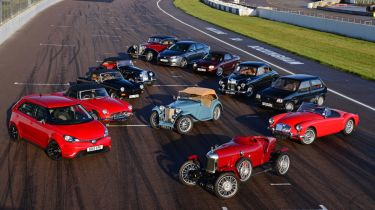
It's been a rollercoaster ride for MG, but 2014 marked 90 years since founder Cecil Kimber registered the company as a car manufacturer. And what better way to celebrate than to bring some classic MGs together with the brand’s current cars, and see how far it has come?
It all started when Kimber was working as a sales manager at Oxford-based car dealer Morris Garages in the twenties. He turned his hand to upgrading the regular Morris models on the forecourt, and these proved so popular, he branded them as MGs through his newly founded company. In the years that followed, the MG badge became synonymous with sporty and affordable roadsters and saloons.
It’s suffered a rocky path, though, with a takeover by Morris Motors in 1935, before being absorbed into the huge BMC conglomerate in 1952. MG suffered in the seventies under British Leyland, and was taken over countless times, until the doors closed on the factory in Longbridge, W Mids, in 2005. But MG is back, with a new owner aiming to turn it into a global brand.
Below we take a trip down memory lane with some famous MGs from years gone by, but don't forget that MG is currently selling two new models.
Used - available now

2021 Ford
Fiesta
15,126 milesManualPetrol1.0L
Cash £11,950
2021 Mercedes
GLE
57,166 milesAutomaticDiesel2.0L
Cash £31,399
2023 Hyundai
Tucson
20,714 milesManualPetrol1.6L
Cash £16,000
2018 Vauxhall
Astra
38,576 milesManualPetrol1.4L
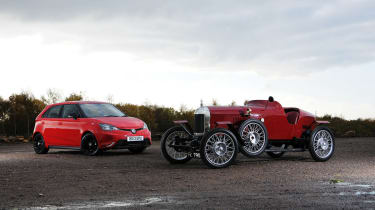
Cash £6,873Nine decades separate Old Number One from the second generation MG3, and while the 90th anniversary is the perfect opportunity to reflect on MG’s history, the company’s current owners are very much looking forwards.
But this progress doesn’t come at the expense of MG’s traditional values, according to chassis man Andy Kitson. “I always liked Cecil Kimber’s philosophy that an MG didn’t necessarily need to be fast, as long as it handled well,” he said. “That’s what we’ve aimed for.”
1925-1949: MG Old No. 1, MG TC Midget & MG SA
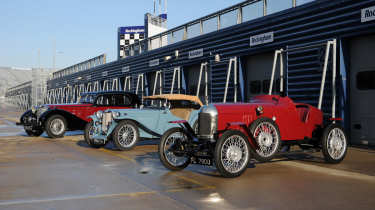
MG Old No.1 - 1925
- Number produced: One
- Price new/now: N/A/priceless
- Engine: 1.5-litre 4cyl, 25bhp
- 0-60mph: 20.0 secs
- Ttop speed: 80mph
In the hearts and minds of enthusiasts, Old Number One is the car that started the MG legend – but technically it’s not even an MG.
The cherry red two-seater bears a Morris Garages circular badge rather than the famous MG octagon, and it’s based on a bullnosed Morris Cowley. Even so, it was specially built by MG founder Cecil Kimber for the 1925 competition season, and debuted at the Lands End Trial in Cornwall. Old Number One won the gold medal for a faultless performance at this early equivalent of a special stage rally.
This was one of a number of modified vehicles developed by Kimber and his colleagues between 1924 and 1929. Not only did it lead to the establishment of MG as a separate entity, but the brand’s sporting success caught the general public’s attention and earned it a reputation for building small, affordable performance cars.
Old Number One and other early MGs featured a low chassis and sporty bodywork, including the boat tail design that was popular in the twenties and thirties. And even today, the muscular stance, stripped-down panelling and elongated body look aggressive.
You use a hand crank at the base of the grille to start the light and punchy 1.5-litre four-cylinder petrol engine. Once fired into life, it chugs away noisily, and only delivers 25bhp – similar to a modern 250cc motorcycle. Performance is sluggish by today’s standards, with 0-60mph taking 20 seconds and a top speed of around 80mph. But remember, Old Number One doesn’t have any seatbelts, and relies on skinny tyres and weak drum brakes.
And besides, this two-seater doesn’t need strong pace – as the car that started the MG story, its legendary status is assured.
MG TC Midget - 1945-49
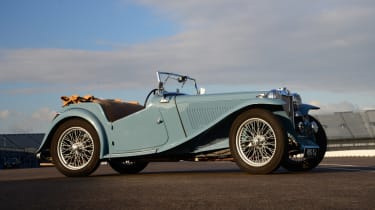
- Number produced: 10,001
- Price new/now: £412/£32,000
- Engine: 1.25-litre 4cyl, 54bhp
- 0-60mph: 27.3 secs
- Top speed: 78mph
In the thirties, MG clocked up multiple motorsport victories, and its small, high-performance sports cars, nicknamed Midgets, became well known on British race tracks and roads. The TC in our pictures typifies MG’s pre-war roadster design, and stands out among other T-types as the first model to catch the attention of the US market, kick-starting the brand’s post-war transatlantic success story.
Yet World War II forced MG’s Abingdon factory in Oxon to halt production. So when the two-seater cabriolet finally went on sale in 1945, it was built on the same base as 1936’s TA, and had the four-cylinder 1.25-litre engine that had been developed for the TB in 1939.
Rear-hinged doors make climbing into the extremely cramped cabin tricky. The oversized wooden steering wheel doesn’t help, and the tricky fly-off handbrake means this isn’t the easiest car to drive. Still, the TC’s purring 54bhp short-stroke engine delivers a decent turn of speed, despite MG’s claimed 27.3-second 0-60mph time.
The TC’s appeal was always more about fun than performance, though – and probably explains why it found a ready market despite being so obviously dated at launch. In the car’s four-year production run, 10,000 were built, with many bought by GIs returning to the US. These exports started America’s love affair with MG, and laid the foundation for the brand’s fifties and sixties heyday.
MG SA - 1935-39
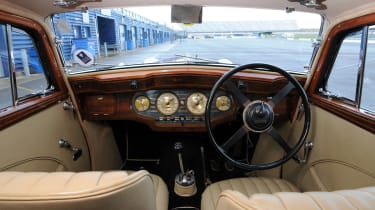
- Number produced: 2,738
- Price new/now: £415/£60,000-plus
- Engine: 2.3-litre 6cyl, 75bhp
- 0-60mph: 14.3 secs
- Top speed: 85mph
MG is renowned for its roadsters, but before World War II it also built a number of luxury saloons, such as the imposing four-door SA.
This was the first MG to launch after 1935’s merger with Morris Motors, and its large proportions were a radical departure. The new management disbanded the factory racing team and relegated sports cars to a secondary role, eyeing a new band of wealthy buyers instead.
The SA was based on a Wolseley Super Six, but used a modified chassis and engine. And Cecil Kimber’s rather unaerodynamic design still has plenty of presence. At the end of a long bonnet is a trademark flat MG radiator, flanked by oversized chrome headlamps. Plus, large circular wings around the wheelarches flow into the running boards.
Inside, walnut trim covers the dash and window surrounds, while details include neat condensation grooves under the windows and a polished aluminum security catch to stop the driver selecting reverse accidentally. A fold-down cover on the throttle lets owners drive in different footwear, while small octagon badges feature throughout.
Yet the SA feels cramped inside, particularly in the back, despite its vast size. And with a 1,500kg-plus kerbweight and just 75bhp on tap, it struggles to live up to MG’s sporty reputation: performance is leisurely. But the sense of occasion is priceless and, for a short time, it proved MG could match the world’s best luxury car makers.
1953-1958: MG TF and MG ZB Magnette
MG TF - 1953-55
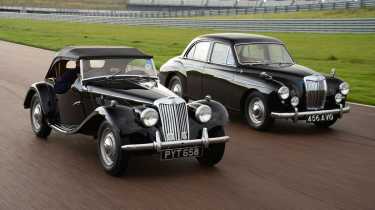
- Number produced: 9,600
- Price new/now: £780/£18,000
- Engine: 1.5-litre 4cyl, 63bhp
- 0-60mph: 16.3 secs
- Top speed: 88mph
Today, the TF is one of the most desirable MGs among collectors, as it combines pre-war ‘square rig’ styling with post-war comfort and reliability. However, it was only ever developed to fill a gap in production ahead of the arrival of the T-Series’ replacement, the MGA. Even so, 9,600 TFs were sold during its two-year life – most found homes in the US, where it enjoyed unprecedented success.
In 1952, MG was absorbed into the British Motor Corporation as part of the Morris and Austin merger. Leonard Lord took charge, and he favoured the new Austin Healey 100 sports car over the MGA, which he saw as too similar. But as sales of the ageing TD dwindled, Lord swiftly approved production of the facelift model, the TF.
The car was launched at the 1953 London Motor Show, and was derided by the motoring press for its dated looks, which didn’t compare well with more streamlined newcomers like the Triumph TR2 and Healey 100. Plus, the TF’s 1,250cc engine was identical to the TD’s, and it only had the same 75mph top speed as 1939’s TA.
The TF is marked out from other T-Series cars by a reclined grille that hides a separate radiator. Its front wings are also different, to accommodate faired in headlamps instead of the traditional bolt-on fixings, which in turn blend into the sides of the bonnet.
After sitting in the MG TC, the TF’s adjustable bucket seats are much more comfortable. The cockpit layout is quite different, too, with parts taken from Y-Series saloons and T-Series roadsters, plus unique octagonal dials mounted in a central position on the dash.
The roadster is much more responsive than its predecessors, holds the road well and feels lighter to steer – although it’s still not exactly fast. This is why, in 1955, MG released the TF 1500, with over 10 per cent more power, at 63bhp, and an 88mph top speed.
MG ZB Magnette - 1953-58
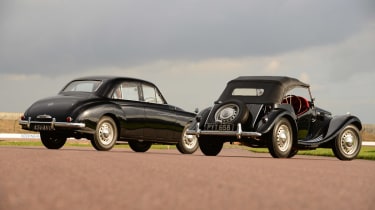
- Number produced: 36,600
- Price new/now: £713/£14,000
- Engine: 1.5-litre 4cyl, 68bhp
- 0-60: 18.5 secs
- Top speed: 86mph
The Z series Magnette represented the new face of MG when its first incarnation, the ZA, debuted alongside the TF at 1953’s London Motor Show. Compared to the traditional roadster, this four-door sports saloon cut a modern figure with its streamlined body and monocoque construction – it was the first car made at Abingdon to use this method, and it would later spread to the rest of the range.
Although the ZA was indeed an all-new model for MG, it was also part of BMC’s policy in the fifties of ‘badge engineering’ under the direction of Leonard Lord. This saw BMC produce basic shells, which were then adapted with different lights, grilles and trim to fit the Morris, Wolseley, Riley, Austin and MG marques.
The ZA was designed by Gerald Palmer, and shared its DNA with the Wolseley 4/44. But the MG was much sportier, featuring the new ‘B’ series engine. This 1,489cc twin-carburettor unit was based on the 1,200cc Austin A40 engine, and produced 60bhp.
In 1956 things were taken a step further, and the ZA was replaced by the ZB Magnette, which used bigger carbs and a modified manifold to deliver 68bhp. The extra power translated to 0-60mph in 18.5 seconds and a top speed of 86mph. This second incarnation of the Magnette was a hit, outselling the ZA by nearly two to one – in total, more than 36,000 were produced, making the Z-series the most popular MG at the time.
By modern standards, the ZB feels rather sluggish when getting up to speed, but this is cancelled out by the comfortable ride, excellent handling and relatively quiet cabin. And as the complete bodyshell carries mountings for the engine, gearbox and suspension, the ZB is relatively light, yet strong and rigid.
This method of construction dramatically reduced costs and made the car very affordable. As a result of this, plus the large production numbers, the Z-series Magnette remains a relatively cheap classic car purchase today – £14,000 buys a tidy runner.
1955-1980: MGB and MGA
MGA - 1955-62
- Number produced: 101,081
- Price new/now: £940/£25,000
- Engine: 1.6-litre 4cyl, 80bhp
- 0-60mph: 13.3 secs
- Top speed: 98mph
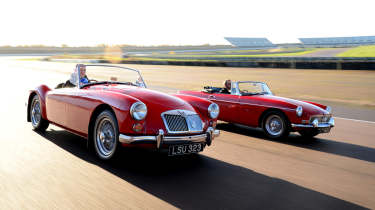
Replacing the successful TF was never going to be easy, but MG delivered in style when it revealed the stunning MGA at the 1955 Frankfurt Motor Show. Featuring an all-new chassis, a sleek, modern design and roadster and coupé bodystyles, it was an instant hit, with 13,000 finding homes in the first year. And by the time production ended seven years later, over 100,000 had been sold – most in exports.
Under the rakish body was the same 68bhp 1.5-litre B Series engine that had debuted in the Magnette saloon. Buyers wanting more pace had to wait for the 1958 Twin Cam model – built with motorsport in mind, this had a 108bhp 1.6-litre engine and four-wheel disc brakes.
The beautifully restored car in our pictures is a 1600, which replaced the 1500 as the entry-level model in 1959. Using an enlarged 80bhp 1.6-litre engine, it promised better acceleration and could hit 100mph.
Even now, more than half a century after its launch, the MGA is thrilling to drive. It’s hard not to smile as you settle into the low-slung seat, while the huge, wood-rimmed steering wheel feels great.
Press the starter button, and the four-cylinder engine rasps into life. The unassisted steering is heavy at low speeds, but becomes surprisingly light and direct once you’re moving. And while most modern city cars are faster in a straight line and through corners, the MGA’s responsive throttle, beautifully weighted gearshift and balanced handling help you make the most of the limited performance. Yet it’s the gorgeous looks and sales success that secure the car’s place in our top 10.
MGB 1962-80 (RV8 1992-95)
- Number built: 513,276
- Price new/now: £690-£1,925/From £4,500
- Engines: 1.8-litre 4cyl (1962 Roadster); 3.5 V8 (1973 MGB GT V8)
- Power: 94bhp; 135bhp
- 0-60mph: 12.1; 7.7 secs
- Top speed: 108; 125mph
The MGB is undoubtedly the most famous MG ever. Plus, it’s the most popular, as more than 500,000 were built during the 18-year production run. Even today, it remains a familiar sight on British roads, as many have survived in the hands of classic car enthusiasts.
It replaced the MGA in 1962, and proved an instant hit with its clean lines, 100mph performance and sporty handling. Although it’s shorter than the MGA, the MGB has a roomier cockpit, with the clever design allowing for larger and more comfortable seats. The driving position is low and close to the road, with long footwells.
The soft-top is a bit fiddly, but it folds into an area behind the seats and can be covered by a tonneau. Power comes from the engine found in the MGA, albeit bored out to 1.8 litres. This sends 94bhp to the rear wheels via a four-speed synchromesh gearbox, and takes the B from 0-60mph in 12.1 seconds.
The light and rigid monocoque construction means a thrilling driving experience, with a responsive throttle and accurate handling. Many thought this experience would suffer when the MGB GT coupé arrived in 1965, but despite being heavier, this more aerodynamic car was faster – and it even outsold the roadster in the UK.
To add to the appeal, MG introduced a 135bhp MGB GT V8 coupe. This car’s 3.5-litre engine weighed the same as the smaller 1.8, and delivered searing pace. But aside from the addition of pedestrian-friendly rubber bumpers in 1974, the MGB barely changed during its 18-year production run. And while the Abingdon factory closed in 1980, the MGB wasn’t dead yet. It returned in 1992 as the RV8 – a car designed to cash in on the roadster craze sparked by Mazda’s MX-5.
1961-2002: MG TF, MG Metro Turbo and MG Midget
MG Midget 1961-79
- Number produced: 224,843
- Price new/now: £1,560/£2,000
- Engine: 1.5-litre 4cyl, 65bhp
- 0-60mph: 12.3 secs
- Top speed: 101mph
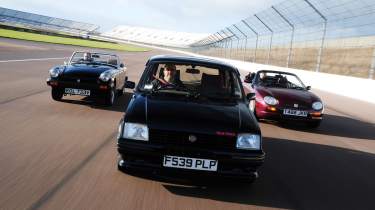
Despite its dinky dimensions, the MG Midget was a sales smash. Designed as an affordable entry-level model, the tiny two-seater combined eager performance, agile handling and wind-in-the-hair thrills with a low price and penny-pinching running costs.
The original launched in 1961, and was essentially a rebadged version of the Austin Healey Sprite. That meant a tiny 948cc four-cylinder engine, with 45bhp, a simple rear-wheel-drive layout and no-frills cabin – even a heater was an extra cost option.
A year after the launch, MG enlarged the engine to 1.1 litres and added disc brakes, while in 1966 the Midget got a detuned 65bhp version of the 1.3-litre A-Series engine from the Mini Cooper S.
The car then carried on virtually unchanged until 1974, when tough crash test regulations forced the company to carry out a major facelift. Engineers had to raise the low-slung ride height, while the dainty chrome bumpers were replaced by chunky black plastic items. Plus, under the bonnet, a new 1.5-litre engine was grafted in from the Triumph Spitfire.
This breathless engine was designed to meet strict US anti-pollution legislation. It was no more powerful than the old A-Series, but had more torque, and when combined with the 805kg kerbweight, it meant the car was nearly as fast as the bigger and more expensive MGB.
Climb behind the wheel and you’ll find there’s a surprising amount of space. The Midget is also good to drive, with decent feedback from the steering and a precise gearshift. And although outright performance is modest, the compact dimensions mean it’s easy to keep your speed up in this car, especially on tight and twisty roads. In fact, after a few miles you can see why nearly 250,000 Midgets rolled out of the factory before production ended in 1979.
MG Metro 1982-90
- Number produced: 142,165
- Price new/now: £4,799/£2,500
- Engine: 1.3-litre 4cyl, 72bhp (in 1300; Turbo had 93bhp)
- 0-60mph: 9.9 secs
- Top speed: 112mph (Turbo)
With the demise of the MGB and Midget at the end of the seventies and the closure of MG’s Abingdon plant in 1980, the brand needed reviving. The rise of the hot hatch gave Austin Rover the perfect excuse to indulge in badge engineering for its Metro, Maestro and Montego.
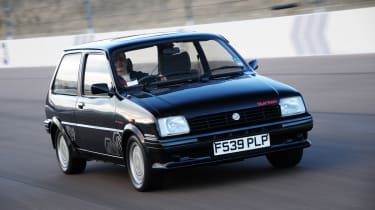
The first model to arrive was the MG Metro 1300. It used a tuned 1,275cc A-Series engine from the original Mini, and while it wasn’t the fastest hot hatch around, it stood out with racy stripes and alloys, plus it had servo-assisted four-piston front brakes as standard.
Six months after the 1300 was launched, the Metro Turbo arrived. It added a Garrett turbocharger, while Lotus worked its magic to produce a heady 93bhp – pretty good for an engine that could trace its roots all the way back to 1951!
Unfortunately, the four-speed box was just as ancient, and couldn’t handle all this power, so a special air intake tweak regulated turbo boost. Keep below 3,000rpm, and there’s light turbo pressure, with full boost only coming in above 4,000rpm, although by today’s standards the only sensation you get of acceleration is a whoosh from the turbo.
Gearbox failures were still common, while the Metro was plagued by rust. Plus, Mini owners cannibalised the turbo engine for their own cars – so the Metro Turbo is now far rarer than the sports cars that preceded it, with only around 20 still registered in the UK.
MGF 1995-2002
- Number produced: 77,269
- Price new/now: £17,540/£2,000
- Engines: 1.6-litre 4cyl, 111bhp; 1.8-litre 4cyl, 158bhp
- 0-60mph: 9.7 secs; 6.9 secs
- Top speed: 115mph; 137mph
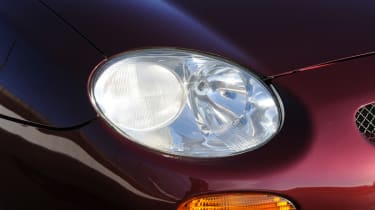
By the early nineties, Austin had become Rover, and bosses had ditched MG performance versions of the company’s hatchbacks to concentrate on developing the new models they hoped would revive its fortunes. But they’d seen the popularity of the Mazda MX-5 roadster – itself inspired by the MGB – and decided that a new MG-badged two-seater sports car was needed.
The MGB-based RV8 had been an interim solution while this all-new model was readied. And when the wraps came off the MGF late in 1995, it caused a major stir: not only was it the first all-new MG since the MGB, but it was also the first car from the brand to have a mid-engined, rear-wheel-drive layout.
Rounded styling meant it was impossible to mistake the MGF for anything other than an MG, while Rover’s revolutionary K Series engine gave the car enough power to compete with the MX-5. That mid-engined layout delivered entertaining handling, too, although the Hydragas suspension – derived from the set-up in the Metro – was ditched when the first facelift came around.
The MGF, and the TF that followed, continued in production throughout MG Rover’s turbulent life, until the company’s demise in 2005. Then, in 2008, the TF returned as the first UK model from Chinese-owned MG Motors. By then, the car was a generation behind its rivals, but it was the start of a new era for MG in the UK.
2009-2023: MG 3 and MG 6
MG6 2009-2015
- Engines: 1.9-litre 4cyl diesel, 148bhp; 1.8-litre 4cyl petrol, 158bhp
- Transmission: Six-speed manual, front-wheel drive
- 0-60mph: 8.9 secs (diesel), 8.4 secs (petrol)
- Top speed: 120mph
- Price range: £15,455-£20,195
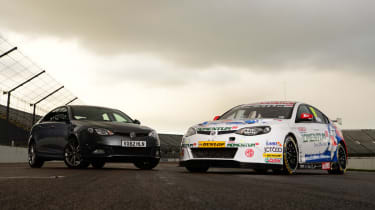
Introducing an all-new car to market is tough enough, but MG plunged head-first into the cut-throat hatchback class when it launched the MG6. In reality, the model falls somewhere between Ford’s Focus and Mondeo in terms of size, and it cuts a dash on the road with its blend of curves and sharp angles.
Buyers get a choice of two engines: a 1.8-litre petrol or a 1.9-litre diesel. The chassis has been developed on British roads by UK engineers, and it delivers entertaining handling. The sub-£20k MG6 also represents great value, with the top-spec TSE getting dual-zone climate control, Bluetooth, sat-nav and heated leather seats.
MG3 2011-2023
- Engine: 1.5-litre 4cyl, 105bhp
- Transmission: Five-speed manual, front-wheel drive
- 0-60mph: 10.4 secs
- Top speed: 108mph
- Price range: £8,399-£9,999
The MG3 supermini launched in 2011, and offered MINI-style personalisation on a budget. The range tops out at just under £10,000, and the flagship 3Style features luxuries such as cruise control and reversing sensors, plus auto lights and wipers.
Most cars get a DAB digital radio, iPod connection, LED running lights and a leather steering wheel, while owners can upgrade their cars with great-value graphics and coloured wing mirror housings.
Under the bonnet there’s only one option: a 1.5-litre petrol. While it isn’t the cleanest or most efficient engine around, keep it revving and it complements the MG3’s sharp handling well.
MG in motorsport
If it wasn’t for motorsport, MG would not exist. While the brand’s earliest cars were simply rebodied Morris Cowleys, Old Number One was created by founder Cecil Kimber to compete in time trials – and its performance in the Lands End Trial established MG as a sporting brand.
From there, MG sold dedicated open-wheel racing cars based on the Midget, and had considerable success. One example took the Brooklands outer circuit record at 122mph.
As part of 1935’s Morris merger, all racing activities were halted, and the MG Competition Department was closed. Yet MG continued to set speed records with its EX streamliners, including a remarkable 246mph run at Bonneville Salt Flats in Utah with race legend Stirling Moss at the wheel.
The company also entered a trio of MGAs in the ill-fated 1955 Le Mans 24 Hours, with a best placing of 12th. And the MGB proved itself in rallying and endurance racing in the sixties.
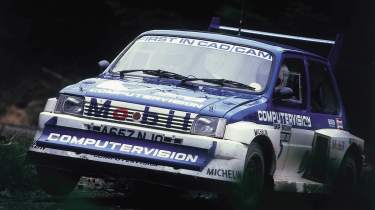
In the eighties, MG returned to the global stage by entering its Metro 6R4 in the World Rally Championship. The mid-engined, four-wheel-drive car bore little relation to the roadgoing Metro, and was developed with the Williams Formula One team. It was outclassed in Group B, but after the class was outlawed it became an effective rallycross car, with Will Gollop taking 1992’s European title.
Even in hard times, MG was still going racing. It entered Le Mans and the British Touring Car Championship at the turn of the millennium, with limited success. And then, the launch of the MG6 (below) saw the factory return to the BTCC, with Triple Eight Engineering and driver Jason Plato.
There have been wins and title challenges, and we can expect more in 2014 as the team expands to three cars – with Plato and 2013 team-mate Sam Tordoff joined by ex-F3 champ Marc Hynes. Right now, the BTCC is the perfect platform for MG.
“It fits with our current strategy,” said marketing boss Guy Jones. “It ties in with our sporting roots and is perfect to promote the MG6 to our target audience. At the moment, it makes more sense for us to compete at a regional and club level before we move to a world series.”