SEAT Leon Cupra R vs Renaultsport Megane 250 Cup vs Mazda 3 MPS: 2010 group test
First there was Rafael Nadal at Wimbledon. Then the World Cup. Now can Spain top off its success in the hot hatch class with SEAT’s new Leon Cupra R? We test it against Renault and Mazda rivals.

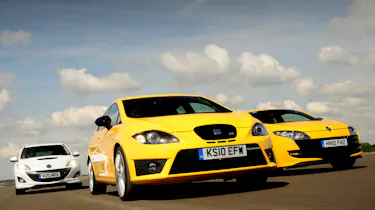
The hot hatch is well and truly back! For the past decade, these high-performance machines have been steadily regaining their reputation, after thousands of high-profile thefts and sky-rocketing insurance premiums threatened to run them off the road for good.
Now these fast, fun and practical cars are more popular than ever, with nearly every manufacturer having some sort of rapid hatchback on its books. And no firm is keener on the pocket rocket than SEAT.
The Spanish brand’s brochures are littered with go-faster models, with FR and Cupra versions of its Ibiza and Leon hatches. And to celebrate SEAT’s success in the World Touring Car Championship, bosses have pulled the wraps off the most powerful and focused model ever – the £25,205 Leon Cupra R.
We’ve lined up a pair of formidable opponents for the new Leon. The Renaultsport Mégane 250 Cup is a firm Auto Express favourite, and sets the standard for performance and driving thrills. It’s also great to look at and comes with an attractive £23,160 price tag.
If it’s value-for-money you’re after, look no further than the Mazda 3 MPS. With a storming 256bhp engine, practical five-door layout and uprated chassis, it could have been used as a template for the SEAT. However, it costs only £22,595 and is loaded with standard kit.
So, which one of our trio has the firepower to blast to the top spot?
Verdict
Each of our contenders proves that family matters needn’t get in the way of driving thrills. If you’re looking for a car which combines strong performance and practicality, all three of these models fit the bill.
The MPS uses the versatile 3 hatchback as a template, so it’s practical, as well as fast and very well equipped. Adding to the appeal is the £22,595 price tag. But it finishes in third place here on account of its unruly chassis and lack of visual drama.
Limited kerbside appeal isn’t an issue for the distinctive Leon. Better still, it has electrifying pace, as well as an agile and engaging chassis. The Cupra R is expensive, though, at £25,205 – and we think this is difficult to ignore when the standard Cupra is just as good to drive, nearly as quick and costs £3,705 less!
That leaves the Renaultsport Mégane to take a well deserved victory. It can’t match its rivals in this test for practicality or kit, but its rakish looks, gutsy engine and sensational driving dynamics more than compensate. In fact, for us, the 250 Cup is one of the most entertaining new cars around, regardless of price.
First place: Renaultsport Megane 250 Cup
Few mainstream firms can match Renault for hot hatch heritage. Ever since bosses bolted a turbocharger to the 5 Gordini supermini in the late Seventies, the French company has enjoyed a strong reputation for bringing high-performance thrills to the masses.
The latest offering is the Renaultsport Mégane 250. It was unveiled last year and has already made an impact, chalking up victories against the SEAT Leon Cupra and the Ford Focus RS and VW Scirocco R. However, this is set to be the car’s toughest test yet.
Not only is the Mégane’s 247bhp turbocharged 2.0-litre engine the least powerful here, it’s also the only model with a family-unfriendly three-door body. This less practical layout does give the Renault the most eye-catching looks, though. With a coupé-like profile and aggressive bodykit, the Mégane never fails to turn heads.
Our Cup variant is given an extra dose of style with its black alloys, while the distinctive LED daytime running lights in the front bumper are a £200 option. Swing open one of the long front doors, and you’re greeted by a cabin littered with sporty cues.
Used - available now

2019 Peugeot
2008
38,370 milesManualPetrol1.2L
Cash £7,499
2024 Vauxhall
Mokka
22,726 milesManualPetrol1.2L
Cash £13,260
2019 Vauxhall
Astra
43,464 milesAutomaticPetrol1.4L
Cash £9,392
2019 Toyota
Corolla Touring Sports
70,712 milesManualPetrol1.2L
Cash £11,999There’s yellow stitching on the steering wheel, gearlever and handbrake, while the pedals are finished in aluminium. The figure-hugging Recaro seats in our test car provide excellent support, but cost an extra £950.
You’ll also have to dip into your pocket for dual-zone climate control, tyre pressure monitoring and an aux-in music connection – these are all included on both rivals. At least strong build quality and decent materials are standard.
The three-door Mégane trails the Mazda and SEAT for practicality. But while access to the rear is tricky, there’s decent head and legroom once you’re in. Opening the tailgate reveals a 344-litre boot – the largest here – but the high lip makes it difficult to load heavy items.
Despite having the lowest power output, the Renault put on a strong show at the test track, where it blasted from 0-60mph in 6.8 seconds – two-tenths of a second faster than the Cupra R.
In reality, the 250 Cup feels even quicker than that figure suggests, and the engine pulls strongly from low revs all the way to the red line. Adding to the drama is a racy soundtrack and quick-shifting six-speed manual transmission.
But it’s the Mégane’s agility that really stands out. The Cup version adds stiffer springs and dampers, a limited-slip differential and uprated Brembo brakes. As a result, it slices through corners with superb precision and poise. And while the ride is extremely firm, it never crashes over bumps and remains reasonably comfortable over longer distances.
The question is whether the Mégane’s engaging dynamics are enough to offset its lack of versatility and poorer kit count.
Second place: SEAT Leon Cupra R
Scorching hot hatches have become something of a SEAT speciality. With its quick FR and faster Cupra models, the Spanish firm has won a legion of fans looking for driving thrills, arresting styling and great value.
Now the brand is aiming to take on the heavyweights with its fastest-ever model: the Leon Cupra R. Based on the standard Cupra, the new addition gets a storming 261bhp turbocharged 2.0-litre engine, an uprated chassis and 155mph top speed.
It certainly has the right ingredients to take on the class leaders, and there’s no denying that the Leon looks the part. The normal Cupra isn’t short of visual aggression, but the firm’s designers have given the R even greater impact. There’s a large tailgate spoiler, 19-inch alloys and a touring car-style splitter below the rear bumper that houses the twin tailpipes.
Climb aboard, and you’ll discover there’s been less effort to distinguish the R from the standard Cupra. Eagle-eyed buyers will notice a discreet R logo on the speedometer, while the diamond-stitched leather seat trim is standard.
There’s also a rather cheap looking shiny black plastic finish for the backs of the chunky sports seats. On the plus side, the Cupra’s thick-rimmed three-spoke wheel is great to hold, while the low-slung driving position is very comfortable.
As with all Leons, the dashboard is attractively styled and well laid out. But while the cabin is solidly screwed together, some of the plastics look and feel low-rent. At least there’s plenty of kit, with climate control, an iPod connection and parking sensors all included. The latter are vital, as the Leon’s high window line and small rear screen can make parking a little tricky.
Family motorists will find there’s no shortage of space inside, while the five-door layout delivers added versatility. There’s room for three adults on the rear bench – although the large front seats will obscure their view forwards – and the cabin is littered with useful cubbies and compartments. Open the tailgate, and there’s a 341-litre carrying capacity, which is 41 litres bigger than the Mazda’s boot.
All thoughts of practicality will vanish the instant you fire up the 2.0-litre engine. The 261bhp unit delivers incredible power, which ensured a strong display at the test track. While the Leon trailed the Renault by two-tenths in the sprint from 0-60mph, with a time of 7.0 seconds, it stamped its authority on our in-gear tests. It needed only 7.2 seconds to go from 50-70mph – nearly a second faster than the Mazda.
In the real world, few cars can match the Cupra R’s overtaking pace, and this impression is heightened by the rasping engine note and slick action of the six-speed gearbox.
As you’d expect with such a high-performance machine, the SEAT’s brakes are eye-poppingly effective. Hit the middle pedal at 60mph, and the Cupra R will come to a stop in 34.7 metres – eclipsing the lighter Renault by 0.7 metres.
There are few complaints about the Cupra’s ability over twisting back roads, either. Lowered and stiffened suspension virtually eliminates body roll and delivers bags of grip, while the steering is well weighted and precise.
Better still, the XDS electronic differential tames torque steer effectively, so you don’t get the same distracting kickback through the wheel that the Mazda suffers from. And while the Leon trails the Renault for razor-sharp responses, it’s still incredibly agile and great fun.
There is one stumbling block for the SEAT, though: its price. At £25,205, it’s the most expensive car of our trio. And it gets worse, because the regular Leon Cupra is very nearly as fast, drives as well and costs £3,705 less!
So, does the newcomer do enough to justify its price premium and snatch victory?
Third place: Mazda 3 MPS
Renault isn’t the only brand with a strong tradition for creating popular driver’s cars. Mazda has scored over the years with its legendary MX-5 roadster and quirky RX-8 coupé, while even the entry-level 2 supermini serves up addictive fun from behind the wheel.
So, the thought of a Mazda-badged hot hatch should have keen drivers licking their lips in anticipation. The original 3 MPS debuted in 2006, and had huge performance potential. But it was let down by uninspiring looks, while its powerful engine overwhelmed the chassis.
When bosses pulled the wraps off the second-generation MPS last year, they claimed all these faults had been fixed. The newcomer has a strong recipe for success, with a punchy 256bhp 2.3-litre engine and similar underpinnings to the sharp-handling Ford Focus.
In the flesh, the Mazda is less convincing. While it shares the attractive lines of the standard 3, it can’t match the other cars for immediate visual impact. Apart from the gaping air scoop in the bonnet, a large rear spoiler and 18-inch alloys, the MPS could easily be mistaken for lesser models in the line-up.
It’s a similar story inside, where any sporting cues are so subtle that they are almost invisible. Look closely, and you’ll see low-key red stitching on the steering wheel, gearlever gaiter and half-leather seats, while there’s also a small LCD turbo boost gauge between the speedo and rev counter.
Elsewhere, the cabin is near-identical to the standard model’s, which means excellent fit and finish, together with a neatly styled and well organised dash. Better still, the MPS has kit to rival a luxury car. Standard spec includes sat-nav, xenon lights, heated seats and a blind spot monitor.
The five-door layout and spacious cabin aid practicality, although the shallow 300-litre boot is the smallest here. Floor the throttle and you’re left in no doubt about the 3’s hot hatch credentials. The 2.3-litre isn’t as vocal as rivals’ units, but it delivers an addictive rush of acceleration as the revs rise – so the car nearly matches the Mégane for mid-range pace.
Sadly, the MPS’s blistering straight-line speed comes at a price. On anything other than smooth tarmac, it suffers from unruly torque steer, causing the wheel to kick and shake in your hands. This makes it hard to place the car accurately on bumpy back roads, discouraging you from making the most of the otherwise balanced and grippy chassis.
It does have a joker card to play, in the shape of a tempting £22,595 price – a healthy £2,610 cheaper than the SEAT. Factor in its impressive standard kit list, and the MPS begins to look like a high-performance bargain.