Citroen Traction Avant
Front-wheel-drive model pioneered the family car as we know it.

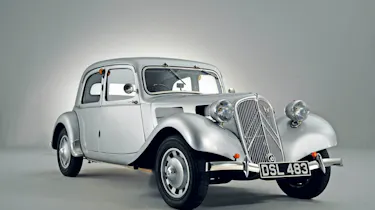
This is one of the most influential cars ever built. By mixing technical innovation with modern dynamics, Citroen’s remarkable Traction Avant set the template for today’s family models.
When it was launched in 1934, it was packed with pioneering technology, from its lightweight all-steel monocoque chassis to its front-wheel-drive layout and independent torsion-bar suspension. Engineers continued to improve it, fitting rack-and-pinion steering, hydraulic brakes and radial ply tyres.
Yet the Traction Avant nearly didn’t happen. Its huge development costs had plunged Citroen deep into the red, leaving a question mark over the firm’s very existence, before Michelin stepped in to complete a buy-out in 1935.
The model’s hi-tech mechanicals were the brainchild of talented engineer André Lefebvre – who went on to design the 2CV and DS – while the gorgeous exterior was the work of Italian stylist Flaminio Bertoni. Early cars had a 1.3-litre four-cylinder petrol engine, which was underpowered. Stronger 1.5, 1.6 and 1.9-litre units became available and, in 1947, a 2.9-litre six-cylinder was introduced. All were mated to a standard three-speed manual gearbox. There was a
bodystyle for every occasion: as well as the immaculate 1949 Légère (‘Light’) in our pictures, Citroen introduced a larger Normale model, a rakish coupé and even a stylish drop-top roadster. Six and nine-seater variants were also made, while the Commerciale was one of the first-ever hatchbacks.
Our favourite is the standard four-door pictured here. With those perfectly proportioned lines and distinctive Michelin Pilote wheels, the design doesn’t look 75 years old. Open one of the rear-hinged front doors and you’re confronted by a spartan but spacious interior. The driver faces a thin-rimmed, three-spoke steering wheel, and the gearlever sprouts from the plain painted metal dashboard.
Yet while the cabin is basic, the driving experience is anything but. On the move, the Traction Avant feels more sophisticated than some cars half as old. At low speed, the steering is heavy but remarkably precise. Supple suspension enables the Citroen to slice through corners with incredible poise and stability – only the poor straight-line pace betrays the car’s age.
When the final model rolled off the production line in 1957 – more than 23 years after the wraps were taken off the first example – rivals were still trying to catch up. Many of the Traction Avant’s innovations are now common across the industry, which is why it ranks not only as one of the finest Citroens ever made, but one of the greatest cars of all-time.