“Sales of electric cars have increased – but at a painfully slow rate”
Mike Rutherford thinks much more needs to be done before the UK bans the sale of new petrol and diesel cars in January 2030

As we say goodbye and good riddance to the early-2020s, which were riddled with everything from deadly Covid and rampant inflation to shattered disposable incomes, there’s no doubt that sales of 100-per-cent-electric cars from UK showrooms have increased – but at a painfully slow rate.
From January to April last year, they had a mere 14.4-per cent share of the new car market. Then, in the same period of 2023, the figure crept up to 15.4 per cent.

But such a meagre increase raises doubts, worries and scepticism among manufacturers, consumers and others that the UK Government’s ban on new petrol and diesel cars simply can’t be met by January 2030. Honestly, is the EV market really ready, happy, willing and able to grab just 15.4 per cent of the pie today, but 100 per cent of it in less than seven years?
I think not – and I say that based on discussions I’ve had with concerned industry execs and real-world consumers who pay for private cars out of their own wages and are therefore mostly excluded from going down the far more expensive EV route.
The Society of Motor Manufacturers and Traders (SMMT) has in recent days admitted that it is now “less optimistic about growth in demand” for pure EVs. The trade body is therefore “downgrading the expected market share” of such vehicles for 2023 and again for 2024 – when only about two in every 10 new cars purchased are forecast to be EVs (the remaining eight in 10 being pure petrol, pure diesel or hybrids). All this despite the industry’s current obvious and ongoing trend of putting more pure-electric and fewer diesel and petrol models into the showrooms, whether consumers like it or not.
Clearly, the business model for EVs isn’t working as well as it should. So to encourage more reluctant consumers to switch from ICE to EV, the SMMT is calling for improved infrastructure and greater “incentives” (Government subsidies and the like). But I think it should be braver and go further – by somehow persuading its motor manufacturer and car dealer members to revise their often over-ambitious EV prices and profit margins.
For longer than I can remember there have been predictions, promises and on-the-record proclamations that retail prices for pure-electric cars would fall and be on a par with those for equivalent ICE models by the mid-2020s. Well, guess what? We’ve just entered month 41 of this 120-month decade. So we’ve already reached the mid-’20s!
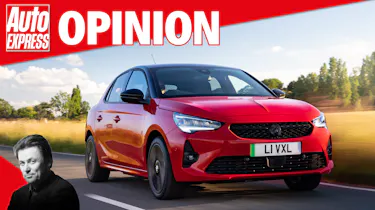
Yet when comparing, say, a current bottom-of-the-range Corsa petrol (at £18,585) with a bog-standard Corsa EV (at £32,430), the latter is 74 per cent more expensive. And therein lies the problem, not just for Vauxhall, but also for other makers with ICE and EV interests.
So what the bloody hell happened to those price-parity predictions, promises and proclamations? If the answer is that we’ll just have to patiently wait until the end of the mid-20s (some 39 months from now) before cars with electric motors and battery packs become as affordable as equivalent models with petrol engines and fuel tanks, it won’t work – for the manufacturers, the dealers and, more importantly, the buying public.
Click here for our list of the best electric cars on sale right now...