Meet Renault’s new SUV: a Dacia Duster but not as we know it…
Posher inside and out and with more headroom, welcome to the upside down world of the Indian Duster

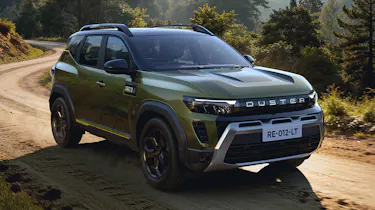
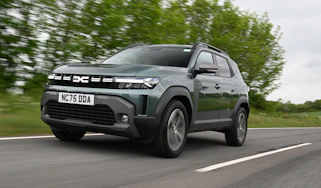
When is a Duster not a Dacia? When it’s a spruced-up Renault, bound for the Indian market as part of the French group’s big overseas sales push in 2026.
Indian customers can get this different Duster with colourful exterior details and two-tone paint, a plusher cockpit boasting additional headroom and Renault’s advanced Google operating system, compared with the budget Dacia Duster European customers know and love.
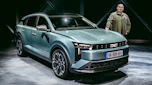
There’s no scrimping on hybrid engines or safety kit, either, as Renault looks to help tackle India’s horrific accident rate and do its bit to reduce local emissions. So the Duster is equipped with lane-keep technology, blind spot warning, automated emergency braking, driver monitoring and many more assistance systems.
This Duster spin-off is a fascinating case study in how Renault Group is trying to sweat its technological assets to boost income. It sold the original Duster in India from 2012, and over a 10-year period shifted 200,000 units.
“In India the Duster is an icon,” said Renault group product boss Bruno Vanel. That explains why the third-generation hi-tech grille blares out the Duster name rather than Renault’s diamond logo.
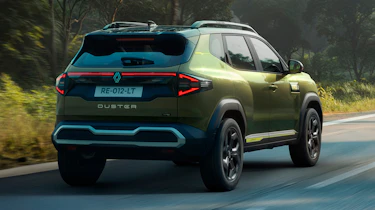
Other exterior tweaks on this Iconic trim include revised headlamp graphics, a shiny grey skid plate and the removal of the vertical plastic strip behind the front wheelarch. The rear end features a new full-width lightbar.
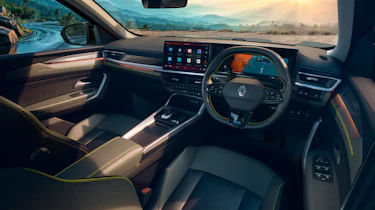
This Renault Duster may be 4cm taller – to accommodate an opening glass roof and boost roominess – but length, wheelbase and ground clearance are the same. However, the “interior has nothing in common with [the European] Duster,” said Bruno Raspail, Renault International’s design director.
On the surface, that is indeed the case, although the dashboard architecture is clearly common to India and Europe to save cash. But the plush-spec Indian finish is obviously enhanced, with twin 10-inch digital screens, a silky Renault steering wheel with colourful stitching and a higher centre console dividing driver from passenger. The touchscreen runs Google software, with access to its app store and – in future – a voice assistant powered by Gemini AI.
The 158bhp E-Tech hybrid powertrain is shared with Europe’s Clio and Symbioz. Renault reckons this will power 33 per cent of Dusters; in Europe, 25 per cent of all Dacias were sold with petrol-electric power in 2025.
Two petrol engines will be offered: a 999cc three-cylinder Turbo TCe 100 with 99bhp and 160Nm of torque, or a blown 1.3-litre four-cylinder with 158bhp or 280Nm. The 1.0-litre is strictly paired with a six-speed manual; the bigger displacement unit can also be specced with a six-speed dual-clutch transmission.
The Indian Duster is part of a concerted plan to grow the Renault Group business: last year it sold 616,800 vehicles outside of Europe, compared with 1.6 million within it. “Our international strategy is an extension of what we are doing in Europe,” explained Renault brand CEO Fabrice Cambolive. “[It gives us a] capacity to be present outside of Europe but feed [back] with components and competitiveness.”
The renewed international push kicked off in 2023, when Renault committed to spending €3-billion to launch eight new models outside of Europe by 2027. Many of them are large in size to deliver a “significant revenue increase per car,” explained Cambolive: a good example is Renault’s Filante SUV, being introduced in Korea this year and tasked with taking premium market share.
Also coming soon is a pick-up for South America. North Africa and Turkey are other big markets in Renault’s international crosshairs – but India is a huge one. “India will be one of the world’s biggest growth [opportunities] in 2026,” said Cambolive.
At 4.3 million units a year, the new car market is more than twice the size of the UK’s. But just like over here, SUVs account for more than half of registrations. With India’s population on course to overtake China’s, Renault predicts the market could reach six million by 2030.
Renault has a design team in its Chennai hub, which also includes the factory that will assemble the Duster. “Feet on the ground help us understand local markets and [employ] designers from there,” explained group design boss Laurens van den Acker. Having team members in India and China enables Renault to work around the clock on pressing projects, taking advantage of different timezones.
The Duster is a great example of global car makers acting locally. Renault chief Cambolive reckons creating a global car to ship to all regions is an impossible task these days, with differing regulation and volatile foreign exchange rates. “But we can catch global trends [like SUVs], and the Duster is a great example of Renault’s capacity to be a global player.”
Did you know you can sell your car with Auto Express? Get the highest bid from our network of over 5,500 dealers and we'll do the rest. Click here to try Auto Express Sell My Car now...