New Ferrari 296 Challenge Stradale is a true race car for the road
Slow-selling 296 loses its PHEV system for a standalone 661bhp twin-turbo V6, offering the ‘most direct link to a race car’ in Ferrari’s current range

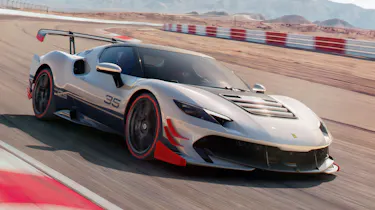
Ferrari is welcoming back a 22-year-old nameplate with a stripped-back, road-going two-seater, that its maker claims is “entirely geared towards providing the driver with a direct and physical driving experience”.
The Ferrari 296 Challenge Stradale embodies the spirit of its early-noughties predecessor, reinvented for the modern age.
Revealed at the 2026 Ferrari Finali Mondiali event in Barcelona, the lighter, faster 296 ditches the standard car’s plug-in hybrid powertrain for an undiluted and “completely overhauled” twin-turbo V6 producing 661bhp and 740Nm right up to the 8,500rpm limiter. Power runs to the rear wheels only, via an eight-speed dual-clutch automatic transmission.

Despite a near-160bhp deficit, the significant 140kg weight saving – the Challenge Stradale has a dry weight of 1,330kg – shaves one-tenth of a second off the 296 GTB’s 0-62mph time, matching the hardcore 296 Speciale over the benchmark sprint, with a time of 2.8 seconds.
Ferrari says that of its current range, the newcomer is the model with the “most direct link to a race car” – emphasised by its decision to unveil it alongside the new 296 Challenge EVO, a track-only version of the 296 tailored to “maximise performance in Ferrari Challenge races”. The two cars have apparently been developed in close collaboration to highlight the “symbiotic bond” between the company’s race cars and road-ready production models.
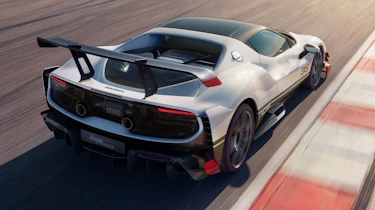
That bond is evident in the two cars’ styling, with the Challenge Stradale taking on a much more aggressive race car aesthetic than either the GTB or Speciale. Ferrari says the “volumes and surfaces of the 296 Challenge Stradale have been stripped of superfluous elements to reduce the car’s visual mass and make its technical functions more readily apparent”.
That’s only part of the story, however. While many of the surfaces have been cleaned up, a new-found focus on aerodynamic performance ensures the Stradale has plenty of presence. Changes to the nose include a huge front splitter, with prominent stacked aero vanes ahead of the front wheels. There’s also a “large technical insert” on the bonnet which incorporates the air outlet from the car’s radiators.
All of these changes – along with the huge, fixed rear wing and completely closed undertray – combine to generate 617kg of downforce at 155mph; 72 per cent more than the 296 GTB. The Challenge Stradale also comes with semi-active dampers, plus a choice of Pirelli P Zero R or Trofeo RS tyres for ultimate road and track performance.
At the rear, a mesh insert inspired by the one fitted to the 2003 Ferrari 360 Challenge Stradale sits above a monstrous diffuser and houses the car’s twin exhaust pipes. These larger tips apparently reduce back-pressure and “enhance the V6’s higher-pitched harmonics”. A new calibration of the in-cabin sound “alters the balance between the intake and exhaust”, according to the Italian company.
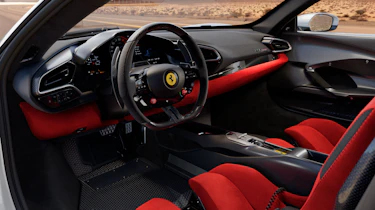
Speaking of the cabin, while it utilises the same basic layout as the GTB and Speciale, the Challenge Stradale once again does away with any superfluous add-ons to place the focus firmly on the driver. There is no armrest, nor are there storage pockets, for example, and all of the trim from the area beneath the seats – plus much of the carpeting – has been removed to leave part of the chassis exposed. The door panels are made from carbon fibre, and a set of optional ‘tubular’ carbon seats reduces weight by up to 25 per cent per chair. But, don’t worry, there’s still room for a cup-holder and wireless charging pad.
In terms of hardware, Ferrari has tweaked its famous Manettino switch to include a predictive slip control function that has been optimised for track use – a first for one of the brand’s road cars. The maker claims this provides “minimal, barely perceptible interventions”, working with the ABS Evo system to “maximise braking potential” across all of the 296 Stradale’s drive modes. Together, the systems enable a Fiorano lap time of 1:18.5 – half a second faster than the 296 Speciale.
Pricing and availability haven’t been confirmed, but in typical Ferrari fashion you can expect a long waiting list and a rigorous selection process before being allowed to place a (substantial) deposit at your local dealer. With the 296 Speciale starting from £359,779, a Challenge Stradale is likely to break the £400k mark – or substantially more with a few choice options. Production should start some time next year.
Did you know you can sell your car through Auto Express? We’ll help you get a great price and find a great deal on a new car, too.