Mazda 3 review
The Mazda 3 looks fantastic, drives brilliantly and rides well, though some rivals are more practical all-rounders

Our opinion on the Mazda 3
The Mazda 3 is still a great family hatchback (or saloon) and among the more desirable models you can currently buy. It's fun to drive, extremely well-equipped, and offers a package of immense quality for the money. Neither variant is the most practical option out there, though.
The more powerful SkyActiv X petrol engine employs groundbreaking technology, but you’ll struggle to detect it at work. Other rivals offer more efficient plug-in hybrid systems, which will be more appealing, especially to business users. However, if you can live with the minor downsides, the Mazda 3 remains a rewarding and exciting family car.
About the Mazda 3
The Mazda 3 is a car aimed squarely at family buyers who enjoy driving, whether they settle on the handy hatchback or sleek saloon. The Japanese manufacturer is pitching this fourth-generation Mazda 3 as a more upmarket offering than its predecessors, with the intention of toppling premium (and ultimately pricier) rivals in the class. No mean feat.
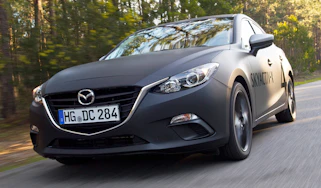
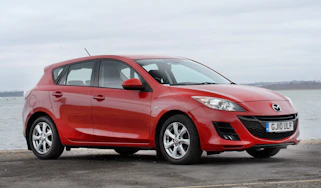
To that end, the latest Mazda 3 can be considered a total revolution over the previous model. It employs a smoother, sportier design language, a significantly repackaged interior, up-to-the-minute driver assistance features, and a new platform. Like certain Mazda icons of the past, unconventional engine technology plays a crucial role in setting the new Mazda 3 apart from the crowd.
Used - available now


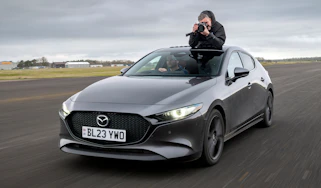
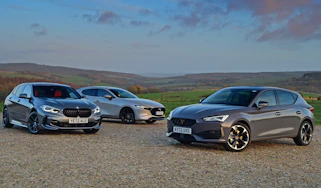
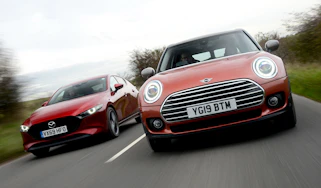
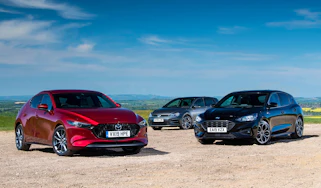
The Mazda 3 faces competition from both the standard and premium hatchback sectors, so when we pitted it against the BMW 1 Series and Cupra Leon in our real-world group test. We’ve also tested the Mazda 3’s family car credentials by placing it in the hands of our senior photographer, Pete Gibson, spent six months as part of our long-term test fleet.
Performance & driving experience
Pros |
|
Cons |
|
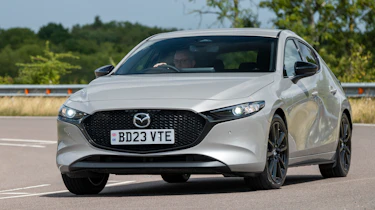
Mazda has carved a reputation for delivering family cars with a thrilling edge, and while the Mazda 3 lacks a true performance variant, we think it still lives up to this reputation for fine handling. It feels solid and confidence-inspiring from behind the wheel.
Performance, 0-60mph acceleration and top speed
In contrast to its many rivals, the Mazda 3 forgoes any turbocharged engine options. Instead, you have two unusually large units to choose from. First up is a naturally-aspirated 2.5-litre e-SKYACTIV G unit (only available with the hatchback) producing 138bhp, which dispatches the 0-62mph sprint in a leisurely 9.5 seconds and goes on to a top speed of 128mph. The automatic variant is slightly slower with its 9.8 second 0-62mph time and 124mph top speed.
Figures like these won’t trouble any of the torquier alternatives on the market, but in practice, we’ve found the SkyActiv G adds up to be a little more than the sum of its parts. During our group test against more powerful, turbo versions of the Volkswagen Golf (1.5 TSI 130), we clocked faster acceleration times than the official numbers suggest. However, in-gear acceleration times exposed the relatively small amount of torque on offer, which would hamper any overtaking attempts when passing slower traffic on a country road. It is refined, though, remaining hushed right through the rev band. In sixth gear at motorway speed, it’s quiet, pairing off nicely with the low wind noise levels.
The second 2.0-litre e-SKYACTIV X engine is smaller displacement-wise, but it’s actually more powerful with 183bhp and 240Nm of torque on tap. This engine achieves an 8.1-second 0-62mph time when fitted to either the hatchback or saloon with a manual gearbox, rising to 8.5 seconds in the automatic. All variants reach a 134mph top speed.
Fire up the e-SKYACTIV X, and it idles like a petrol, but as the engine reaches mid-revs, it begins to mimic the sound of a diesel. Push through towards the 6,500rpm redline, and the noise returns to that of a conventional petrol engine. It’s not quite as refined as the SkyActiv G engine, but it’s a much better performer for everyday motoring. It also adds some much-needed pep to exploit the excellent chassis, too, making the SkyActiv X our pick of the line-up.
| Model | Power | 0-62mph | Top speed |
| 2.5 e-Skyactiv G MHEV Prime-Line | 138bhp | 9.5 seconds | 128mph |
| 2.0 e-Skyactiv X MHEV Homura auto | 183bhp | 8.5 seconds | 134mph |
| 2.0 e-Skyactiv X MHEV Exclusive-Line | 183bhp | 8.1 seconds | 134mph |
Town driving, visibility and parking
For the most part, the Mazda 3 offers typical small car levels of ease when driving within an urban sprawl. The controls are light and the car is easy to place on the road. We did find the clutch needed a bit of getting used to in our test car, because it was rather high even though the car was pretty much brand-new at the time. Once we got the hang of it, though, the box was enjoyable to use.
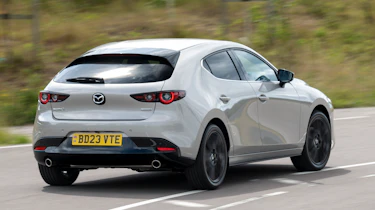
Rearward visibility is an issue in both the hatchback and saloon due to chunky C-pillars and a relatively slim rear windscreen. A standard-fit rear-view camera mitigates the impact, but it still makes reversing and parking more challenging than we’d like.
Country road driving and handling
The Mazda’s level of driver engagement quickly becomes apparent from the moment you take a seat. While there’s little feedback from the steering (common in modern cars), the Mazda 3’s steering rack is at least well weighted. The speed of the electric power steering motor is spot on, too, resisting the urge to re-centre too quickly while still being sharper than a Skoda Octavia or Volkswagen Golf.
The six-speed manual gearbox is simply the best in class and an absolute joy to use. The throw is short, while the action is tactile and mechanical in its feel. The six-speed automatic isn’t quite as strong as other auto options because Mazda still uses a torque converter rather than the faster-shifting dual-clutch transmissions that have become popular in this segment. Even with wheel-mounted paddles (provided on Exclusive-Line trim cars and above), this gearbox doesn’t respond quickly enough for our liking.
The Mazda 3 is responsive on turn-in and, by family car standards, extremely composed. Much of that comes from standard G-Vectoring technology, which monitors various parameters and preemptively reduces engine power just enough so the front wheels aren’t overwhelmed during hard cornering and can maintain grip on the road. There is a little body roll, but it rolls in a very progressive manner, so you’ll quickly learn to adapt your driving style.
Motorway driving and long-distance comfort
Another impressive Mazda feat is how it manages to be genuinely fun while providing excellent ride quality. The firm’s engineers have struck a sweet spot between forgiving springing and damping and body control, and while a Golf is still the most comfortable family hatchback on sale, the Mazda manages its priorities better than its handling might suggest.
“The combination of a decent engine and the cracking manual gearbox means it’s delivered some genuinely enjoyable cross-country trips; the 3 is very much a driver’s car, yet it also proves that you don’t need an SUV for practical transport.” - Pete Gibson, senior photographer.
MPG & running costs
Pros |
|
Cons |
|
We recorded an average of 41.4mpg after covering 464 miles in a manual Mazda 3 hatch fitted with the SkyActiv G engine. This was reasonably close to the brand’s official claim of 47.9mpg on the WLTP combined cycle, but the Volkswagen Golf 1.5 TSI is more efficient (at least on paper) with a claimed 53.3mpg. The 3’s automatic transmission results in a slightly decreased maximum fuel economy of 44.8mpg.
The SkyActiv X petrol engine offers better efficiency as well as boosted performance, with Mazda claiming up to 50.4mpg for the manual hatchback (which is our pick of the bunch).
When we tested this engine with an automatic gearbox as part of our real-world group test against the Cupra Leon and BMW 1 Series, we managed 42.5mpg on a combination of A and B roads as well as motorway driving. Again, this was very close to the official claim of 45.6mpg. If you’d prefer the saloon, this manages up to 51.4mpg on the WLTP combined cycle in manual form, dropping to 46.3mpg for the automatic.
CO2 emissions of between 123 and 141g/km aren't particularly remarkable numbers when you consider the low emissions of hybrid rivals such as the Honda Civic and Toyota Corolla, let alone fully electric hatchbacks like Peugeot E-308 and Renault Megane E-Tech.
| Model | MPG | CO2 | Insurance group |
| 2.5 e-Skyactiv G MHEV Prime-Line | 47.1mpg | 133g/km | 18 |
| 2.0 e-Skyactiv X MHEV Homura auto | 45.6mpg | 138g/km | 23 |
| 3 saloon 2.0 e-Skyactiv X MHEV Exclusive-Line | 51.4mpg | 123g/km | 23 |
Insurance groups
The Mazda 3 SkyActiv G models start in insurance group 17 (out of 50) for the auto and group 18 for the manual. For comparison purposes, the Toyota Corolla starts from group 17, while the Vauxhall Astra starts in group 19.
The more powerful SkyActiv X understandably sits in the higher insurance groups of 23 to 24. Fortunately, this means it should prove a bit cheaper than the similarly powerful Honda Civic, which resides in group 26.
Tax
Every variant of the Mazda 3 is liable for VED road tax, and the entire line-up avoids the £40,000 luxury car tax threshold for petrol, diesel and hybrid vehicles.
As always, company car drivers will be best served by electric rivals like the Renault Megane E-Tech, Peugeot E-308, Vauxhall Astra Electric or Volkswagen ID.3. The zero tailpipe emissions of an electric car mean considerably lower Benefit-in-Kind (BiK) tax rates than the petrol-powered Mazda 3 can provide.
Depreciation
Our expert data shows that the Mazda 3 hatchback should retain between 39 and 42 per cent of its initial value after three years or 36,000 miles, while the saloon should retain 41 per cent. This is better than the Vauxhall Astra, which is expected to retain between 37 and 40 per cent over the same period, but lags behind the Honda Civic, which is expected to still be worth 49 per cent of its initial value.
To get an accurate valuation on a specific model check out our free car valuation tool...
Interior, design & technology
Pros |
|
Cons |
|
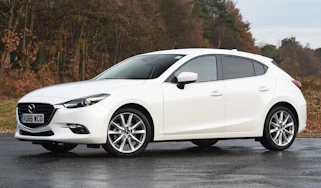
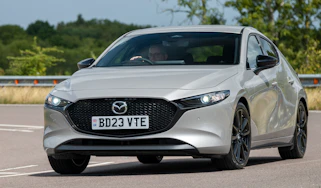
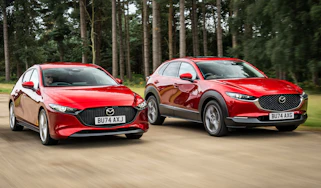
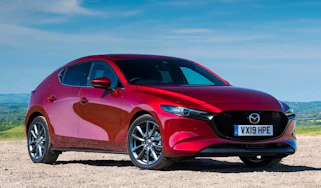
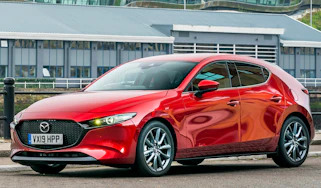
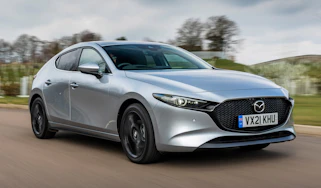
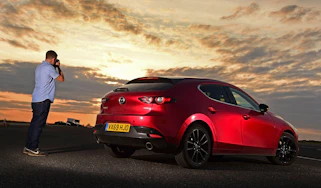
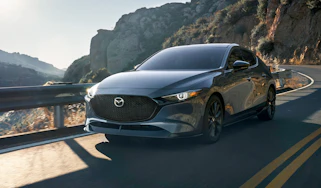
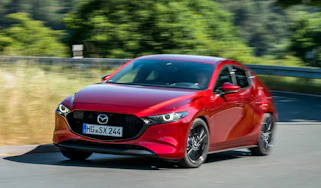
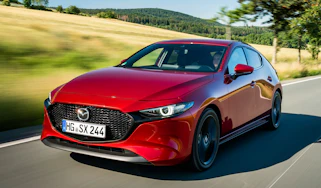
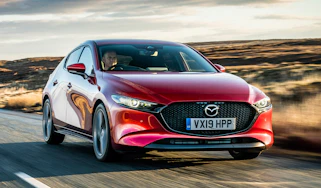
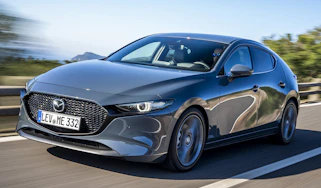
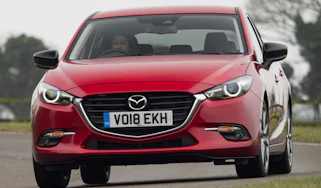
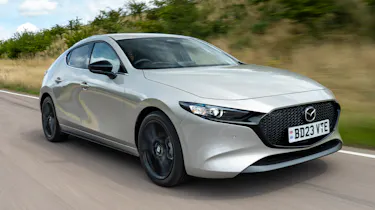
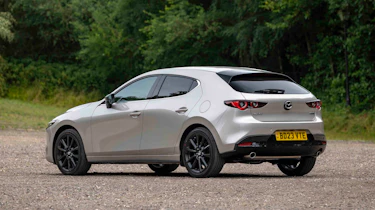
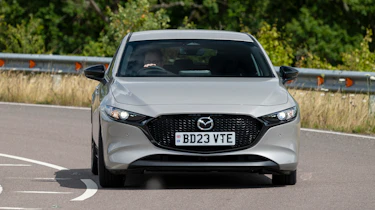
The Mazda 3 is one of the more distinctive-looking family cars on sale; its aggressively sporty styling isn’t too far removed from the Kai concept car that first appeared at the 2017 Tokyo Motor Show. As with other modern Mazda products like the Mazda CX-5 and Mazda MX-5, the 3 has been designed to look fast and powerful even at a standstill, and the result is a family car that looks far sportier than its competition. It’s a handsome car that looks decidedly upmarket.
Entry-level Prime-Line comes with an impressive amount of equipment, such as 16-inch alloys, rear parking sensors and a reversing camera, LED headlights with auto high beam, and a 10.25-inch infotainment screen. Next up is Centre-Line, which adds front parking sensors, auto wipers, heated front seats, dual-zone climate control, and wireless phone charging.
Our preferred engine option starts with Homura trim, which has black 18-inch alloys, rear privacy glass and a sunroof – although it's only a small sunroof like something out of the '90s rather than the panoramic glass roofs of today.
High-end Exclusive-Line has adaptive LED headlights, some shiny bits of chrome interior trim, and a 12-speaker BOSE sound system. Range-topping Takumi has a 360-degree camera system, an electrically adjustable drivers seat with memory controls (including for mirror position), a heated steering wheel, and black leather trim.
Interior and dashboard design
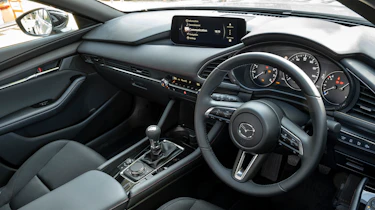
The Mazda 3 stands out by feeling more driver-focused than most of its rivals, with great ergonomics and a fantastic driving position built around the driver’s needs. That’s apparent the moment you take a seat because of the low seating position, as well as the armrests on the centre console and driver’s door card that are perfectly positioned for your elbows. The wheel is well-sized, and the rim isn't too thick, making it ideal for exploiting the Mazda 3’s tidy handling.
The cabin ambience feels fairly premium, with simple lines and sensibly placed controls. The dashboard has a wrap-around design and is topped with an infotainment screen that’s controlled by a rotary dial behind the gear lever. Control of the climate system is provided by easy-to-use buttons and dials, which scores well with our road testers compared with the awkward-to-use touch-sensitive sliders like in the VW Golf, or buried within the touchscreen as with the Peugeot 308.
The Mazda 3 doesn’t have a fully digital driver instrument cluster, and while it lacks the configurability of a digital display, it is refreshingly simple and easy to read at a glance. The Mazda 3 comes as standard with a head-up display, which projects key information onto the windscreen ahead of the driver, meaning you don’t need to refocus your eyes just to check your speed.
Materials and build quality
The Mazda’s build quality is great, and the materials used are top-notch, especially on higher-spec models – there’s very little to complain about inside the 3’s cabin. It feels just as well-built as a VW Golf (if not better) and is arguably more interesting to both look at and sit in.
Infotainment, sat-nav and stereo
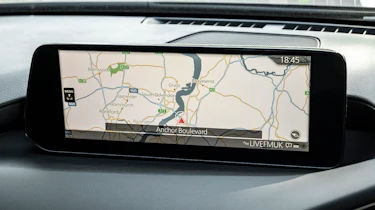
The Mazda 3’s 10.25-inch infotainment is a massive improvement over the previous model’s. The screen is sharp, the graphics are excellent, and the software is intuitive and easy to use. Due to it being a slightly older system, there’s a rotary-dial control along with key shortcut buttons on the centre console to supplement the touchscreen controls, so it’s more natural to use while driving than either of the rival systems that are touchscreen only. It may be a more traditional setup, but it works very well.
The 3 is also fitted with satellite navigation as standard, but you also have Android Auto and Apple CarPlay if you would rather use your smartphone’s mapping. The system works well, although it’s a bit more cumbersome than the touchscreen versions found in rivals like the Volkswagen Golf.
There’s a digital dial display of sorts, but it isn’t as feature-rich as the VW’s Active Info display or Audi virtual cockpit. You do get some slick-looking traditional dials at either side of the digital screen in the 3, though.
“That sunroof that’s part of Takumi trim helps to brighten the interior. It opens electronically and tilts and slides, while the manual sun shade means it feels like a proper accessory from the eighties, but I wouldn’t change it for any reason.” - Pete Gibson, senior photographer.
Boot space & practicality
Pros |
|
Cons |
|
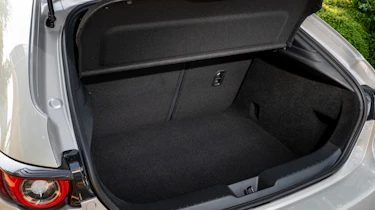
As is so often the case with swoopy car designs, the Mazda 3 can’t quite match a number of rivals for practicality. Its low roofline encroaches upon head room for rear passengers, and the boot is not the largest in the class. Worse still, the small rear windows make the cabin feel dark. We found that the saloon suffers similar issues with lighting and visibility, although the hatch is the worst offender of the two. Interior storage is good, at least, with a large cubby ahead of the gear lever proving particularly useful.
Elsewhere, the Mazda 3’s great driving position is set low and can be adjusted to feel almost like what you’ll find in a sports car. There is a lot of steering wheel adjustment, and the front seats offer plenty of support and comfort over lengthy journeys.
Those looking for a more practical Mazda 3 will be slightly better served by the saloon, a car fulfilling an increasingly small niche following the demise of the Mercedes A-Class saloon. Like the Audi A3 saloon, the Mazda 3 saloon offers a larger boot than the hatchback, albeit without the flexibility of its five-door sibling.
The Mazda 3 isn’t the best choice in this class if outright practicality is your priority, because Skoda has got this covered with the Skoda Octavia. However, the Mazda still offers enough space for most needs, all the while offering a much sportier take on the traditional family hatchback recipe.
Dimensions and size
The Mazda 3 measures in at 4,460mm long, 1,795mm wide and 1,435mm tall. It’s longer than a VW Golf and slightly lower, too, helping it look and feel more sporty. That extra length seemingly accounts for the Mazda 3’s long bonnet, because the rear seat area and boot space are not especially impressive. The saloon is slightly longer at 4,660mm and sits a fraction taller than the five-door hatchback, although the extra length is mainly in the rear overhang.
| Dimensions comparison | |||
| Model | Mazda 3 (hatchback) | Toyota Corolla (hatchback) | Honda Civic |
| Length | 4,460mm | 4,380mm | 4,560mm |
| Width | 1,795mm | 1,790mm | 1,802mm |
| Height | 1,435mm | 1,460mm | 1,408mm |
| Wheelbase | 2,730mm | 2,640mm | 2,730mm |
| Boot space | 351 litres | 313 litres | 409 litres |
Seats & passenger space
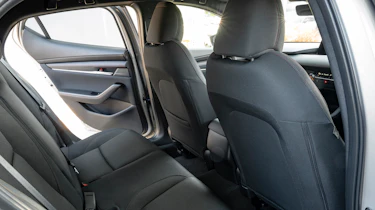
Space in the back of the Mazda 3 is tight compared with rivals such as the Skoda Octavia, Skoda Scala and Volkswagen Golf. Like the Peugeot 308, Toyota Corolla and Vauxhall Astra, there isn’t a huge amount of leg room, so anyone who’s six foot and above might find their knees pressing into the back of the seat ahead of them, especially if there is a similarly tall person up front.
Entry and egress are made difficult by the sloping roofline and small rear door opening – something that could prove particularly problematic for families with small children who need to fit a child seat in the back. As we discovered during our long-term testing of the Mazda 3, growing children will struggle for space in the back seats. The saloon’s slightly higher roofline does reduce this problem, but it’s still nowhere close to matching the class leaders.
Boot space
There’s a 334 litre boot in the back of the Mazda 3 hatchback, which is less than you’ll find in the Volkswagen Golf and Skoda Octavia. The space is well-shaped, and there’s a usefully wide opening, but a high load lip and significant drop on the other side makes loading and unloading heavy items a challenge. The rear bench folds with a 60/40 split to reveal 1,026 litres of storage space, with no real lip between the boot floor and the seat back.
The Mazda 3 saloon actually offers extra loadspace at 450 litres, and the slightly taller roofline aids practicality. However, the narrower boot opening, due to its saloon body shape, could cause difficulties when loading taller items. Fold the seats down, and you get 1,138 litres of space.
“The rear passenger footwells are nice and large, so smaller items like rucksacks can easily move or roll around if you decide to use these areas for storage. This isn't a massive issue, but the swooping roofline does mean you have to stoop down to retrieve whatever you've put there, with a high risk of hitting your head on the way back up.” - Ryan Birch, content editor.
Reliability & safety
Pros |
|
Cons |
|
The Mazda 3 was assessed by industry safety body Euro NCAP in 2019, and because the testing criteria has changed significantly, the 3's excellent five-star result has since expired. The VW Golf was retested in 2025, and retains its five-star rating.
The 3 should still be a very safe car in a collision, and it has an array of standard safety kit to help you avoid getting into a collision in the first place. It has a blind-spot monitoring system to warn of cars alongside you on the motorway, rear cross traffic alert to spot vehicles crossing your path when reversing, intelligent speed assist to display the current speed limit, lane-keeping assist with lane departure warning to nudge you back into your lane, and a driver attention alert system to make sure you’re paying attention. There’s also an emergency calling system that can automatically alert the emergency services in the event of a collision when the airbags are deployed.
Mazda, as a brand, has climbed from 17th place out of 31 brands in the 2025 Driver Power best manufacturer results to a much more credible 11th out of 30. This means it beats many of its major rivals, including Honda (17th), Skoda (20th) and Volkswagen (26th). Owners were very happy with exterior quality and the driving experience of their Mazda cars, but practicality and smartphone connectivity were criticised, though.
| Euro NCAP safety ratings | |
| Euro NCAP safety rating | Five stars (Expired, 2019) |
| Adult occupant protection | 98% |
| Child occupant protection | 87% |
| Vulnerable road user protection | 81% |
| Safety assist | 73% |
Buying, prices and deals
Best buy: Mazda 3 hatchback 2.0 e-Skyactiv X MHEV Homura
The range starts off with the hatchback in Prime-Line trim from around £25,500, eventually winding up at the fanciest Takumi trim, which surpasses the £31,000 mark. Things are slightly simpler if you opt for the saloon, because this is only available in mid-range Exclusive Line trim, and costs the same as the equivalent hatchback.
We prefer the e-Skyactiv X powertrain due to its increased power and efficiency, and the cheapest way to get this engine is with the Homura trim level. If you want the saloon, it's only available in Exclusive-Line trim. Either way, you’ll get a good amount of kit for your cash, along with a powertrain that makes the most of the Mazda 3’s enjoyable driving characteristics.
If you build your ideal Mazda 3 hatchback via the Auto Express Buy a Car service, you can save an average of £4,000. You can also save an average of £2,750 on a brand-new Mazda 3 Saloon. We can even help you to sell your old car.
Mazda 3 alternatives
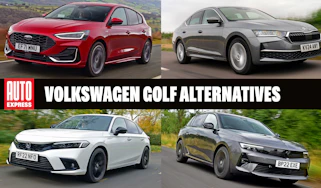
The family hatchback market has been transformed with the arrival of electric models onto the scene. The Renault Megane E-Tech, MG4, Volkswagen ID.3, Peugeot E-308 and Vauxhall Astra Electric are all trying to take their share of this growing sector. However, we’d be inclined to look towards the Cupra Born if you want something a bit sporty.
As a halfway point, the Toyota Corolla and Honda Civic are two highly efficient hybrid hatchbacks. Or, if you’d prefer to stick with full-on combustion, few cars can top the Volkswagen Golf and Skoda Octavia for outright all-round ability.
Mazda 3 Takumi long-term test
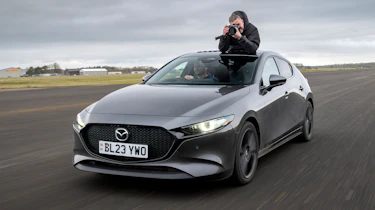
Our senior photographer, Pete Gibson, lived with a Mazda 3 in Takumi trim as part of our long-term test fleet. As he is constantly attending photoshoots all over the country, Pete racked up plenty of miles over a year, and the 3 took these in its stride.
Pete continuously praised the Mazda’s build quality and distinctive styling. The biggest highlight for Pete, was the 3’s ability to deliver a surprisingly engaging driving experience, thanks to its 2.0-litre engine and satisfying six-speed manual gearbox. You can read the full long-term test here…
Mazda 3 pictures
Frequently Asked Questions
A six-year/100,000-mile warranty covers all new Mazda models, which is an improvement over the older 60,000 mile/three-year plan.
Deals on the 3 and alternatives
More reviews
Car group tests
Long-term tests
Which Is Best