Skoda Vision O concept: interior walkaround and review
We get up close and personal with the Skoda Vision O's futuristic interior, and then we take it for a drive

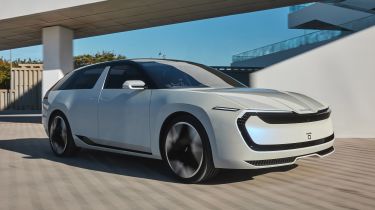
Of all the Volkswagen Group’s concept cars and future models on display at the Munich Motor Show earlier this year, there was one which stood out for a very good reason. The Skoda Vision O, a concept of a future all-electric version of the marque’s long-running Octavia, wasn’t just our first look at the brand’s new design language. It was also an initial preview of the next-generation architecture that will underpin both this and the all-important Volkswagen ID. Golf.
We had already walked around the car’s exterior styling with Skoda’s head of design, Oliver Stefani, but now we’ve looked at the cabin, and more specifically the technology in what will be the biggest shake-up of the Czech manufacturer’s interfaces since the introduction of the touchscreen.

Just like BMW did with its new Panoramic iDrive system for its Neue Klasse cars, Skoda plans to introduce a brand-new digital layout, which starts with a vast, full-width screen mounted right at the junction of the dashboard and windscreen.
Skoda’s user interface designer Daniel Hájek talked us through the new set-up on the left-hand-drive version. “As you can see, this is split into three areas,” he explained. “The driver’s part only shows necessary information, on the right side you have the possibility to share the content with your passenger, but the middle area is the most important bit, which includes our virtual assistant, Laura.”
This ultra-wide screen is a huge change from Skoda’s current layout, and is something that’s only so far been seen on the Neue Klasse BMWs. However, there are a few key differences, including the fact that this is a physical screen, not a head-up display, which means that Skoda’s interior designers have to take the surrounding materials into consideration in order to avoid creating reflections.
Another difference between the BMW Panoramic iDrive system and this fresh Skoda layout is that it works in tandem with a selection of physical controls and the Laura virtual assistant, which Hájek again talked us through. “The middle switch is a smart dial, and from here you can control that middle section [of the full-width screen],” he said. “You [can] ask Laura generic questions, or ask her something more specific, like a fairy tale.”
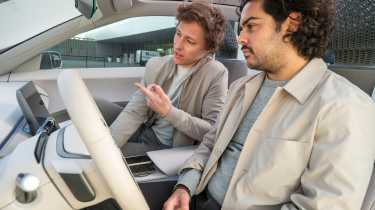
This sounded a little random, until Hájek used the example of having a baby in the rear seats, to which the car read out loud an AI-generated story with on-screen illustrations. This is most likely the remit of this concept, but what it does is highlight the sort of generative content that could be possible, thanks to powerful new machine-learning models that are integrated directly into the car’s software.
In addition to this smart dial, other key switches such as those that control the climate functions and volume are also mounted on the centre console.
Next we moved to the vertically mounted touchscreen that will form the core interface, where the car’s basic settings can be changed. Hájek told us: “The next step of our standard homescreen [can allow you to] pinch in and out of different levels, and it’s contextual.” We pinched all the way out and he told us: “This is the overview of the road with the weather conditions and a standard driving map. But if you, for example, park the car, more options become available. Now we’re stopped, the car’s active parking assistant is now available, and highlights the spot available.”
This sounded like another gimmick, but this sort of contextualised interface could make complex functionality, such as automatic parking, much quicker and more intuitive to engage if the car knows when certain features are and aren’t applicable.
Much more than a standard upright touchscreen that you’ll see in something like a Polestar 3, this felt like a more intuitive way of using the main interface, leaving critical driving information to the high-mounted screen.
Yet the interfaces went further, because another pinch in revealed interior controls, again contextualised to the environment. “It’s a really believable system, the architecture is close to this, which you’ll be able to sit in and understand [on the future model],” Hájek added.
If you can't wait for an all-electric Skoda Octavia to arrive, why not check out our deals on the current model through our Buy a Car service. You can get your hands on a new Skoda Octavia for under £20,000.
What is the Skoda Vision O like to drive?
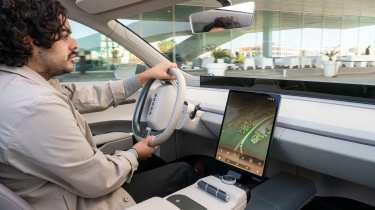
As with most show cars, we didn’t have an opportunity to properly drive the Skoda Vision O on public roads, but our short laps around a closed road gave us a chance to try out this new type of digital interface in motion, and there were a few interesting details to note.
Being a screen, and not a head-up display, it required a decent amount of focal adjustment between your eyes and the road. The BMW’s system is a reflected image and takes less effort to quickly glance at. We also thought the Skoda’s screen needed to be brighter and of a higher resolution to cut through the glare that was being reflected onto it from the light-coloured interior.
However, the addition of some physical controls in addition to this heavily digitised layout definitely felt like Skoda taking a substantial step forward in how its cars portray themselves, without compromising how drivers interact with key functions.
There’s also the small matter of cost, because the BMWs will sit in a higher price bracket than the eventual Skoda Octavia EV, and considering its position feels like a giant leap forward in terms of perceived quality and access to this type of high-end technology.
We still have a few good years to wait before this technology is found in a production Skoda, but when it does, we’ll already know it’s heading in exactly the right direction.
Get the latest and best car news and reviews, first! Follow Auto Express on Google today