New Dacia Striker 2026 preview: prices, specs and release date
The rugged yet athletic estate car is, in essence, an Audi A6 Allroad for a third of the price

Who needs SUVs when the new Dacia Striker family estate car will go on sale in the UK later this year, starting from less than £25,000 and featuring fuel-sipping hybrid power as standard.
The first images of this robust yet athletic-looking jack-of-all-trades were released in March, but now Auto Express has had a chance to get up close and personal with the value-for-money champion’s challenger to the MG HS, Nissan Qashqai and Skoda Octavia.
The new Striker is phase two of Dacia’s invasion plans for the hugely important C-segment of the car market. Phase one was the boxy, more utilitarian and aptly named Dacia Bigster. There’s one more model still to come, but Dacia executives are tight lipped on that particular subject.
| Key specs | |
| Fuel type | Hybrid |
| Body style | Estate car |
| Powertrain | 1.8-litre four-cylinder petrol engine, 1x electric motor and 1.4kWh battery, front-wheel drive 1.2-litre three-cylinder petrol engine, 1x electric motor and 48-volt battery, four-wheel drive |
| Price | £24,000-£25,000 |
What powertrain options and performance can we expect?
In the UK, the Dacia Striker will be available with a choice of two hybrid powertrains that are shared with the Bigster.
The Hybrid 155 will offer the best efficiency. It comprises a 1.8-litre four-cylinder petrol engine and six-speed automatic gearbox, working together with one main electric motor, a separate starter-generator motor and 1.4kWh battery. According to Dacia, this Striker can return roughly 60mpg, spends up to 80 per cent of the time driving in town in EV mode and emits less than 100g/km of CO2.
For those who need to tackle tougher terrain regularly, the Hybrid 150 4x4 uses a 1.2-litre turbocharged three-cylinder petrol engine aided by a small starter-generator motor, powered by a much smaller 48-volt battery. Four-wheel drive is provided by a 30bhp electric motor at the back.
The extra e-motor drives the rear wheels via a two-speed gearbox that allows it to deliver strong torque at low speeds in first gear, perfect for off-roading, and thanks to that second gear it can still lend a hand when needed, like in slippery conditions, all the way up to 86mph.
This version also comes with a six-speed automatic and drives around town on pure-electric power up to 60 per cent of the time, says Dacia, and comes with drive modes for handling snow, mud and sand, and an extra special off-road setting for tackling the toughest stuff at low speeds.
| Model | Power | 0-62mph | Top speed |
| Dacia Striker Hybrid 155 | 153bhp | 9.0 seconds (est) | TBC |
| Dacia Striker Hybrid 150 4x4 | 148bhp | 10 seconds (est) | TBC |
What is the exterior and interior design like?
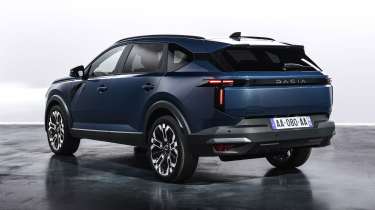
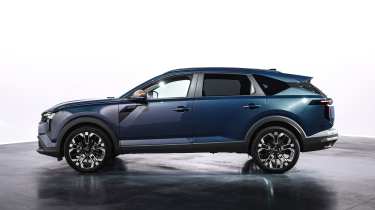
As you can see, the Striker isn’t your traditional low-slung load-lugger. Dacia says it’s meant to blend all the best qualities of a tough SUV, a versatile estate car and a sleek saloon. The result is a car that looks dynamic and more desirable than any previous Dacia, yet still robust. Basically, it’s an Audi A6 Allroad, but for a third of the price.
Dacia design boss David Durand showed us around the Striker, and told us that while the goal was to create something athletic “we wanted to keep this Dacia DNA of having a car that you can bring anywhere, even if the road is completely ruined or if there is snow. So you can say ‘okay, no problem for me. I have a Dacia, I'm not afraid of damaging it.’”
You can see this blending of genres by looking at the crisp shoulder line that runs the length of the car. Above it, there’s the raked windscreen, long, sloping roofline, strongly sculpted bonnet and a sizeable rear spoiler. Lower down, the Striker has a generous 20cm of ground clearance and chunky plastic cladding all around.
That cladding is made from Dacia’s special ‘Starkle’ material that’s produced in a way that light scratches, such as those you’re likely to get in a supermarket car park or perhaps during some light off-roading, are harder to see. Meanwhile, the slim T-shaped lighting signature at the front and rear is a unique detail for the Striker, and wheel diameters range from 17 to 19 inches.
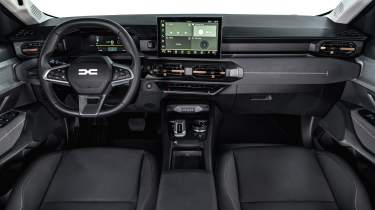
Inside, the Striker is similar to the Bigster, but not identical. It gets a different dashboard design that’s supposed to help emphasise the cabin space, for instance, and is covered in some interesting materials, including a denim that’s also used on the seats. The doors get more of Dacia’s Starkle and a soft-touch wetsuit-type material.
All this helps to break up the hard plastic that the rest of the cabin is made from. But while the Striker isn’t as plush as certain rivals, you can be sure it’ll be able to withstand whatever you or your family might (literally) throw at it.
Dacia is committed to using as many sustainable materials as possible in its cars, so Starkle contains up to 20 per cent recycled polypropylene. All told, the Striker uses 47kg of recycled plastics, which is more than double the average for the European market and a new record for the brand.
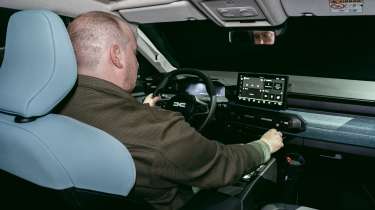
Dacia says it worked very hard to make the Striker as comfortable and refined as possible, using thicker glass for the windscreen and front windows, and shaping the door mirrors to reduce wind noise. But we’ll have to wait until we drive this car later this year to find out if all its work has paid off.
One thing you’d never have expected to see in a Dacia just a few years ago is a single-piece panoramic glass sunroof, which also helps to make the Striker feel more spacious. Unsurprisingly, this is reserved for top-spec models.
What do we know about the infotainment system?
Every Striker will feature a 10.1-inch touchscreen running Dacia’s simple and very easy-to-use infotainment system; this includes wireless Apple CarPlay and Android Auto connectivity.
It’s paired with either a seven-inch or 10-inch instrument display, depending on the specification, which is similarly simple and doesn’t try to overload the driver with too much information. Rather than just an ordinary screen though, Dacia has used reflections – similar to some older head-up displays – to create a rather impressive-looking holographic effect.
Below the touchscreen are physical toggle switches for the climate control, while there are proper buttons on the steering wheel, and the centre console offers up to 6.7 litres of cubby space and lots of storage options.
How practical is the Dacia Striker and how big is the boot space?
At 4.62 metres long, the Striker is the biggest car Dacia has made to date, stretching about 50mm longer than the Bigster. But at the same time the newcomer is 1.53 metres tall, whereas the SUV stands at up to 1.7m tall.
That does mean the estate offers less headroom than its boxier brother but we found that six-foot-tall adults still have a good amount to spare, plus enough legroom to be comfortable on long journeys, even with similarly tall individuals up front. There’s space under the front seats for their feet, too.
There is a sizeable central tunnel in the floor, however, which might make getting three adults into a back a bit of a squeeze. Teenagers should be fine though, and for those with small children the Striker has two sets of Isofix mounting points on its back bench.
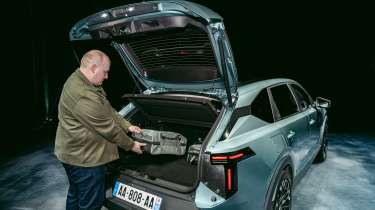
But of course, this is an estate car, and the reason people buy these is boot space. The Striker doesn’t disappoint with 600 litres of space on offer, which is more than the Kia Sportage or Nissan Qashqai family SUVs offer. However, it’s not quite as much as the Skoda Octavia Estate’s 640-litre boot. Fold the Dacia’s rear seats down and you have 1,600 litres to play with.
The Striker makes up for that with some clever features, such as a three-part boot floor that can divide up the space, create a flat load area when you need to lug large items around, or be flipped over to reveal a wipe-clean surface on the other side.
If you’ve just been to everyone’s favourite Swedish furniture house and aren’t sure if your new purchase will fit in the back of the Striker, there’s a handy diagram with max load measurements in the boot opening.
There’s also an ice scraper hidden behind the driver’s door, and Dacia’s YouClip system that lets you attach various accessories, such as bag hooks or cup-holders, to mounts dotted throughout the cabin.
Dacia will offer various other accessories when the Striker launches, including a specially designed roofbox, a racecar blanket to keep your kids entertained on long journeys and a pet bed.
| Dimensions | |
| Length | 4,620mm |
| Width | 1,820mm |
| Height | 1,530mm |
| Number of seats | 5 |
| Boot space | 600-1,600 litres |
What safety tech does it have?
Every Dacia Striker will be equipped with an array of safety systems, including automatic emergency braking, traffic-sign recognition, speed-limit warning, lane-keep assist and driver-attention monitoring. Adaptive cruise control will also feature as standard, while other driver-assistance tech like blindspot warning, rear cross-traffic alert and a surround-view camera system will be available as part of an optional pack.
How much is the Dacia Striker going to cost?
The Dacia Striker will go on sale in the UK in later this year, with prices starting from less than £25,000 – about £10,000 less than the hybrid Nissan Qashqai, and roughly £4,500 less than the base Skoda Octavia Estate, which has no hybrid tech.
Customers will have a choice of four trim levels. Entry-level Essential models will come with 17-inch steel wheels, roof bars, a 10.1-inch touchscreen, 7.0-inch driver’s display, manual air-conditioning and a rear-view camera. Expression will add alloy wheels, dual-zone air-conditioning, higher centre console design, USB ports for the rear passengers and auto-hold function to make stop-start traffic easier.
In Extreme trim, the Striker will get 18-inch rims, copper-brown trim inside and out, the panoramic sunroof, larger 10-inch instrument panel, sat-nav and a six-speaker Arkamys sound system, plus hill-descent control. Finally, sitting at the top of the range will be Journey trim, which throws in a wireless charging pad, heated front seats and a heated steering wheel.
Did you know you can sell your car through Auto Express? We’ll help you get a great price and find a great deal on a new car, too.