Skoda Superb vs Ford Mondeo vs Volvo V70 vs Honda Accord vs Subaru Legacy: 2010 estate mega-test
Estates face a tough battle against practical MPVs and SUVs. But the latest models are fighting back – and leading the way is Skoda’s new Superb. We pitch it against key rivals...

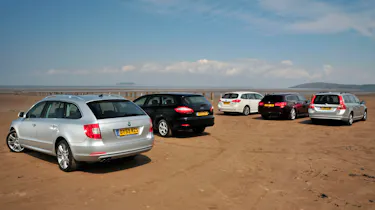
Call them what you like, but it’s hard to beat the practicality of an old-fashioned estate. While many of them are dubbed tourers or sportwagons, buyers shouldn’t be fooled: whether you’re off to the beach for a family holiday or the supermarket for the weekly shop, these cars are more flexible than most.
They have a tough brief, though, as buyers are offered more choice than ever these days. To see off the latest compact MPVs, crossover models and SUVs, modern load carriers need to look good, drive well and be affordable to buy and run.
Skoda hasn’t been put off by this list of demands, and its new Superb Estate took the scalp of the Vauxhall Insignia Sports Tourer on its road test debut . Here we rate the company’s 168bhp 2.0-litre diesel model against a selection of rivals.
First up is Volvo’s V70. The Swedes have a history of building practical family cars, and in DRIVe trim the V70 promises minimal diesel thirst. It’s joined by a former class champ, the Ford Mondeo, Honda’s Accord provides the style benchmark and Subaru’s 4WD Legacy has the kind of estate car heritage some rivals can only dream of.
Verdict
Estates come in all shapes and sizes – but the Skoda Superb is the best of this bunch. Its wide-ranging talents had us looking for weaknesses, and we struggled to find any. Not many cars do what they set out to do quite so effectively; the Estate is even better than the five-door. The Mondeo takes second. While it’s as good to drive as it’s always been, it can’t match the Skoda for interior quality or space. The Volvo isn’t cheap, but it’s supremely comfortable and practical. Don’t be put off by its 1.6-litre engine, as it delivers good economy and surprising pace. Fourth goes to the Honda. It handles well and looks fantastic, yet it’s simply not practical enough. That leaves the Subaru bringing up the rear. Its practical boot and four-wheel drive provide genuine appeal, although it has to rank as an alternative choice.
First place: Skoda Superb
Few cars carry as much expectation as the new Skoda Superb Estate. The five-door model swept all before it to be crowned Best Family Car at last year’s Auto Express New Car Awards. The manufacturer is also the reigning champion in our annual Driver Power owner satisfaction survey. Does the load carrier live up to our high hopes?
Used - available now

2018 Skoda
Superb
92,720 milesManualDiesel1.6L
Cash £7,995
2018 Skoda
Superb
67,922 milesManualDiesel1.6L
Cash £8,395
2018 Skoda
Superb
70,584 milesAutomaticPetrol2.0L
Cash £10,095
2019 Skoda
Superb
94,037 milesAutomaticDiesel2.0L
Cash £8,499As with many rivals, the Estate looks better than the hatch. This is partly down to the five-door’s TwinDoor tailgate – the hauler is more conventional, and doesn’t demand styling compromises.
It’s neatly styled and well proportioned, and arguably the most attractive choice in this test, too. While it’s not as overtly sporty as, say, the Honda, the Superb’s clean design and smooth rear are very easy on the eye.
Inside, it feels as classy and well built as the hatch. Its simple centre console is easy to navigate and constructed from high-grade plastics. It looks and feels good enough to rival compact executive models for quality.
Elegance trim brings lots of kit, including sat-nav and an electrically adjustable driver’s seat. But as with the other cars, the powered seat doesn’t lower far enough for really tall owners to feel truly at ease – although this is less of a problem in cars with manual adjustment.
It’s telling that this is just about our only complaint inside. The rear seats are really spacious, providing limousine levels of legroom. Anyone who carries teenagers and adults in the back regularly should pick the Skoda.
And the boot follows this lead. With the seats in place, the wide load area provides 633 litres of luggage capacity – that’s over 200 litres more than the Honda – although a full-size spare tyre under the boot floor costs £65.
The Skoda is the only car in our group with a small lip at the edge of its opening, but it doesn’t really make loading or unloading especially tricky. Fold the split rear seats and the Superb provides 1,865 litres of space, making it the number one for practicality. They don’t fold completely flat, though.
It’s just as impressive on the move. Despite costing less than most of the other cars here, the Skoda packs more punch, thanks to its powerful 168bhp 2.0-litre common-rail diesel engine. Its six-speed box isn’t as enjoyable to use as the sporty Honda’s, but it’s light and the well spaced ratios help to stir strong mid-range pace from the engine. And through a series of bends, the big Skoda handles with impressive poise and agility.
It also rides well, coping admirably with scarred surfaces and deep potholes. Add good high-speed refinement, and it’s a genuinely talented long-distance cruiser. The Skoda even performed strongly in terms of efficiency, returning an impressive 42.3mpg in its time with us. It’s proof that you can have your cake and eat it.
Second place: Ford Mondeo
We've always been big fans of the Ford Mondeo. Excellent driving dynamics and great value for money have made it a family favourite. But with more competition than ever for estate car honours, does it have what it takes to keep up?
First impressions are mixed. Our mid-range Titanium model sits above the lesser Zetec variant used for our pictures, but misses out on the styling additions that come as standard on higher-spec Titanium X Sport models. As a result, we think it’s short on visual flair.
Buyers wanting a bit more design polish do have options, though. Ford offers a £500 Style Pack that adds 18-inch alloys, tinted rear windows and silver-finished roof rails. They sound like minor additions, but they transform the family mode.
Climb aboard and you’re greeted by a well laid-out cabin packed full of equipment. All models get air-con, cruise control, a Quickclear heated windscreen and Bluetooth connectivity as standard.
Rear passengers have plenty of space to stretch out in, too – there’s masses of leg, shoulder and headroom on offer. It’s a similar story up front, although the seats fitted to the Zetec in our photos proved too firm, and we struggled to get comfortable on the 300-mile round trip to our photoshoot location. Part-leather seats are a £750 option, and are more cosseting and supportive over long journeys. We have no complaints about the size of the boot. At 542 litres, it comfortably beats the Accord’s 395 litres, but falls short of the Superb’s huge 633-litre luggage area. Fold the rear seats flat, and the Mondeo’s 1,733-litre area is the second most spacious on test.
There are also plenty of useful nooks and crannies, and the rear squabs pivot forwards to provide a flat load area when the seats are folded. Take to the road, and the Mondeo continues to impress. The 2.0-litre TDCi diesel fitted to our model isn’t the most powerful engine here, providing a mere 138bhp to the Skoda’s 168bhp. But it does deliver that power very progressively, and torque increases on the overboost to 340Nm, which means in-gear punch is impressive.
The manual gearbox provides slick shifts and is simple to use, while the steering is light but wonderfully precise. Add a responsive brake pedal, a comfortable ride and a well insulated cabin, and the Mondeo asserts itself as a balanced all-rounder.
It’s economical, too. In our hands, the Ford returned 45.1mpg – a figure only the much slower Volvo could beat.
The clincher, though, could be the price. At £22,295, the Ford is the cheapest car here by at least £2,500. The only worry concerns residual values, which are the worst of all the cars on test.
Third place: Volvo V70
Meet the international superpower in the estate class! Volvo’s boxy load carriers have a near-mythical status among motorists who value space over everything else. The firm’s smaller V50 adds a dash of style to the mix, but the V70 tested here follows a more traditional template.
The angular profile of the bluff estate features a vertical tailgate, designed to optimise boot space. And this tells buyers an awful lot about the approach of the Swedish brand, because the V70 puts practicality first.
Distinctive light clusters that rise up the rear pillars and Volvo’s familiar grille up front provide some visual interest, but this is the least striking car in our group in terms of looks.
Things improve on the inside, where the V70 has a neat interior. The trademark floating centre console, simple instruments and comfortable seats combine with smart switchgear and decent materials to provide an attractive cabin. Only the clumsy remote control-operated sat-nav (£1,500) spoils things. Rear passengers enjoy plenty of leg and headroom, while the boot is a masterclass in maximising space. The floor is long and wide, with a flat load lip and the least amount of wheelarch intrusion on test.
Practical touches include a handy flip-up load divider to restrain smaller objects, plus aluminium floor rails with tie-down points and a three-piece rear backrest. This allows long objects to lay between the two outer rear seats. And when you fold them all, they lie completely flat and boost space from 575 litres to a huge 1,600 litres. The good news for buyers is that the Volvo doesn’t demand huge sacrifices from behind the wheel.
The firm’s premium aspirations result in high prices, though, so for the same price as our 168bhp 2.0-litre Skoda, you’re looking at the 108bhp 1.6-litre DRIVe engine. And in SE trim, it’s more expensive than its Czech rival.
DRIVe spec is tuned to deliver maximium fuel economy, with revised aerodynamics and optimised gearing among a range of tweaks. The diesel is the smallest and least powerful on test, so predictably the V70 lagged behind its rivals at the track, but in traffic it only feels really lethargic from a standstill.
On the move, the torquey engine and long gearing demand a relaxed approach, although the Volvo is supremely comfortable at motorway speeds – despite being the only car with a five-speed box. Here, the small alloys and tall tyres come into their own, as the big sidewalls combine with supple suspension to smooth outbumps and ruts. Only when you fling the estate into a corner do the flaws show. There’s plenty of grip, but body roll is pronounced and the car isn’t as responsive as rivals.
The V70 is exactly as Volvo fans would expect – and is unlikely to disappoint any estate car buyer.
Fourth place: Honda Accord
The previous-generation Accord forged a reputation for estate car excellence, but the current model has taken a slightly different tack. While the old car made a virtue of its proportions, with an exaggerated chopped-off rear end, the latest one arrived in 2008 with a more dynamic look.
A sleek profile, thrusting grille and tapering roofline give the Honda the most racy appearance of all our contenders – a look that’s underlined by the GT’s aero bodykit and smart alloy wheels. But does it still make a great estate?
Inside, anyone familiar with the car’s European rivals can be forgiven for being overwhelmed by the sheer number of buttons on display.
The centre console is initially confusing, although once you get used to the controls, the various functions work quickly and logically. Thanks to the car’s high waistline and big transmission tunnel, the cabin has a cosseting rather than spacious feel, but the driving position is comfortable, and offers plenty of scope for adjustment.
Plus, ES GT trim includes luxuries such as Bluetooth and a USB port.
The cosy ambience continues in the back, where passengers get very little legroom for a vehicle in this class. It provides the least amount of space for occupants in the rear, and as a result is a compromised choice for family buyers with a couple of teens to accommodate. Open the tailgate and the boot follows a similar trend.
While the load space is beautifully trimmed, its capacity of 406 litres is below par here. And as the Japanese firm doesn’t provide a luggage figure for the car with the rear seats folded, direct comparisons are difficult. Even so, its narrow load area looks and feels smaller than its rivals with the back seats down.
The rear does house a big underfloor cubby – fine for a soft holdall or pair of laptop bags – and you get covered storage panels on either side. But there’s no spare wheel and the height of the boot opening is the shortest on test.
What the Honda lacks in practicality it makes up for on the road, as it’s great to drive. From its powerful and smooth diesel engine to its rifle-bolt six-speed gearbox and agile handling, the Accord is an engaging choice.
The ES GT comes with sports suspension, which adds to the car’s personality, yet still copes with bumps well. It can fidget on rough surfaces, but strikes a fine balance between being entertaining and comfortable.
The i-DTEC engine is a key part of the car’s appeal. It delivers 350Nm of torque and has the character of a petrol, as it thrives on revs. Yet it doesn’t do well at the pumps, returning 37mpg in our test – less than its main rivals.
As a sporty, desirable hatch, the Honda makes sense, but view it as a practical carry-all and the cracks begin to show. Will that cost it dear in the final analysis?
Fifth place: Subaru Legacy
Think Subaru, and the chances are you imagine a flame-spitting Impreza blasting through a forest on its way to World Rally Championship glory. But before the Japanese brand established itself as sporty, its foundations were laid in the UK by practical estates like the old L-Series.
The latest cars still subscribe to this model’s workmanlike approach, although the Legacy continues to be viewed as an alternative choice. It was given a makeover last year, but the heavy-handed changes have taken away some of its appeal. While the clean and attractive lines are now more distinctive than the original’s, we’re not sure the sharper features are an improvement.
Inside, Subaru didn’t go far enough with its updates. Although there’s enough space, with more rear legroom than in the Volvo and Honda, the Legacy’s cabin is sure to polarise opinion.
The design is incredibly dated compared to its rivals, and while build quality is beyond criticism, the cheap plastics and switchgear are no match for Europe’s best. The large glass area does provide a light and airy feel, though, and our SE model comes generously equipped, with heated front seats, plus leather trim, as in the Skoda and Volvo.
Of course, these cars are all about load space, and the Subaru picks up points here. With the seats in place, its large 526-litre boot is competitive; fold them, and it expands to 1,677 litres. Plus, at the side of the load area is a set of nifty handles, which release the rear backrests. The rest of the boot is unflashy but effective, although it misses out on the lidded cubbies, sliding rails and boot dividers included in the Skoda and Volvo.
The Subaru’s unique selling point is its all-wheel-drive transmission, which holds obvious appeal if you plan to use the car for towing, or tackling wet grass or bumpy back lanes. In these conditions, the Legacy is peerless – but it’s less convincing on the road. The 2.0-litre boxer diesel is outclassed by the more powerful Skoda and Honda units. While in-gear punch and overall refinement are fine, the notchy gearbox emphasises the short first ratio. Plus, the light steering doesn’t inspire confidence and takes some getting used to.
The firm’s sporting heritage shines through on twisty roads, where the Legacy generates lots of grip and impressive traction. There’s plenty of body roll if you attack bends with commitment, but the Subaru is engaging and its 4WD chassis is reassuring – especially on slippery surfaces. The price you pay for this all-weather ability at the pumps is small. Our long-term Legacy averaged 40.0mpg, not far behind the Skoda and ahead of the Accord. But CO2 emissions of 168g/km are the highest here, so it isn’t the green choice.