Used Skoda Superb (Mk3, 2015-2024) review and buyer's guide
A full used review of the Skoda Superb covering the Superb Mk3 (2015-2024) and Superb Mk2 (2008-2015)

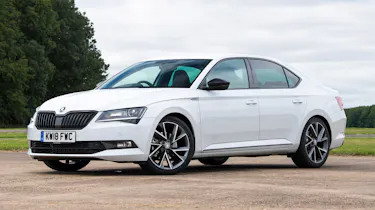
This year marks three decades since Volkswagen began its acquisition of Skoda, and it’s fair to say that since then the Czech brand – and its products – have been completely transformed. Although Skoda produced luxury cars in its distant past, before VW the focus was very much on cheap vehicles that weren’t always so cheerful.
In 1991 the idea of Skoda offering an upmarket car was unthinkable, but such was the pace of change with VW that within a decade Skoda introduced the original Superb, a stretched saloon based on the Passat platform. It proved so popular that a sequel came in 2008 (with the option of an estate), and an all-new third edition in 2015, also in hatchback or estate forms.
Models covered
- Skoda Superb Mk3 (2015-2024) - Big on space, and big on value, the Superb is one of the best used family cars around.
- Skoda Superb Mk2 (2008-2015) - You get a lot for your money with award-winning family car.
Skoda Superb Mk3 (2015 to 2024)
Skoda’s trophy cabinet is bursting at the seams with the Superb having won so many awards since it arrived. Auto Express and our sister title Carbuyer are just two of the many publications to have bestowed best-in-class status on the Superb. We named it Best Family Car in 2015, 2016 and 2017, while the Superb estate was also Carbuyer’s Best Estate Car in 2016, 2017 and 2019. There really is nothing else quite like the Superb when you take into account the equipment levels, build quality, dealer network and purchase prices on offer. With low running costs and excellent ergonomics also part of the mix, this really is a class-leading large family car in both hatchback and estate forms, which is why the Superb lives up to its name.
History
The third-generation Skoda Superb arrived in September 2015, and buyers could choose between 124/148bhp 1.4 TSI and 217/276bhp 2.0 TSI petrol engines, along with 119bhp 1.6 TDI and 148/187bhp 2.0 TDI diesels. There was also an ultra-frugal GreenLine edition with a 1.6 TDI engine, rated at 96g/km CO2 (97g/km for the estate).
Used - available now

2024 Skoda
Superb
92,860 milesAutomaticPetrol1.5L
Cash £11,995
2024 Skoda
Superb
33,952 milesAutomaticDiesel2.0L
Cash £21,845
2019 Skoda
Superb
70,378 milesManualDiesel2.0L
Cash £10,290
2018 Skoda
Superb
67,200 milesAutomaticPetrol2.0L
Cash £12,800Initially there were S, SE, SE Business, SE L Executive and Laurin & Klement trims available, but in June 2016 a SportLine option was added, with a SportLine Plus edition following in April 2018. Upgraded infotainment and improved parking sensors were fitted to most models from May 2017, then a more complete facelift in September 2019 brought LED headlights, improved driver-assistance systems and a refreshed nose – plus Skoda’s first ever plug-in hybrid model, the Superb iV.
Which one should I buy?
The 1.4 TSI engine is surprisingly perky, but the 1.5 TSI that replaced it in spring 2018 is even better. The 1.6 and 2.0-litre diesels offer more muscle with far better economy, so there are no poor choices, although the 2.0 TSI unit, while powerful, is thirsty.
Similarly the manual and automatic transmissions are user-friendly, while all Superbs are well equipped. Even the S has alloy wheels, Bluetooth and a DAB radio, while the SE adds dual-zone climate control, rear parking sensors, adaptive cruise control and power-folding door mirrors.
With SE Business you get front parking sensors, navigation, Alcantara trim and Drive Mode Select; SE L Executive adds bi-xenon headlights, leather trim and heated front seats. The L&K features three-zone climate control, a heated windscreen, park assist, a TV and keyless go.
Alternatives to the Skoda Superb
Price-wise the Superb is pitched against large family hatchbacks and estates such as the Ford Mondeo and Vauxhall Insignia, both of which are in reasonably plentiful supply, although they don’t sell in the quantities that they used to, and neither offers the interior space of the Skoda.
If you want a car with a similarly roomy cabin, you’ll need an executive saloon or estate, such as an Audi A6/A7, a BMW 5 Series or a Mercedes E-Class – all of which cost much more to buy, and their running costs are likely to be far higher, too. The alternative is to opt for an MPV instead, such as the Ford Galaxy, SEAT Alhambra or Volkswagen Sharan, all of which are ultra-practical, great value and decent to drive.
What to look out for
Dials
From October 2018, digital instrumentation could replace the standard analogue dash dials. This ‘Virtual Cockpit’ option cost £450-£550.
Wheels
Superbs in S trim have 16-inch wheels, SE brings 17-inch items, and SE L Executive/L&K get 18-inch rims. Smaller wheels improve ride comfort.
Towing
All Superb variants are capable of towing between 1,500-2,000kg, apart from four-wheel-drive models, which can pull 2,200kg.
Engines
Only the 148bhp 1.4 TSI and 1.5 TSI engines have Active Cylinder Technology. This shuts down two cylinders during light engine loads to save fuel.
Interior
The Superb’s cabin is really strong, and undoubtedly one of the highlights of the car. It has huge amounts of space and a user-friendly dash, offers lots of equipment, and gives good all-round visibility, while the car as a whole is built to a very high standard.
Entry-level Superbs don’t feel quite as special and feature a fair few blanking plates around the gearlever, for example, but as you move up the range, the materials used are much improved (such as leather/Alcantara upholstery), while the infotainment screens grow in size and improve in functionality. Boot space is deeply impressive, at 625/1,725 litres for the hatch (rear seats up/down); the estate is even better at 660/1,950 litres.
Prices
Check out the latest used prices for the Skoda Superb on our Find a Car service or use our free car valuation tool for prices on a specific car.
Running costs
Fixed servicing is every year/9,300 miles, alternating from minor to major, at £185 and £245. Or the alternative variable regime can see up to two years between services, but each is a major.
Brake fluid is required every other year; diesels need a cambelt every five years/130,000 miles, petrols are chain-driven. Pay every couple of years for an air-con service, every three years/30,000 miles for a 4x4 fluid change, and you'll need DSG fluid every four years or 40,000 miles.
Recalls
Skoda has issued eight recalls for the Superb Mk3 so far, the first of which came in December 2015 because a potentially unsecure cable clamp could lead to electrical problems. Four months later, examples of the car with a panoramic sunroof were recalled because of incorrect software, then in March 2017 faulty airbags and seatbelt pre-tensioners led to a third recall campaign.
Poorly made rear hubs led to recall number four in November 2017, then the fifth action came in May 2019, again because of airbag glitches – which was also the reason for recall seven, which was issued in February 2020. Faulty software leading to the engine stalling was behind the sixth recall, which came in September 2019; the most recent campaign came in February 2020 because eight Superbs had a faulty eCall system.
Driver Power customer satisfaction
The Superb came 10th in the 2020 Driver Power new car survey, 24th in the 2019 new car survey and 13th in the used car poll that year – impressive for a car launched back in 2015. To reinforce its desirability, it gets an average 4.2 out of five with owners who have left a review on carbuyer.co.uk. Buyers love its cabin space, quality, reliability, infotainment and big boot; the lowest scores are for handling and front-seat comfort.
Skoda Superb (2015-2024) review: What we said
Extracts from our 2023 in-depth review of the Mk3 Skoda Superb...
The handsome Skoda Superb is a revelation if you’re looking for a large family car with a premium feel and an affordable price tag. We rate it so highly we awarded the Superb our Family Car of the Year title in 2020.
To drive, it’s comfortable, quiet and relaxing whether you’re in the front or the back, and can even be hustled along at a fair pace. It’s easy to live with too, with a hatchback that opens onto an enormous boot. The practical interior has an upmarket feel, and there's a range of efficient and refined engines.
With generous levels of equipment, acres of space and a pleasant driving experience, the Superb is one of our favourite cars on sale and with very good reason.
About the Skoda Superb
The Skoda Superb has been a cornerstone of the Czech manufacturer's range for much of its recent history. Underpinned by Volkswagen’s ubiquitous and effective MQB architecture, the latest model was facelifted in 2019 to bring it up-to-date – and to maintain its lead over the large family saloon (and estate) competition.
The sales figures show that much of the car buying public are more likely to go for an SUV as family transport, but the Superb still holds strong appeal with its space, refinement and great value for money. Rivals such as the Vauxhall Insignia and the closely related Volkswagen Passat are no longer available, although the Mazda 6 is worthy alternative.
The Skoda Superb was the first model from the Czech firm to benefit from the VW Group's MQB front-wheel drive platform. It's one of the largest models to use it, but from behind the wheel the Superb does a great job of hiding its mass.
There are no complaints about legroom - the Audi A8 limo is about the only VW Group model to offer more rear seat space. The boot is very generous, too, with 625 litres on offer in five-seat mode, and 1,760 litres with the rear seats folded. And if that isn't enough space for you, then the Superb Estate is even bigger.
But there's much more to the Skoda Superb than space. It takes Skoda's 'Simply Clever' slogan to heart, with the ubiquitous umbrellas stored in the doors, ice scraper in the filler flap, one-handed bottle-opening cup holders and plenty of storage. Safety kit is comprehensive, too, with all of the latest VW Group tech on offer.
The Superb trim range comprises SE, SE L, SportLine Plus and Laurin & Klement (L&K) trims, and prices range from around £28,000 to £45,000. Entry-level SE models come well-equipped with 17-inch alloys, manual air con, electrically adjustable heated mirrors, cruise control, an eight-inch touchscreen infotainment system (with DAB, Bluetooth, Apple CarPlay and Android Auto connectivity) plus a suite of basic safety kit.
SE L trim takes another step with 18-inch alloys, privacy glass, full LED Matrix headlights, extra safety kit and sat-nav with wi-fi capability, plus a number of other upgrades.
Sportline Plus models focus on improving standard kit while adding a slightly sportier character to the Superb’s styling and interior, while Laurin & Klement models step on the toes of much pricier executive cars thanks to added leather, kit and Dynamic Chassis Control (DCC) adaptive suspension.
The Superb’s engine range was changed slightly in 2019. Today, there’s a similar mix of petrol and diesel engines, with the 1.4-litre petrol being replaced by the VW Group’s latest 1.5 TSI unit producing 148bhp. It’s available in SE trim and above with a choice of manual or DSG dual-clutch automatics and is joined by the more powerful 2.0 TSI with 187bhp, available on SE L models and up exclusively with a DSG ‘box. The fastest Superb models also use a 2.0-litre petrol, tuned to 276bhp and mated to a DSG gearbox and four-wheel drive for Audi-like all-weather performance.
For those with one eye on economy, the 1.4 TSI iV plug-in hybrid might well fit the bill. The 1.4-litre four-cylinder petrol unit is paired with a 113bhp electric motor, and combined the two systems offer 215bhp.
The 2.0-litre diesel range no longer includes the 120bhp version, leaving the 148bhp and 197bhp variants. Depending on specification these can be paired with manual and DSG ‘boxes, plus four-wheel drive capability on SE L cars.
Engines, performance and drive
The Superb’s mission is to be an executive limousine for the masses, so the focus is firmly on comfort and refinement ahead of pin-sharp driving dynamics. And whether you’re wafting around town or cruising quietly along the motorway, it’s clear that Skoda has done a great job.
Refinement is noticeably better than its predecessor, especially with the quieter petrol engines under the bonnet, making it a relaxing way to cover big miles. Four-wheel-drive versions grip harder when the weather turns nasty, but front-wheel-drive models feel just as planted the rest of the time.
Adaptive dampers are an option on SE cars and above, or standard on Laurin & Klement cars. They offer a dramatic effect on the Superb’s behaviour as you toggle through the three settings – Comfort, Normal and Sport.
In Comfort it floats over crests and dips, while the nose has a tendency to bob, and body control is too slack for fast cornering. Sport tightens everything up, but feels a bit too brittle on poor surfaces and with the larger wheels fitted to top-spec cars. Normal mode, then, is the best compromise for everyday driving.
If you want to save money then the manual gearbox is perfectly adequate, but we’d recommend stretching to the DSG auto that adds another layer of sophistication to the driving experience and suits the Superb’s laid-back character.
Go for a SportLine Plus model, and while the 19-inch alloys and subtly dropped ride height give the Skoda plenty of appeal, they do affect the ride quality slightly. It lacks the same absorbent edge as the standard Superb on the road, but the ride could never be considered uncomfortable. The optional Dynamic Chassis Control adaptive dampers help negate this a little when in Comfort mode.
The trade-off is that the Skoda is more direct on twisting country routes. The steering is sharper and less spongy than in some rivals, while there’s marginally more grip, too, because the Superb controls roll better.
Engines, 0-60 acceleration and top speed
The Superb’s engine range was revised in 2019, with petrol and diesel models still on offer to suit most buyers. The four-cylinder, 1.5-litre TSI petrol produces 148bhp and is available on SE models and above, mated to a six-speed manual or seven-speed DSG automatic gearbox. A 2.0-litre four-cylinder engine is also offered, producing 187bhp and available exclusively with a DSG gearbox.
The most powerful engine available is a 2.0-litre TSI petrol with 276bhp – enough for a 5.3-second sprint to 62mph in the hatch or 5.3 seconds in the estate. It’s an engine best enjoyed with the optional adaptive dampers, but even in conventionally sprung cars is fast and agile enough to keep up with some much sportier machinery.
Customers looking to the 1.4 TSI iV plug-in hybrid will benefit from a combination of a 1.4-litre four-cylinder petrol engine and a 113bhp electric motor, producing a total of 215bhp. In addition to the increased efficiencies on offer, the iV model brings decent performance, managing the 0-62mph dash in 7.7 seconds.
Diesel power is represented by a 2.0-litre unit offering outputs of either 148bhp or 197bhp, with the former needing 9.1 seconds to complete the 0-62mph run, and the latter just 7.3 seconds with the addition of four-wheel-drive.
MPG, CO2 and running costs
Despite it being a large, luxurious car, the Superb shouldn’t cost much more than a Skoda Octavia to run. The iV plug-in hybrid model brings new levels of efficiency, with Skoda claiming up to 248mpg - provided you ensure the battery is regularly topped up and make best use of the 20 miles of all-electric drive. Company car drivers, in particular, will be attracted by the CO2 emissions of 26-30g/km.
Although increasingly unfashionable, the diesel models are the next best option for those covering big distances. The 2.0-litre diesel in 148bhp form produces CO2 levels from 125g/km, while a claimed maximum economy figure of 59.3mpg remains impressive.
Petrol buyers know to expect reduced economy and increased CO2 emissions, but the Superb still manages to stay competitive. The 1.5 TSI, added to the range in 2019, is an efficient unit that can return up to 47mpg on average in SE hatch models; CO2 emissions for this model sit at 136g/km.
If you decide to go for the range-topping 276bhp four-wheel-drive model in high-spec Laurin and Klement trim, you'll see CO2 emissions of 185g/km and average economy of 34.6mpg on the combined cycle. Choosing an estate bodystyle will affect these figures slightly, with CO2 climbing to 188g/km and a reduction of 0.5mpg.
Interior, design and technology
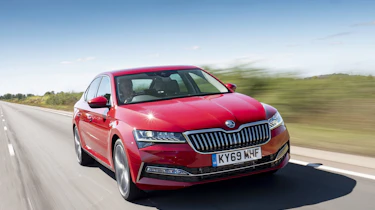
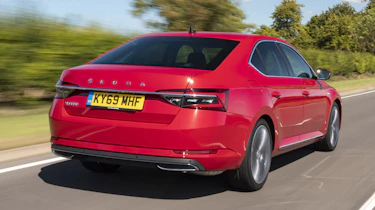
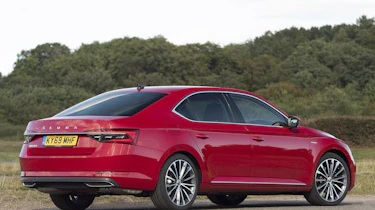
In the past, the Superb has been the ugly duckling of the large family car class, as Skoda’s efforts to maximise interior space left its flagship with some ungainly exterior proportions. However, the latest version has shaken off its predecessor’s dowdy image, with a facelift in 2019 improving things further. The facelift brought in new bumpers front and rear, a new grille and headlights, along with some new wheel designs. Inside, uprated infotainment was the most significant change.
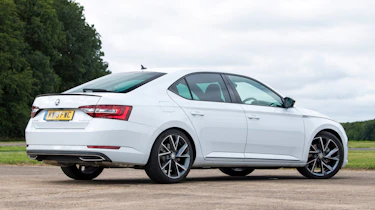
In profile the Superb has a traditional look, yet despite its saloon car proportions features a versatile hatchback tailgate – Skoda has ditched the old car’s Twindoor mechanism, which was complicated and heavy. Overall, the Superb has its VW Passat sister car beaten hands down for kerb appeal - especially in cool-looking SportLine trim.
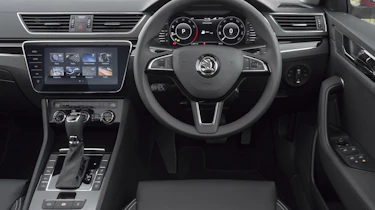
Inside, the Superb is more than a match for the VW. It features a slick design, a thoughtfully laid-out dashboard, plenty of high-grade materials and has a real premium feel.
Look closely and you’ll find much of the switchgear has been carried over from the Passat, while all the plastics you can see and touch have a soft feel. The fit and finish is first rate, while a wide range of adjustment on the seat and steering wheel makes it easy to find the perfect driving position.
As you’d expect from Skoda, there’s plenty of standard equipment. All models get heated mirrors, air conditioning, cruise control and an eight-inch touchscreen infotainment system with DAB and Bluetooth, plus all-important Apple CarPlay and Android Auto connectivity. The lack of standard sat-nav is a moot point if you are happy to use your smartphone through either of these systems.
Sat-nav, stereo and infotainment
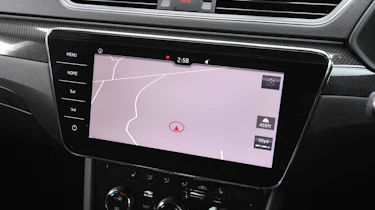
All cars come equipped with a dash-mounted touchscreen, with SE models getting the basic eight-inch ‘Bolero’ version, SE L getting a the ‘Amundsen’ unit with sat-nav and Sportline Plus and L&K cars getting the larger 9.2-inch ‘Columbus’ system. A Virtual Cockpit digital dial display is standard.
Practicality, comfort and boot space
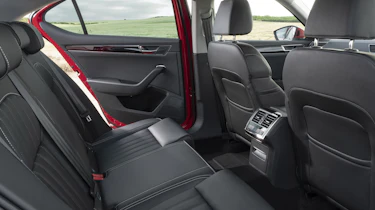
Once you’ve got over the acres of space that make sitting in a Superb feel like relaxing in your living room, it’s time to cast an eye over some of the clever ‘practical’ touches.
Useful features include a parcel shelf that can be slid behind the rear seats when you need it out of the way, a removable LED torch in the boot and a grippy cupholder in the front so you can unscrew bottle tops with one hand. Like the Octavia and Fabia there’s an ice scraper hidden in the fuel filler cap, while iPad holders can be fitted to the back of the front seats and there’s an iPad cradle in the storage bin between the front seats.
Big storage bins in the front doors, and slightly smaller ones in the rear doors, improve things further, as do cupholders in the pull-down central armrest in the rear. Features such as lane assist (which nudges the steering automatically to keep you between the white lines) and traffic jam assist (which steers, brakes and accelerates for you at slow speeds in jams) help to take the stress out of long journeys.
Size
The Superb’s roomy interior is one of its most attractive features, but Skoda hasn’t employed any trickery to make the space – the Superb is a big car on the outside as well. At 4,861mm it’s nearly as long as the 4,899mm BMW 5 Series.
Leg room, head room & passenger space
If you thought the previous Superb was cavernous, prepare to be surprised. This new model is larger in every direction, and while there’s no more legroom (there really wasn’t any need to add any), elbow room and headroom have increased both in the front and the rear, so three adults can sit in the back with space to spare. In fact, the only car the VW Group produces with more space in the back is the long-wheelbase Audi A8 limousine.
Boot
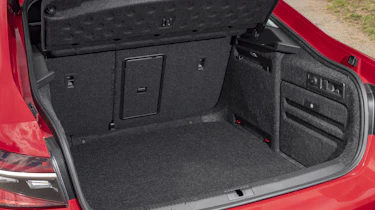
The boot in the Superb hatch measures 625 litres with the rear bench in place. Fold the split rear bench down using two levers in the boot and space increases to 1,760 litres. The space is deep, wide and extremely long with the rear seats down, so chucking a couple of bikes in there would be easy, even with all the wheels attached.
Now you can buy a car through our network of top dealers around the UK. Search for the latest deals…