Toyota and Tamiya build the mini hydrogen-powered Mirai RC car
The mini Toyota Mirai will go twice as far as a battery powered RC car and has been designed to show how hydrogen tech can be effective on a small scale

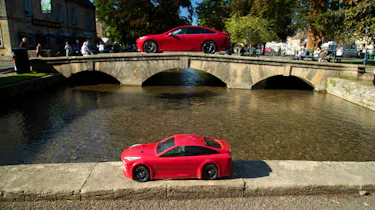
Every once in a while Toyota lets its engineers have some fun. The last time that happened, we got the rather excellent GR Yaris hot hatchback. This time, though, the brand’s boffins have downsized and, in conjunction with radio-controlled car specialists Tamiya, built an RC version of the Mirai which – you guessed it – runs on hydrogen.
The mini Mirai is one tenth the size of the actual car, but the technology that powers it is exactly the same. There’s a tiny hydrogen fuel cell under the body, which uses compressed hydrogen to generate 20 watts of electricity and drive an electric motor.
It means the Mirai RC can go twice as far as a conventional battery powered remote controlled car, and it has the same benefits as a full-size hydrogen vehicle. So, refueling times are fast, as the hydrogen is stored in a pair of quick-release canisters, and like the real Mirai, the only emissions made by the toy are water.
The technology for the RC car was miniaturised by Bramble Energy – a UK green energy supplier who specialises in hydrogen fuel cells. It was then bolted to Tamiya’s popular TT-02 chassis, which is a four-wheel drive platform popular with RC racers.
Toyota says it tackled the challenge of building the UK’s first hydrogen RC car to showcase the system’s breadth of ability. Following the success of the full-size Mirai, the firm aims to increase production of its fuel cells tenfold, to 30,000 units a year.
This will allow Toyota to expand its hydrogen fuel cells into different forms of transport, including haulage, and industrial energy applications. David Rogers, a Toyota spokesperson for alternative fuels, explained the company’s strategy, saying: “Cars are the tip of the iceberg for Toyota in terms of progress towards a hydrogen society.
“Hydrogen will play a key role in meeting our future energy needs, bringing zero-emission driving for both big cities and small villages. It allows us to store renewable energy and transport it easily, so that it can be used on demand to power a variety of industries.
“In Toyota collaborations across Europe you’ll increasingly see trials of fuel cell-powered buses, trains, boats and, who knows, maybe even homes. We undertook this challenge to have some fun and show what can be done with fuel cells and we think the results are great!”
Sadly, it’ll be quite some time before we can head down to our local toy shop and pick up a hydrogen-powered RC car, as it’s still far too expensive. But at least the technology has already been proven.
Now click here for our run-down of the greatest Tamiya RC cars, as well as some build tips for your own project…