BMW 3 Series review
The BMW 3 Series offers fine performance, driving dynamics, technology and refinement, but electric rivals are catching up

Our opinion on the BMW 3 Series
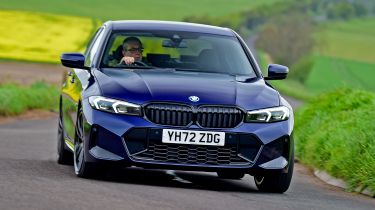
The BMW 3 Series has always been great to drive, offering engaging handling and sure-footed road holding. The latest model retains its driver appeal, punchy performance and impressive frugality, but has added a more luxurious driving experience, greater interior space and an impressive array of technology to its arsenal.
With its class-leading blend of performance and economy, the 3 Series went straight to the top of the compact executive class when it launched, and a number of updates over its lifetime have only strengthened this BMW’s hand.
About the BMW 3 Series
In spite of ever-increasing competition, the BMW 3 Series is a phenomenally successful model, with its six previous incarnations having sold over 15 million examples. The arrival of the seventh-generation G20 model in 2019 was the latest step in this important lineage.
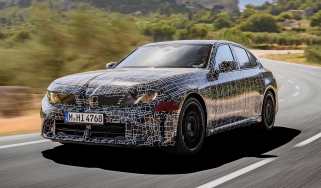
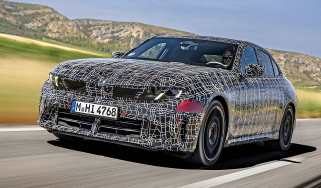
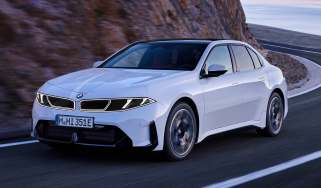
A facelift in both 2022 and 2024 introduced upgrades like revisited styling inside and out (taking inspiration from the larger BMW 5 Series), along with revamped engine line-ups and technology. The interior now features BMW’s ‘Curved Display’, with an instrument and infotainment panel that appears seamless and sits perched atop the dashboard, running BMW’s latest OS infotainment software.
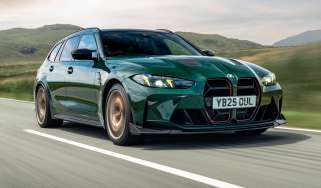
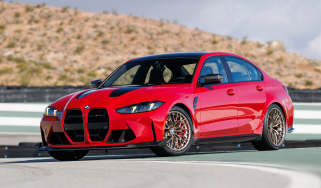
BMW has long offered a wide range of engines in the 3 Series, but today buyers only have the choice between petrol or plug-in hybrid power, because diesel is long gone. For those in need of a sizeable family car, there’s also an estate variant. If you’re looking towards this model, we also have a dedicated in-depth review of the BMW 3 Series Touring. Alternatively, if you crave performance over practicality, we also have a review of the BMW M3.
Used - available now

2020 BMW
3 Series
68,000 milesAutomaticPetrol2.0L
Cash £17,490
2024 BMW
3 Series
58,185 milesAutomaticDiesel2.0L
Cash £26,090
2024 BMW
3 Series
43,412 milesAutomaticPetrol2.0L
Cash £22,816
2022 BMW
3 Series
65,335 milesAutomaticPetrol2.0L
Cash £15,110This review focuses on the standard BMW 3 Series saloon, and our expert road testers have had plenty of encounters with this executive car since it first arrived in the UK. To fully understand what this big seller is like to live with every day, we spent six months with a 3 Series as part of our long-term test fleet, and were highly impressed by the sheer level of driving enjoyment and quality on offer for the price.
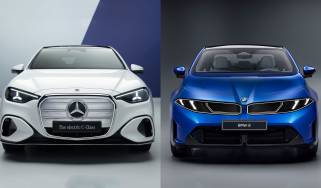
We also pit the 3 Series against its arch-nemesis, the Mercedes C-Class, in a real-world twin test. Here, the Bavarian exec managed to defeat its three-pointed star opponent thanks to its superior performance, technology, and finance deals.
BMW 3 Series prices and latest deals
The BMW badge is generally a highly desirable one, so you’ll need to be prepared to pay for the privilege. The base 320i Sport spec starts off the wider line-up at around £42,000, while the least expensive 330e plug-in hybrid is available for just over £47,000. At the top end of the regular 3 Series range sits the M340i xDrive, and this commands at least £62,500.
There’s no reason why you can’t save some money on a new BMW, though. In fact, you can save an average of £6,700 when you spec your new BMW 3 Series through the Auto Express Buy a Car service. We also have a number of new 3 Series models in stock, as well as some tantalising used BMW 3 Series offers. We can also help you sell your car.
Performance & driving experience
Pros |
|
Cons |
|
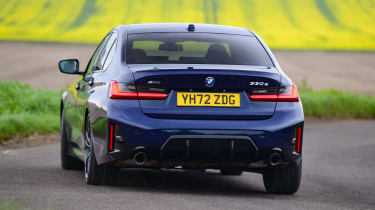
The BMW 3 Series has long been the default choice for those looking for an entertaining driving experience from their compact executive saloon. And for the most part, this latest incarnation of the 3 Series retains its crown as being the drivers’ car in the class. However, BMW has also attempted to increase refinement and ride quality to match the Mercedes C-Class. It’s a tough job to retain the 3 Series’ sporting appeal while also raising the bar in the comfort stakes.
| Model | Power | 0-62mph | Top speed |
| 320i Sport | 184bhp | 7.4 seconds | 146mph |
| 330e M Sport | 292bhp | 5.9 seconds | 143mph |
| M340i xDrive | 392bhp | 4.3 seconds | 155mph |
Performance, 0-60mph acceleration and top speed
The petrol range kicks off with the 186bhp 2.0-litre four-cylinder 320i, which can only be specified with rear-wheel drive (it used to have the option of xDrive four-wheel drive). It manages the 0-62mph run in 7.4 seconds and has a top speed of 146mph.
The plug-in hybrid 330e mixes a 2.0-litre four-cylinder turbocharged petrol engine with an electric motor for a total output of 296bhp and 420Nm; enough for 0-62mph in 5.9 seconds, and a top speed of 143mph. Meanwhile, the sporty M340i has a 3.0-litre straight-six with 369bhp and four-wheel-drive as standard. The 0-62mph dash takes just 4.3 seconds, and it’s limited to 155mph.
Keen drivers who don't want to spend over £80,000 on a brand new BMW M3 will be best served by the M340i. It’s effortlessly fast and – thanks to standard xDrive four-wheel drive – has loads of grip and traction.
However, it's best to consider this car as a fast, capable cruiser, because it’s good to drive but doesn't feel much different to M Sport models. Adaptive suspension is standard on the M340i, making for great ride quality if Comfort mode is selected. Things sharpen up in Sport, and while some may find it a little uncomfortable, it offers a marked improvement in dynamics on the right piece of road.
Town driving, visibility and parking
Driving the 3 Series in the city should prove pretty uneventful. While you won’t be able to enjoy it as much as if you were out on the open road, you will at least be comfortable and pretty unbothered by narrower streets due to the high level of front and over the shoulder visibility on offer.
Parking is a slightly different story, though, as we found the BMW’s rather chunky C-pillars restricted our rear visibility. Thankfully, every model comes with BMW’s Parking Assistant pack as standard, which consists of a camera and all-round sensors. It also includes an automatic parking function that remembers reverse parking manouvres, if you want to take even more effort out of the process.
Country road driving and handling
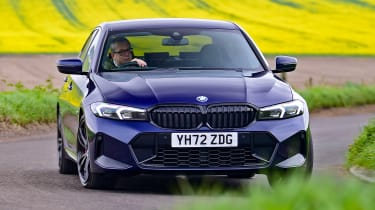
BMW has managed to deliver on its ambition to pretty much fully balance excitement and refinement, as the 3 Series is still a very entertaining car to drive, with impressive road holding and improved ride quality over its predecessor. Part of this improvement is thanks to BMW’s new stroke-dependent suspension damper technology, which is a standard feature on all models. When the car is carrying a light load, the damping rate is softer, resulting in a compliant ride.
However, when the car is fully laden with passengers and luggage, the damping is stiffer to take into account the heavier load, which results in appreciably better body control without unduly affecting the ride quality. For the most part, it works very well, but part of the improvement in the 3 Series’ ability is also the result of using BMW’s CLAR platform. This has reduced weight by up to 55kg, and increases body rigidity by up to 50 per cent. It’s an impressive feat given that the latest 3 Series is larger than its predecessor.
Motorway driving and long-distance comfort
On the motorway, the 3 Series is an accomplished cruiser, offering lower noise levels than it exhibited previously, partly thanks to the standard fit acoustic glazing. The ride is good too, and while in the past we might have recommended the optional adaptive dampers that can be specified as part of the M Sport Pro pack on M Sport cars, this is no longer necessary thanks to the stroke-dependent dampers. On the largest wheels, there is an occasional thump from the worst potholes, but it’s certainly no worse than its rivals in this respect.
The 3 Series lives up to the driver appeal expected of the model with excellent poise and agility, comfortably beating both the Audi A4 and Mercedes C-Class in this respect. But like its rivals, it does suffer from having slightly lifeless steering that doesn’t offer keen drivers a huge amount of feedback. Despite this, the 3 Series is still a drivers’ car, with excellent grip and composure. And while the steering rack lacks feel, it is quick, enabling accurate, rapid corrections to your cornering line.
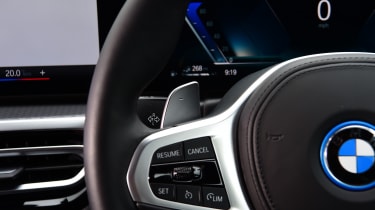
Range rationalisation means the six-speed manual has been dropped, and all models now come with an eight-speed ZF automatic. That’s not a major issue in our view because the automatic is an excellent transmission with smooth changes whether the gearbox is left to its own devices or if you change gear manually using the standard steering wheel-mounted paddles.
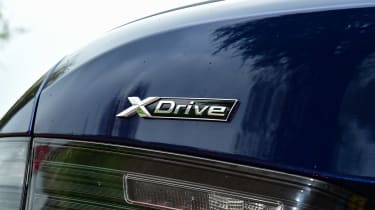
BMW’s xDrive four-wheel drive system, as fitted to the M340i and M3, gives a surefooted feel with plenty of traction, no matter the conditions.
“The 330e manages to deliver a better balance between entertaining handling and cruising comfort than the Mercedes C 300 e. Both cars are punchy off the line thanks to their electric assistance, but the weight of the drive battery also means they’re not quite as agile as their petrol counterparts.” - Dean Gibson, senior road test editor.
MPG & running costs
Pros |
|
Cons |
|
The latest 3 Series offers decent economy across the board, and CO2 emissions are relatively low. All quoted figures here are for the saloon, although 3 Series Touring buyers should factor in a slight dip in fuel economy and an increase in emissions because of the extra weight of its estate car body.
The most efficient of the petrol engines is the 320i Sport with a claimed WLTP combined maximum of 42.8mpg and 154g/km of CO2. In comparison, a Mercedes C200 manages up to 45.6mpg, so it has a tiny advantage over the BMW here.
The BMW M340i, on the other hand, is the least efficient model in the range with its six cylinders and weighty four-wheel drive system. It isn’t too far behind the 320i, though, a claimed 40.4mpg and CO2 emissions of 159g/km.
| Model | MPG | CO2 | Insurance group |
| 320i Sport | 42.8mpg | 148g/km | 28 |
| 330e M Sport | 353.1mpg | 19g/km | 34 |
| M340i xDrive | 40.4mpg | 159g/km | 39 |
Electric range, battery life and charge time
The plug-in hybrid 330e is capable of travelling up to 63 miles using fully electric power when charged. While the official 353.1mpg figure looks remarkable, it’ll be near impossible to replicate this in the real world, and efficiency will drop even further if the battery is out of charge. We saw an average of 43.2mpg when we tested a 330e that we intentionally left with no charge, which is still better than the petrol cars, but not by much.
As with any PHEV, you’ll need frequent top-ups to get the best out of this variant, and charging the 330e will take a little under four hours when using a 7.4kW home wallbox charger.
| Model | Battery size | Range | Insurance group |
| 330e M Sport | 19.5kWh | 62 miles | 34 |
Insurance
Insurance groups for the 3 Series saloon and Touring models are competitive and range from 28 (out of 50) for the 320i in both Sport and M Sport trims, to group 39 for the M340i xDrive.
This means the 3 Series won’t be notably cheap to insure (which probably comes as little surprise), but it’s still a bit more affordable than covering the Tesla Model 3. This electric rival starts in insurance group 36 in standard rear-wheel drive form, with the long range all-wheel drive starting in group 41.
Check your tax status and renewal date in seconds. Check your VED car tax now...
Tax
The plug-in 300e is the best choice in the 3 Series range for company car drivers due to its slightly lower Benefit-in-Kind (BiK) tax rate. However, these savings still won’t come close to those offered by fully electric executive cars like the BMW i4, Tesla Model 3 and Polestar 2.
Because it’s a premium car with an equally premium pricing structure, every 3 Series surpasses the £40,000 luxury car tax threshold. This means you’ll need to factor in a combined annual road tax charge of over £600 between years two and six after the first year tax fee.
Depreciation
Thanks to the lure of the premium badge, the BMW 3 Series has never suffered from terrible rates of depreciation, but as with the C-Class and the Audi A4, the sheer number of these premium models being sold each year has ultimately had a slight softening effect on their residual values.
Our expert data suggests that the 3 Series saloon should retain between 46 and 51 per cent of its initial value after three years and 36,000 miles. The strongest performer here is the 320i M Sport, while the worst is the 330e Sport. In comparison, the Mercedes C-Class is set to only hold on to 42 to 47 per cent after the same period of time. If you’re considering an electric car instead, the BMW i4 manages 41 to 44 per cent.
To get an accurate valuation on a specific model check out our free car valuation tool.
Interior, design & technology
Pros |
|
Cons |
|
The G20 3 Series is instantly recognisable as belonging to the BMW family, but it does seem to be a somewhat evolutionary design. And while the car’s looks are obviously subjective, we feel it’s a little bland from some angles. From the front, it’s instantly recognisable as a BMW with its trademark headlights (LED throughout the 3 Series range) and the kidney grilles remain, but from the rear, it’s perhaps less recognisable as a BMW.
Interior and dashboard design
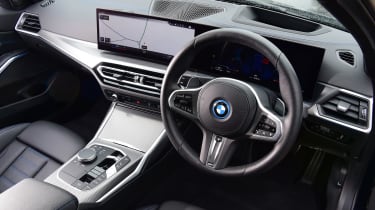
The BMW’s dashboard design works seamlessly with the new technology on board, which saw a big change with the facelift, thanks to the introduction of BMW’s ‘Curved Display’. This looks like a single ‘floating’ screen, but is in fact a 12.3-inch driver’s instrument panel and 14.9-inch touchscreen in a wide-screen format, running the latest OS software.
Materials and build quality
The 3 Series is based on BMW’s CLAR (short for Cluster Architecture) platform that was first introduced on the previous-generation 7 Series back in 2015. Today, these underpinnings are also used for the 5 Series saloon. Because of this, the BMW 3 Series boasts an interior that’s befitting of its pricier brethren. In other words, it’s an excellent, high-quality cabin throughout.
Infotainment, sat-nav and stereo
A DAB radio comes as standard, as do three years of free satellite navigation and connected services, which give you access to BMW Apps informing you about live weather and traffic reports. Apple CarPlay and Android Auto smartphone connectivity are also standard across the 3 Series range, while the car's Emergency Call system automatically calls emergency services in the event of a collision.
The stereo, along with many other functions, can be accessed via the central control display as a touchscreen, via voice commands or through the iDrive controller. While it can seem a little bewildering at a glance, those coming from a previous generation 3 Series will have no trouble operating the system, and it soon all becomes second nature once you’ve gotten the hang of it.
Unfortunately, some physical buttons for the climate control and the heated seats have migrated to the touchscreen, which we find more distracting to use on the move than before.
Our other criticisms concern the reversing camera, which rotates with the steering lock, and makes it hard to figure out when you’re aligned with a parking space. The digital dials work well enough, but the graphics look a bit fussy, and it isn’t as configurable as Audi’s Virtual Cockpit.
“While the cabin of its Mercedes rival undoubtedly looks more contemporary, there’s very little to choose between the two when it comes to quality. Both feel expensive and well finished, but the BMW’s driving position is excellent, with a steering wheel that has plenty of adjustment for reach.” - Alex Ingram, chief reviewer.
Boot space & practicality
Pros |
|
Cons |
|
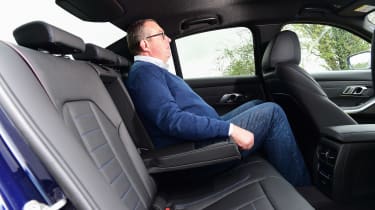
The 3 Series is bigger than before, and the focus for BMW has been on improving accommodation for those in the back. As a result, it now offers a similar amount of space to the Mercedes C-Class. BMW says the 3 Series is now wide enough to accommodate three child seats side by side in the rear, but only the two outer positions have Isofix points.
Dimensions and size
As with most new cars, the 3 Series has grown compared to its predecessor. The Mercedes C-Class is also a touch narrower than the BMW. What has changed significantly for the BMW 3 Series is that its wheelbase has been extended, giving rear passengers more leg room.
| Dimensions comparison | |||
| Model | BMW 3 Series | Mercedes C-Class | Tesla Model 3 |
| Length | 4,714mm | 4,793mm | 4,720mm |
| Width | 1,827mm | 1,820mm | 1,850mm |
| Height | 1,446mm | 1,446mm | 1,441mm |
| Wheelbase | 2,850mm | 2,865mm | 2,880mm |
| Boot space | 480 litres | 455 litres | 594 litres |
Seats & passenger space
Both front seat occupants should be able to find a comfortable position with a good range of seat adjustment and a steering wheel that’s adjustable for height and rake. Cloth seat trim is standard with the Sport trim, or you can option BMW’s ‘Sensatec’ upholstery for just under £700.
This is a vegan-friendly alternative to leather which does quite a convincing job of looking like leather and is perforated for greater comfort. A genuine leather option called Vernasca is also available for a fairly steep price of just over £1,800 and has to be included with the optional Sports front seats (£325). Moving up to M Sport adds in part-Alcantara upholstery, along with the option of genuine leather.
If the 3 Series had previously been a little tight in the rear for three passengers, it now offers a decent amount of legroom. That’s thanks to the increase in wheelbase, but if three adults are carried in the rear, the middle seat passenger might feel a little hard done by because the middle seat base is firm, and has little room for your feet due to a sizable central tunnel where mechanical gubbins like the exhaust and propshaft run through – something that doesn’t exist in the all-electric Tesla Model 3 with its completely flat floor.
There should be no complaints about the amount of headroom though, because the 3 Series offers a few millimetres more than the Mercedes C-Class. There’s plenty of room for storing oddments too, with decently sized door pockets.
The driver and front seat passenger fare very well with comfortable and supportive seats. One slight disappointment is that lumbar support is an option rather than a standard feature, but this can be added as a reasonably priced single extra for £225, or as part of the near £1,600 Comfort Pack. Unfortunately, you will still have to pay around £1,000 more for electrically adjustable front-seat with driver memory settings, a feature that comes as standard with the Tesla Model 3.
Boot space
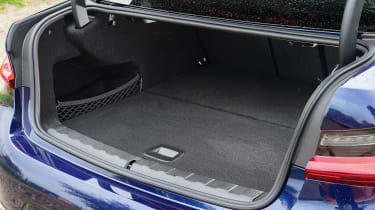
While the 3 Series has grown in size, the same cannot be said of its boot, which stays at 480 litres – the same as the previous generation model. It should be more than adequate for most buyers without being class-leading, but it does at least beat the Audi A5 (445 litres) and Mercedes C-Class (455 litres) for capacity.
However, the 3 Series isn’t as versatile as the Tesla Model 3, which not only has a large boot with a sizable underfloor storage area, but also a front boot big enough for another carry-on bag.
As standard, the 3 Series has 40:20:40 split folding rear seats that improve its practicality, along with some handy nets in the boot compartment to stop small items rolling around. An electrically operated boot lid is available as part of the Comfort Pack, allowing the lid to be opened by swiping your foot under the rear bumper.
“The 3 Series is set up to cope with everyday life. Isofix child seat fittings are fitted as standard in the back, and they’re easily accessible behind removable plastic covers.” - Alex Ingram, chief reviewer.
Reliability and safety
Pros |
|
Cons |
|
The BMW 3 Series was voted into 24th place out of 50 cars in the most recent Driver Power best cars to own results. This shows there’s a fair amount of room for improvement, especially as the Mercedes C-Class wound up in fifth place.
BMW put on a reasonable performance in the best manufacturer rankings, though, with an eighth-place ranking out of 31 brands. This put it ahead of Audi and Tesla, but it couldn’t outshine Mercedes and Lexus.
Euro NCAP put the seventh-generation 3 Series through its rigorous safety testing procedure in 2019 and awarded it a full five stars – although that rating doesn’t apply to the M340i and 330e plug-in hybrid models, the latter needing additional testing.
Additional safety systems come under what BMW terms Active Guard Plus. This includes speed limit information to warn you about the limit on the road you’re driving on, lane departure warning to let you know if you are straying out of your lane, a collision and pedestrian warning system with a city brake function to put the brakes on if it thinks you’re going to hit something to either avoid or mitigate a collision, and cruise control with a speed limiter function. A BMW Emergency Call service is offered as standard, which can alert the emergency services in the event of a collision.
For a more comprehensive suite of safety systems, buyers can add the Driving Assistant Professional package for around £1,300. This includes adaptive cruise control to keep you a safe distance from the vehicle in front, a steering assistant to help keep you in the middle of your lane on the motorway, and a lane-keeping assist system to not only keep you within your lane, but also intervene if you’re about to collide with a vehicle travelling alongside you in your blindspot. There’s a wrong-way warning system that detects ‘wrong way’ signs if you happen to drive down a road in the wrong direction, and a cross-traffic alert system to warn you of vehicles crossing your path when reversing or entering a main road from a junction.
| Euro NCAP safety ratings | |
| Euro NCAP safety rating | Five stars (2019) |
| Adult occupant protection | 97% |
| Child occupant protection | 87% |
| Vulnerable road user protection | 87% |
| Safety assist | 76% |
Buying and owning
- Best buy: BMW 320i M Sport
The petrol-powered BMW 320i provides a healthy dosage of power and efficiency, so this is the model we recommend the most. Moving up to M Sport trim adds extra mod-cons that make the car feel just that bit more premium and performance-focused.
However, company car buyers will be better catered for by the 330e or fully electric BMW i4 due to the considerably larger tax savings on offer.
BMW 3 Series alternatives
The Mercedes C-Class has been a key BMW 3 Series rival for decades, and this car provides more of a focus on plushness than sportiness, if that’s your thing. Another long-standing competitor is Audi, but due to this brand’s revamped naming process, it’s the Audi A5 that finds itself competing with the 3 Series now, rather than the A4.
There are an increasing number of electric executive cars that are worth considering, too. The BMW i4 shares many similarities with the 3 Series, so this is the most direct alternative. However, the Tesla Model 3, Polestar 2, Hyundai Ioniq 6 and BYD Seal also possess many attractive qualities.
BMW 3 Series history
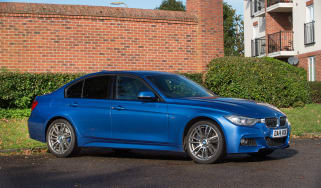
BMW 3 Series F30 Mk6: 2012-2018
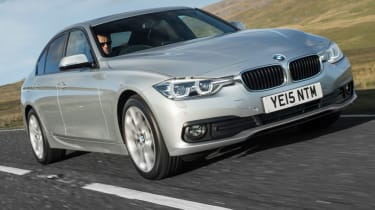
A well-looked-after Mk6 BMW 3 Series should make a great used buy; comfortable, well-equipped and good to drive, the F30 range also offered powerful, efficient engines in petrol, diesel and plug-in hybrid form. Cars produced after July 2015 received a facelift, with sharper exterior styling and the introduction of LED headlights, along with BMW's iDrive system being fitted as standard on all models.
If you're after plug-in hybrid power, you'll be looking at a post-2016 car. Sport, Modern, and Luxury trim levels offer a slightly different look from the ubiquitous M Sport-spec versions. The Mk6 3 Series had six manufacturer recall notices during its lifetime, so be sure to check all remedial work has been done before you buy. Read our full Mk6 BMW 3 Series buyer’s guide here…
Frequently Asked Questions
We think the BMW 3 Series is one of the best cars in its class. It’s highly enjoyable to drive and boasts some excellent on-board technology, but this hasn’t resulted in the sacrifice in overall refinement.
More reviews
Which Is Best