Best winter tyres 2026
Our testers warmed to the task of finding the best cold-weather rubber for your car
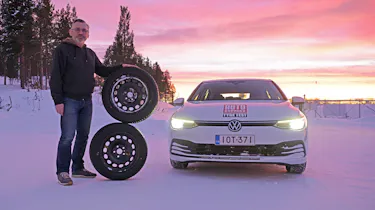

We have a bumper entry for this year’s winter tyre test, which returns to the big-selling 205/55 R16 size, last tested back in 2024.
Parts of the UK can go the whole winter without seeing any snow, which is why so many of us take the chance and run summer tyres all year round. But winter tyres are not only the ultimate solution for our worst weather, they’re also designed to work better in very cold conditions, regardless of whether there’s any precipitation.
Our packed, 11-tyre field includes the Continental WinterContact TS 870, now a two-time winner in this size. Can it make it a triple crown?
Out to beat it is last year’s runner-up, the Goodyear UltraGrip Performance 3, and the third-placed Hankook i’cept RS3 W462, while fourth-placed Pirelli fields its new Cinturato Winter 3. A couple of big names return, too: Michelin with the Alpin 7 and Bridgestone with the Blizzak 6.
There are also five other contenders: the Falken Eurowinter HS02 and renamed Linglong Sport Master Winter HP have been seen before. Plus we have the Dunlop Winter and Maxxis Premitra Snow WP6, and a budget offering: the Minerva Frostrack HP.
What we tested
As usual, we purchased all test tyres from the open market via an independent wholesale supplier in Germany to ensure that the tyres we tested are consistent with any you can buy.
Used - available now

2025 Volkswagen
T-Roc
63,605 milesManualDiesel2.0L
Cash £13,610
2026 Audi
A1 Sportback
15,203 milesAutomaticPetrol1.0L
Cash £17,660
2022 MG
HS
8,889 milesAutomaticPetrol1.5L
Cash £15,110
2023 MG
HS
3,897 milesAutomaticPetrol1.5L
Cash £17,060We let the manufacturers nominate variants, with all opting for a speed rating of V (149mph) or W (168mph), and a weight rating of 91 or 94, with several opting for Extra Load (XL). EU label ratings (self-certified by the maker) are included for fuel economy (RR – rolling resistance) and wet grip (WG). These range from A to E, with A being best, plus pass-by noise (N) measured in decibels, so the lower the number the better.
| Bridgestone Blizzak 6 Enliten | 91H RR: C WG: B N: B (70) | £108 |
| Continental WinterContact TS 870 | 91H RR: C WG: B N: B (70) | £135 |
| Dunlop Winter | 91H RR: C WG: C N: B (71) | £119 |
| Falken Eurowinter HS02 | 91H RR: D WG: B N: A (69) | £105 |
| Goodyear UltraGrip Performance 3 | 94VXL RR: C WG: B N: B (70) | £138 |
| Hankook i’cept RS3 W462 | 91H RR: C WG:B N: B (72) | £115 |
| Linglong Sport Master Winter HP | 94V XL RR: D WG: A N: B (72) | £90 |
| Maxxis Premitra Snow WP6 | 94V XL RR: D WG: B N: B (70) | £73 |
| Michelin Alpin 7 | 94H XL RR: C WG: B N: B (71) | £152 |
| Minerva Frostrack HP | 91V RR: C WG: C N: B (70) | £90 |
| Pirelli Cinturato Winter 3 | 91H RR: C WG: B N: A (69) | £132 |
How we tested them
Three main elements make up our test: snow, wet and dry performance
Snow
For the snow elements, we headed to Hankook’s facility at Ivalo, Finland, 200 miles inside the Arctic Circle. Conditions were good: temperatures ranged from minus 9 to minus 11 deg C. We tested braking from 25-3mph and acceleration from 3-25mph. The handling test was on an undulating track that assessed grip, turn-in, handling balance and traction, plus stability and recovery from slip.
Wet
We conducted all of our wet and dry tests at Continental’s Contidrom in Germany, where temperatures were just above ideal. Winter tyres are designed to work below 7 deg C, but the temperatures for our tests were a couple of degrees above that. Our wet tests measure each tyre’s braking and cornering ability plus the resistance to aquaplaning in deeper water. Straight-line braking from 50mph to zero was conducted on a rail, ensuring that the same piece of asphalt was used each time, while wet cornering was derived from lap times on a 57.5m-diameter circle.
The wet handling circuit revealed a tyre’s grip and traction, composure under braking, handling balance and breakaway characteristics. In straight-line aquaplaning we took the speed at which each tyre running in 9mm of water was slipping 15 per cent more than the other tyre on a dry surface. In curved aquaplaning, each tyre is run through a corner flooded to a depth of 5mm at speeds from 37 to 56mph, and the average residual lateral acceleration was calculated.
Dry
Dry-braking distances were measured from 62mph-zero. For lap times we used a one-mile section of the dry-handling circuit thatgave a demanding mix of fast and slow turn so we could assess handling balance, grip, transient stability and traction.
Noise
The EU label describes drive-by noise – measured from outside a car – but we took readings inside. We measured coastdown noise from 62mph on three surfaces and took the average.
Fuel economy
We measured rolling resistance – the energy required to turn a loaded tyre – to industry standards. The less energy required, the more economical a tyre will be. A four to five per cent change in rolling resistance is equivalent to a one per cent change in fuel consumption.
Prices
If possible, these were sourced from online retailer Black Circles. Otherwise, they were an average of prices from other retailers, and are for a fitted tyre at the time of writing. Price plays only a small part in the end result, because tyres are a safety-critical item.
The winner
The results for each test category are converted into percentages with the top tyre rated at 100 per cent and the rest scored relative to this. In the overall score, 50 per cent is allocated to wet performance, 20 per cent to snow and 20 per cent to dry, with the emphasis on braking and handling. The other tests share 10 per cent.