Alternative winter tyre choices
Running all-season or summer tyres year-round may seem like a cost-effective option, but our performance figures show why doing so can be a false economy

All-season: Pirelli Cinturato All-Season SF3
- 94V XL RR: C WG: A N: B (72)
It is an illustration of the advances in all-season tyre design that the snow performance of this winner of last year’s all-season test would be good enough for a mid-field finish against the winter tyres where they work best. The caveat is that it would almost certainly slip down the order if there was a way of testing in very deep snow.
As its name implies, the advantage of an all-season tyre is that it can be used all year round. Winter rubber should be changed for summer tyres in the spring and back again in late autumn, as some of our European neighbours in snowy regions are legally obliged to do.
This is because a winter tyre’s design and compound are optimised for snow and the cold, and so don’t work well in summer heat, particularly in terms of wet and dry braking. Meanwhile, an all-season tyre’s braking is better than a winter tyre’s but not as good as a summer one’s.
There’s a performance shortfall to a summer tyre in terms of wet and dry handling, too. Choosing an all-season product is a compromise for the convenience of not changing tyres.
Blackcircles.com says...
“With a score of 4.6/5 in the ‘would buy again’ category, reviews highlight the confidence, safety, and trust felt when using this tyre.”
| Pirelli Cinturato All-Season SF3 | |
| Overall | 101.2% |
| Price | £105 |
| Snow braking | 95.4 |
| Snow traction | 97.6 |
| Snow handling | 98.1 |
| Straight aquaplaning | 94.2 |
| Curved aquaplaning | 91.1 |
| Wet braking | 103.4 |
| Wet handling | 99.8 |
| Wet circle | 97.9 |
| Dry braking | 111.6 |
| Dry handling | 99.1 |
| Cabin noise | 98.8 |
| Rolling resistance | 84.3 |
Buy the Pirelli Cinturato All-Season SF3 from Blackcircles.com…
Summer: Continental PremiumContact 7
- 91V RR: C WG: A N: B (71)
Used - available now

2023 Hyundai
Tucson
23,265 milesAutomaticPetrol1.6L
Cash £21,661
2023 Hyundai
Santa Fe
59,985 milesAutomaticPetrol1.6L
Cash £21,364
2023 Skoda
Fabia
25,513 milesManualPetrol1.0L
Cash £11,000
2023 Ford
Puma
40,939 milesManualPetrol1.0L
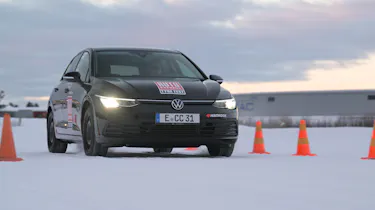
Cash £11,228It's getting less easy to spot the difference between winter and all-season tyres on the snow-handling circuit –and then there’s the summer tyre, which is so ridiculously poor you wonder if you’re going to get from the workshop to the start of the lap. A couple of times I’ve not made it up the first shallow gradient; other times I’ve done it with a bit too much pace and then hit the snow bank at the first corner. And yet when it snows in the UK, many drivers decide they’ll give it a go on their summer tyres.
As our results once again show, a summer tyre’s traction and braking performance are incredibly weak on snow, with traction being less than a third as strong and braking less than half as good as even the worst-performing winter rubber.
In numbers, the best winter tyre stops from 25mph in 18.7m while the summer tyre goes on for another 24m. That should dissuade any driver from tackling snow on summer tyres. Sure, they are better in wet braking in the cold, but as temperatures drop below 7deg C, the compound starts to harden and become less effective.
Blackcircles.com says...
“Buyers rate the tyre at 4.7/5 and praise the PremiumContact 7’s grip in wet and dry conditions, its durable tread and comfortable ride.”
| Continental PremiumContact 7 | |
| Overall | 97.3% |
| Price | £113 |
| Snow braking | 44.3 |
| Snow traction | 31.8 |
| Snow handling | 67.3 |
| Straight aquaplaning | 89.8 |
| Curved aquaplaning | 94.6 |
| Wet braking | 120.4 |
| Wet handling | 102.3 |
| Wet circle | 105.0 |
| Dry braking | 120.3 |
| Dry handling | 106.2 |
| Cabin noise | 98.5 |
| Rolling resistance | 87.8 |