New Aston Martin DB12 S 2026 review: an incredibly complete super-GT
The Aston Martin DB12 S is an incredibly capable and well rounded super-GT car which is almost perfect

Verdict
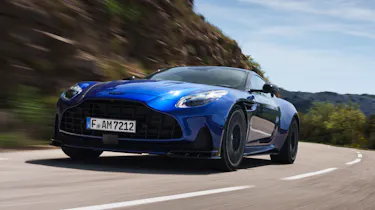
In creating the DB12 S, Aston Martin has given its big GT car more than a nip and tuck. Instead, it’s created a fully rounded super-GT that the original promised but missed the mark. It drives confidence and a high quality of feedback and involvement that few, if any, of its rivals get close to.
Aston Martin’s DB12 was the first of the new-era cars launched under Lawrence Stroll’s stewardship of the iconic storied British brand. Arriving in 2022 with a striking look that built on the DB11 it replaced (there’s a lot of its predecessor under the skin of the DB12), Aston Martin used its new front-engined super-GT to lay down its aspirations to move closer to Ferrari.
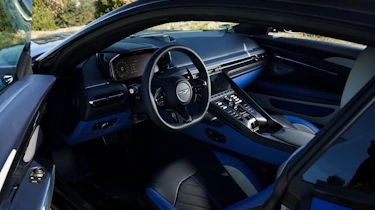
Alongside the new exterior was an even bigger transformation inside, with an all new interior design that incorporated a bespoke infotainment system banishing the outdated Mercedes system of the past, much higher quality and variety of materials and a sense that Aston Martin no longer needed to rummage through other manufacturers parts bins to dress its cars.
Then there was the powertrain. Out went the DB11’s 6.0-litre twin-turbocharged V12, in favour of Mercedes-AMG’s 4.0-litre twin-turbocharged V8 – mated to a ZF eight-speed automatic transmission that was equipped with a shorter final-drive ratio to aid acceleration.
Used - available now

2023 Kia
Sorento
36,000 milesAutomaticPetrol1.6L
Cash £30,625
2022 Toyota
Corolla
34,760 milesAutomaticPetrol1.8L
Cash £19,294
2027 Land Rover
Range Rover Sport
16,067 milesAutomaticDiesel3.0L
Cash £59,000
2023 Land Rover
Discovery
68,935 milesAutomaticDiesel3.0L
Cash £29,691A new electronic e-differential was also fitted, the front of the car was made stiffer and changes were made to the steering column. Bilstein were called upon to supply the dampers and Aston Martin’s long-standing relationship with Pirelli was side-stepped in favour of a specially-developed Michelin Pilot Sport 5S tyre.
The result? An Aston Martin that felt a little confused, falling between a GT car and a super-sports car, missing the bullseye of both targets by enough of a margin to leave more than a few heads being scratched. Where you expected the DB12 to float like a GT car and sting like a supercar when you wanted it to, its GT credentials were too hard edged, and when you leant into its performance the DB12 felt a little soft and nervous.
Which makes the arrival of the new DB12 S a moment that could instil concerns around Aston Martin creating a harder, more focussed variant of a car that already felt edgy and hard to read. Yet it doesn’t take many miles sitting in the driver’s seat for these fears to be wiped from your mind.
In the DB12 S, the Aston Martin engineering team set about to not only resolve the characteristics of the non-S model, but to extract more from the base car to create a more focussed, more polished performance model. CEO Adrian Hallmark has made it part of his core strategy to offer more choice within each model range, hence the recent introduction of the DBX707 S and Vantage S models, but the upgrades to the DB12 S go much further than they do in either of those two models.
For the DB12 S the changes are transformational. Significant modifications to the suspension’s dampers allows the car to breathe with the road much better, with a cleaner more linear action making for both a smoother ride at lower speeds and improved accuracy when you extract more performance from that V8 engine. Across poor road surfaces the S is a much more refined car, isolating the cabin from noise and vibrations but not you as a driver from how the car is reacting beneath you.
Changes to the DB12 S’s steering include making it heavier by reducing the self-centring assistance, resulting in a more natural and neutral feeling that allows you to more cleanly position the car on the road. The constant fidget that is present in the standard car is eradicated, with the S a much calmer car to control, the hyperactivity a distant memory. Aston Martin has also worked on the car’s geometry to improve the tyre’s contact patch on the road to make the rubber work harder.
On roads that require constant directional changes the DB12 S steers with a clarity that’s pure-bred sports car in feel and feedback. You can position it in, through and out of a corner with impressive accuracy reassured that those front Michelin’s have little to no interest in deviating from their line. More roll stiffness and a thicker anti-roll bar across the rear axle ties the package together, with a calmer rear end that allows the new e-differential to balance torque with more measured precision.
Across faster terrain that focus remains, allowing you to enjoy more of the DB12 S’s prodigious performance more of the time. Directional changes are instant but not sharp, the car flowing through your chosen course with just enough roll in the body to provide crucial feedback on how it’s all performing. Small corrections are no longer a leap of faith that leave sweaty finger prints on the fine-leather steering wheel. The conversation between car and driver is more free flowing.
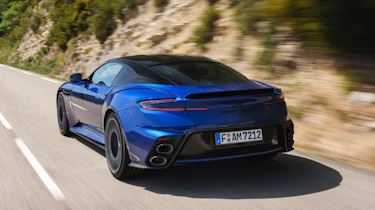
Accompanying the chassis upgrades you can’t see are a handful of aerodynamic enhancements you can. A more pronounced double-element front splitter cleans the air-flow up at the front of the car, accelerating it under and through the larger cooling vents, with the revised bonnet louvres to drag the heat out the engine bay more efficiently, too. A fixed rear spoiler (it’s more of Gurney flap) and a redesigned diffuser under the rear of the car drags air out from under the car.
As per other S models, the quad exhausts are now stacked vertically in pairs on each side of the car. There are also new side sills to smooth the air flow along the flanks of the car. None of the additions take anything away from the DB12’s imposing design that blends speed with sophistication like few others.
Some might be thinking that with all these chassis and aero improvements that Aston Martin has also gone to town with the car’s AMG sourced V8, but only a gentle remap to improve the top-end performance has been carried out, resulting in a 20bhp increase to 690bhp. Which is, as you’d expect, plenty. The DB12 has never left you feeling wanting in the performance stakes and the S is no different, pulling with muscle-car strength from low down and barely breaking sweat, to fizzing at the top end like a thoroughbred sports car.
There’s genuine duality in how you can work with the S. Leave its gearbox in drive and it’s a better GT car than Bentley’s recently launched Continental GT S. Switch to manual mode and climb through the drive modes to Sport or Sport + and the DB12 S becomes within touching distance of Ferrari’s Amalfi dynamically and for entertainment. It would be a tough decision to choose between Maranello and Gaydon if push came to shove.
There are still some foibles with the Aston, however. Its infotainment system, despite being an improvement over its predecessor, is still hard to use. It’s too fiddly when operated in conjunction with Apple Car Play Ultra, mostly due to Apple’s poor integration. And for a GT car, you need to pack light for the boot and be prepared to have a soft bag or two on the rear seats (they’re not much use for humans anyway).
Aston Martin has had its much publicised financial problems for more than half a decade, but despite this it hasn't stopped the company from developing its best line-up of cars for a generation. If not of all time. From Vantage to Valhalla there isn’t a duff car between them, and the DB12 S continues this trend.
| Model: | Aston Martin DB12 S Coupe |
| Price: | £211,500 |
| On sale: | Now |
| Engine: | 4.0-litre V8 twin-turbo petrol |
| Power/torque: | 690bhp/800Nm |
| Transmission: | Eight-speed automatic, rear-wheel drive |
| 0-62mph: | 3.5 seconds |
| Top speed: | 202mph |
| Economy: | 23.2mpg |
| CO2: | 276g/km |
| Size (L/W/H): | 4,725/2,135/1,295mm |