Hyundai Ioniq 5 vs Kia EV6: 2022 twin test review
Both of these electric siblings are accomplished, but where would we put our money?
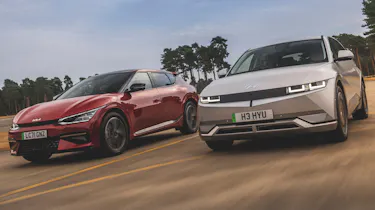
The Hyundai group has dabbled with electric cars for years, but it wasn’t until the Ioniq 5 that the brand catapulted itself to the head of its segment.
The Ioniq 5 was the first car in the group to showcase the new E-GMP platform designed specifically for EVs. Its on-paper stats are impressive: an 800-volt electrical architecture means that, should you find a charger quick enough, it’ll replenish its 77kWh battery at up to 220kW. That translates to a 10-80 per cent charge – more than 200 miles of range – in 18 minutes. Those stats are exactly matched by the Kia EV6.
There’s a choice of single and twin-motor options, with as much as 321bhp at the driver’s disposal. The mid-range 225bhp single-motor version is our choice.
The Ioniq 5 caused a stir even before we’d had a chance to dive into its tech. Inspired by the original Pony Coupé concept from 1974, and with more than a whiff of Lancia Delta in its looks – unsurprising because both cars were penned by legendary designer Giorgetto Giugiaro – the Ioniq 5 gives tasteful nods to the past while looking contemporary at the same time.
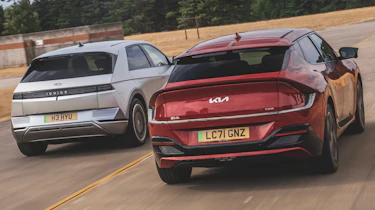
Beside it, the Kia adopts a smoother, sleeker appearance. There’s some fabulous detailing at the back, where the wraparound tail-light houses the electrically opening flap for the CCS charge socket.
Used - available now

2021 VAUXHALL
VIVARO
58,009 milesManualDiesel1.5L
Cash £8,495
2014 RENAULT
TRAFIC
113,703 milesManualDiesel1.6L
Cash £7,495
2018 Porsche
Macan
83,000 milesAutomaticDiesel3.0L
Cash £6,990
2023 Tesla
Model Y
31,582 milesAutomaticElectric
Cash £23,497While we’ve found some Kia and Hyundai models’ engines lag behind those of European and Japanese counterparts, once you remove that from the equation, this pair feels as accomplished as anything else.
Differences
There are differences between the two, though. The Kia gets a firmer suspension set-up than the Hyundai, which translates into a more fidgety ride. Because of the pair’s weight and size, neither feels that agile, so we prefer the Ioniq’s marginally more relaxed approach.
That doesn’t mean there’s no fun to be had, though. Both cars have a neutral chassis balance, which combined with the low centre of gravity brought on by the heavy battery located under the floor, means that the pair are quite pleasant to point along a twisty road. The steering helps here, too; both the EV6 and the Ioniq 5’s racks are well judged on weighting and responsiveness.
Both cars have their axles pushed out towards the extremities of the car, which doesn’t just translate into strong stability on the road, but also plenty of space inside. A high boot floor limits boot capacity slightly, but the Ioniq’s 527 litres is still impressive. The Kia is slightly behind at 490 litres.
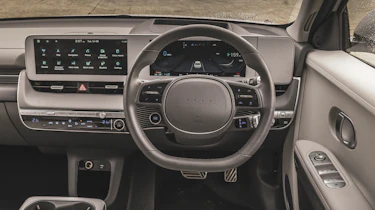
The Hyundai also has a slight lead in terms of cabin space. Both are simply vast in the back, but taller drivers might find headroom a little bit tight in the Kia. The rest of its cabin looks and feels fantastic, though. The dashboard’s twin screens gently wrap around the driver, while a touch panel sits beneath them, flanked by physical controls which serve a dual purpose; a button press changes their function from temperature adjustment to volume and menu controls. Offering a mix of touch and physical switches works very effectively here.
The Hyundai’s climate controls are solely physical, yet they sit within a cabin that’s a little more minimalist and less cluttered than its rival’s.
There isn’t much to separate them on finance. Our picks of the range – the Ioniq 5 Premium and EV6 GT-Line (we tested in the top-spec Ultimate and GT-Line S trims) – come to £719 and £732 per month respectively on a three-year PCP agreement with a £5,000 deposit.
Verdict
First place: Hyundai Ioniq 5
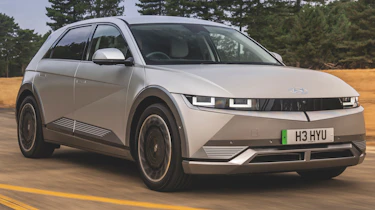
While both cars are two of the very best EVs around, the Ioniq 5 just holds a marginal edge. It’s slightly more practical, a touch more comfortable, and feels just as impressive in every other area. The lengthy list of advanced cabin tech works really smoothly, while the efficient powertrain and rapid charging make this a fabulous all-rounder.
Second place: Kia EV6
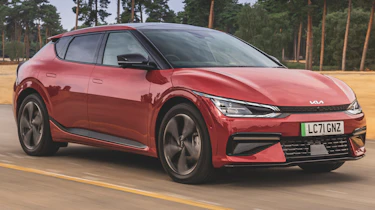
From a technical standpoint, the EV6 is a brilliant machine. Charging, range and efficiency ratings are as strong as anything else for the money, while the in-car tech is slick and the design really stands out. Beside the Ioniq 5, we find the ride just a little more fidgety, and the interior space isn’t quite as great up front.
Figures
|
Hyundai Ioniq 5 2WD Ultimate |
Kia EV6 AWD GT-Line S | |
|
On the road price |
£48,150 |
£55,195 |
|
Residual value (after 3yrs/36,000) |
£25,317/52.6% |
£29,899/54.2% |
|
Annual tax liability std/higher rate |
£192/£385 |
£221/£441 |
|
Ins. group/quote/road tax cost |
N/A / N/A/£0 |
40/£970/£0 |
|
Servicing costs |
£275 (3 yrs) |
£389 (3 yrs) |
|
Length/wheelbase |
4,635/3,000mm |
4,680/2,900mm |
|
Height/width |
1,605/1,890mm |
1,550/1,880mm |
|
Powertrain |
1x e-motor |
2x e-motors |
|
Peak power |
225bhp |
321bhp |
|
Peak torque |
350Nm |
605Nm |
|
Transmission |
Single-spd rwd |
Single-spd 4wd |
|
Battery capacity/usable |
82.5/77.4kWh |
82.5/77.4kWh |
|
Boot capacity (seats up/down) |
527/1,587 litres |
480/1,260 litres |
|
Kerbweight/towing weight |
1,935kg |
2,105kg |
|
Turning circle |
12.0 metres |
11.6 metres |
|
Basic warranty (miles) |
5yrs (unlimited) |
7yrs (100,000) |
|
NCAP: Adult/child/ped./assist/stars |
88/86/63/88/5 |
90/86/64/87/5 |
|
Driver Power manufacturer/dealer pos. |
11th/12th |
3rd/5th |
|
0-62mph/top speed |
7.3 secs/114mph |
5.2 secs/114mph |
|
Claimed range (WLTP) |
295 miles |
300 miles |
|
Charging capability |
11/50/220kW |
11/50/220kW |
|
Charging time |
8h 30m/68m/18m |
8h 30m/68m/18m |
Now read our list of the best electric cars to buy...