Kia Cee'd vs Hyundai i30
Hyundai is thinking green on the new-look i30, which has the same engine as sister firm Kia’s Cee’d. But which is the wiser buy for economy minded drivers?

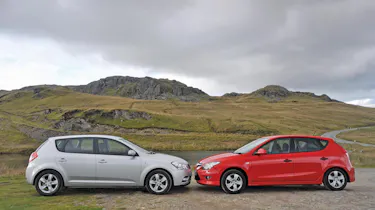
Family rows are the most intense you can get – and the rivalry between these two cars is fierce. The Hyundai i30 and Kia Cee’d are essentially the same under the skin – but don’t be fooled by their similarities, as a host of differences set them apart.
In the race for sales, the i30 has been treated to a new look, but it’s playing catch-up, because the Cee’d was revised late last year. Here the two adversaries go head-to-head in their greenest incarnations.
Video: watch CarBuyer's video review of the Kia Cee'd
[[{"type":"media","view_mode":"content_narrow","fid":"68582","attributes":{"alt":"","class":"media-image"}}]]
And with CO2 emissions of 110g/km, they promise to be both economical and efficient...
The most eco-friendly version of the Hyundai is available only in entry-level Classic trim, while adding stop-start costs £200 extra. The fuel-saving kit is offered as an option across the diesel i30 line-up, but if you want it fitted to the Kia, you have to choose the special 2 EcoDynamics model. This version of the Cee’d has it included as standard, along with a host of other kit to justify its higher price.
So which makes the better buy for eco-conscious motorists? We drove nearly 1,000 miles in each car to settle this family dispute.
Verdict
IF you’re buying an affordable family car, both of these models should be on your shortlist. In many ways they’re incredibly similar – but very different sales strategies set them apart... Hyundai only offers its eco warrior in basic entry-level guise, and we think that’s a mistake. Stop-start technology also adds to the i30’s price, so it has to take second place to the better equipped, more attractive and sharper to drive Cee’d 2 EcoDynamics. On the plus side, the i30 range gives customers the option of stop-start technology allied to the more powerful 113bhp version of its 1.6-litre engine, and in higher trim levels. Kia’s idea of offering a standalone eco model won’t appeal to all, but in this comparison it takes a deserved win. Either way, these two are keenly matched, but in the greenest trim, the Kia takes top spot.
1. Kia Cee’d 1.6 CRDi 2 ecodynamics
Choosing the greenest Kia in the range couldn’t be simpler. To make matters easier, the firm has also opted to give its eco model a comprehensive equipment list and attractive styling additions, such as smart alloy wheels. The Cee’d also won the battle at the pumps, returning an impressive 50.7mpg.
2. Hyundai i30 1.6 CRDi Classic
The differences between these cars are small, but significant. In Classic trim, the i30 lacks the grip and body control of its rival. It doesn’t look as smart, either, despite its revised appearance, and the interior is missing some vital kit. However, its brilliant aftersales package is a real bonus.