Lexus LFA vs Porsche GT2 RS: 2010 twin test
Two of the rarest, most extreme supercars come together in this explosive head-to-head

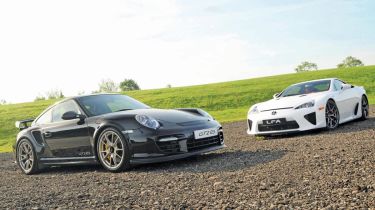
There are certain years that have wine buffs purring, and it’s the same for cars. The great news is that 2010 is sure to go down as one to remember for enthusiasts...
This year two truly astonishing supercars went on sale. Only 500 of each will be built, and both are the fastest and most powerful production cars ever created by their respective firms – the extraordinary Porsche GT2 RS and Lexus LFA.
First place: Porsche 911 GT2 RS
Porsche has been building RS versions of the 911 for 37 years, and GT2s for 15 – but this is the first time a car has worn both badges. That fact alone tells you this is a very special version of arguably the world’s most famous sports car.
In case onlookers are in any doubt about the GT2 RS, its aggressive styling makes a statement of intent. The bodywork looks similar to the old GT2, but a weight-saving regime that includes a carbon fibre bonnet, mirror covers and rear air intake surrounds has helped to shed 90kg. These additions are unpainted, and their bare weave is the most overt element of the styling – even though the huge rear wing is hard to miss! Polycarbonate windows and optional carbon front wing panels also contribute to the low kerbweight.
Used - available now

2024 Audi
A3 Sportback
36,129 milesManualPetrol1.0L
Cash £17,500
2023 Citroen
e-C4
40,939 milesAutomaticElectric
Cash £10,900
2022 MG
HS
38,462 milesAutomaticPetrol1.5L
Cash £13,497
2020 Kia
XCeed
41,141 milesManualPetrol1.4L
Cash £12,997The quest to rid the 911 of unnecessary mass continues inside, where the elegantly simple cabin is dominated by a pair of carbon fibre-reinforced plastic bucket seats. The standard Clubsport package includes a rear roll cage, six-point harnesses and a fire extinguisher. All the chassis upgrades enjoyed by the GT3 RS over the GT3 feature here and you can adjust the GT2 RS’s springs, roll bars and ride height to fine-tune the handling. However, the Michelin Pilot tyres boast a unique compound and the rear suspension has race-inspired rose-jointed links.
But what really separates the GT2 RS from the GT3 RS in our Performance Car Of The Year line-up is the incredible engine sitting behind the rear axle. It features a smaller 3.6-litre capacity, but benefits from a pair of variable vane turbochargers, which serve up mind-boggling amounts of torque at very low revs.
The result is a car that can rearrange your internal organs when you press the accelerator. Peak torque of 700Nm is available from only 2,500rpm, and acceleration is instantaneous. The breadth of the power band is also deeply impressive – in any gear and at any speed, the 911 GT2 RS is brutally fast.
However, it isn’t a dragster built purely to go fast in a straight line. You can choose from two active damper settings, while the traction and stability control can be switched off independently. The RS shares the razor-sharp precision, incredible grip and awesome stopping power of its less powerful brother.
Lightweight wheel rims and ceramic brakes contribute to the tremendously accurate steering. Turn into a corner and the GT2’s grip, body control and composure are astonishing.
Driving the GT2 RS is intoxicating. There’s seemingly no limit to Porsche’s ability to develop the 911’s unique layout to new heights, and the GT2 RS is one of the most devastatingly accomplished supercars we’ve ever driven.
Second place: Lexus LFA
The LFA project was originally conceived in 2000 as a Research and Development exercise… but the idea grew into a single-minded quest to develop a car that pushed the boundaries of technology and performance to the limit. The result is a machine quite unlike anything ever to have worn a Lexus badge before.
For all of its high-performance potential, the firm’s engineers certainly haven’t been in a rush. The first prototype appeared in 2003, before a concept made its debut at the Detroit Motor Show in 2005. After that, Lexus test drivers spent years working in the world’s toughest locations. As a result, the LFA had a very public development and the sense of anticipation was huge by the time the production car was launched at last year’s Tokyo Motor Show. So has it been worth the wait?
A quick look at the spec sheet is enough to see where the development hours and money have gone. The high-revving V10, composite chassis, auto transmission and optimised aerodynamics make the LFA a road car that’s been created with the fanatical attention to detail that’s normally exclusive to top-level motorsport vehicles.
It looks the part, too. Winglets, vents and intakes show how the appetite for downforce influences styling in this sector. The carbon fibre-reinforced plastic body panels are tightly sculpted over the composite chassis and the LFA is a dramatic presence wherever it goes.
Inside, Lexus hasn’t abandoned its luxurious roots. As you would expect for a car costing nearly £340,000, the cabin is hand-built and beautifully finished. The seats are superb, while forged aluminium pedals and a flat-bottomed wheel contribute to a near perfect driving position and ergonomics.
But any concern that the LFA would be sanitised by the usual Lexus strengths of comfort and refinement is dispelled by the burble of its mighty V10 engine. Co-developed with Yamaha, it wails with a high-pitched exhaust note. And it takes on an even more manic persona between 7,000rpm and the 9,000rpm limit. With 552bhp and 480Nm of torque – 90 per cent of which is available from 3,700rpm – performance is scintillating, while the positive throttle response and six-speed automated manual gearbox add to the race car feel.
The transmission doesn’t have the seamless changes of more modern double-clutch units, but there are seven shift speeds to choose from. At its fastest, there’s a brutality to every upshift that suits this car’s no-compromise feel.
The chassis impresses, while a large spoiler rises automatically at the rear and helps to deliver genuine downforce, adding to the levels of mechanical grip. High-speed stability is reassuring, while fast steering and powerful ceramic brakes ensure the LFA feels at home on the track. On the road the conventional suspension is firm but well damped, so it copes admirably with bumpy surfaces.
With its old-fashioned gearbox, the LFA isn’t perfect, and it’s certainly expensive, but you can sense the effort that has gone into creating this machine. It’s a beautifully built technological extravagance.