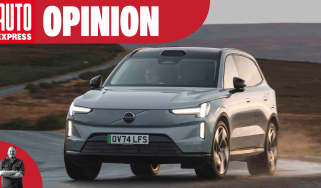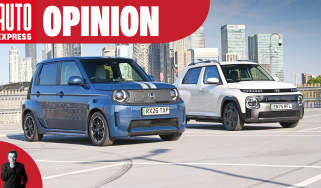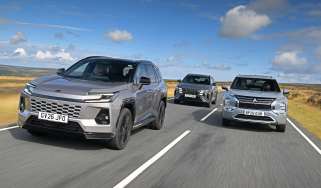
Chinese cars now beat mainstream models on depreciation, just about
If you thought Chinese cars would depreciate hard, think again. They’re predicted to be fractionally ahead of non-Chinese brands for average retained value.


It looks like there’s another reason to buy a Chinese car beyond the low prices and high equipment levels. On average, they will hold their value slightly better than models from established non-Chinese brands, too.
New data analysis from Auto Express, using new car residual value predictions from CDL Vehicle Information Services, has calculated the average retained value of Chinese cars compared to those from other manufacturers.

The results show that after three years and 36,000 miles, models from Chinese manufacturers come out fractionally on top with a 46.16 per cent average residual value, as opposed to exactly 46% per cent for non-Chinese brands.
The tiny 0.16 per cent difference between the Chinese and non-Chinese brands might seem insignificant, but it speaks to the growing acceptance of Chinese models by buyers and the car market as a whole.
This strong depreciation performance is in part being driven by the sharp value proposition the new Chinese manufacturers such as BYD, Jaecoo, Omoda and Chery are typically making to UK buyers. The relatively low prices and generous specifications are leading market experts to predict that values for these cars won’t have as far to fall when they hit the used car market after three years. The variation is slight, but the data should serve to further ease consumer concerns over any potential sting in the tail of a decision to buy a Chinese car.

Chinese car values by market sector
In the interests of fairness, the analysis excludes cars in market sectors where Chinese brands are not currently active or where no data is yet available for Chinese entrants. It also differentiates between domestic Chinese car brands and brands that are now under Chinese ownership, such as MG, Volvo, Lotus, Smart and Polestar. It still covers the majority of the UK car market, with SUVs, superminis and models in the lower and upper medium car sectors all factored in.
In the crucial SUV sector, cars from Chinese brands outperformed non-Chinese models by a slim 0.5 per cent margin. Meanwhile, China wins in the lower medium, upper medium and MPV segments by 0.47 per cent, 4.48 per cent and 10.22 per cent respectively. In the supermini sector, the non-Chinese brands have a significant 4.79 per cent advantage.
| Market sector | Chinese brands avg retained value | Non-Chinese brands avg retained value | Chinese-owned brands avg retained value |
| Lower Medium | 40.92% | 40.45% | 35.46% |
| MPV | 54.52% | 44.30% | N/A |
| SUV | 46.59% | 47.14% | 43.12% |
| Supermini | 40.89% | 45.68% | 44.68% |
| Upper Medium | 47.65% | 43.17% | N/A |
| Overall | 46.16% | 46.00% | 42.60% |
Chinese electric car residual values
When we focus on fuel type, the low-cost positioning of the Chinese models stands out again. The average on-the-road (OTR) price for Chinese electric cars currently on sale in the UK is £38,645, compared to £55,827 for EVs from non-Chinese brands. When it comes to residual values, the Chinese EVs retain 44.57 per cent, while the non-Chinese alternatives are at 43.41 per cent on average.
The UK Government’s EV grant is a factor, although experts suggest its impact will decrease over time and will be more keenly felt on younger used cars than the three-year-old ones examined here. While Chinese cars do not qualify for the subsidies, many of the non-Chinese EVs do. The grant of £1,500, or £3,750 on some models, is not reflected in the on-the-road prices, but will be a factor in forcing down residual values for the simple reason that customers pay significantly less than the OTR price on cars qualifying for the grant. Of course, any manufacturers heavily discounting their cars to compete in the challenging market will have a similar effect.
The story with hybrid and plug-in hybrid cars is similar to the one with EVs. Chinese cars offer better residual values, but on significantly lower average prices.
| Fuel type | Brand ownership category | Avg. OTR price (£) | Avg. residual value (% of OTR) |
| Electric | Chinese | £38,647 | 44.57% |
| Chinese-owned | £56,188 | 40.59% | |
| Non-Chinese | £55,827 | 43.41% | |
| Plug-in Hybrid | Chinese | £35,159 | 46.68% |
| Chinese-owned | £65,798 | 45.56% | |
| Non-Chinese | £75,284 | 44.94% | |
| Petrol | Chinese | £28,311 | 48.27% |
| Chinese-owned | £59,981 | 45.59% | |
| Non-Chinese | £52,662 | 45.86% | |
| Hybrid | Chinese brands | £26,778 | 48.71% |
| Chinese-owned | £25,995 | 45.03% | |
| Non-Chinese | £45,277 | 47.84% |
China’s assault on the premium car market
Although Chinese newcomers have targeted the cheaper, volume end of the market very successfully up to this point, that is far from the extent of their ambitions. We are starting to see more models from China aiming to compete with premium European marques, and this could present new challenges on residual values.
The likes of Denza, Xpeng and MG’s IM sub-brand are already selling cars in the UK, but volumes are too low to be reflected in this predicted future value data. Selling higher priced cars in premium sectors, where desirability and brand equity carry more weight, may prove to be a tougher task for the Chinese.
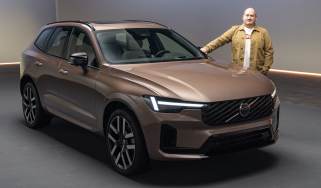
The data gives some insight into this, because the ‘Chinese-owned’ brands segment includes models from Volvo, Polestar, Smart and Lotus; the established brands Geely has assembled to challenge in the premium car market. Electric cars from the Chinese-owned brands are 45 per cent more expensive than the average price of cars from Chinese domestic brands, with four per cent lower retained values.
We are already seeing established European and Japanese brands emphasising their heritage and exploring retro design themes as they try to underline their points of difference. Of course, technology is also hugely important in the upper echelons of the market, and here Chinese models may have an edge. In the end, as always, the market will have the final say.
Don't miss the best of Auto Express on Google! Make us a preferred source. Click here...