Used Ford Focus ST (Mk3, 2012-2019) review and buyer's guide
A full used buyer’s guide on the Ford Focus ST covering the Focus ST Mk3 (2012-2019)

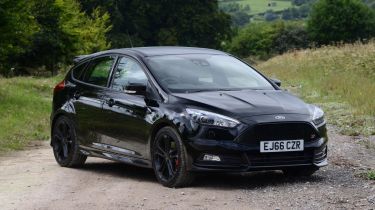
The Focus ST hits the spot for many reasons. Not only is there a choice of body styles, but you can also choose your fuel. In fact, it’s so talented that it scooped our 2012 Best Hot Hatchback award, and won our sister title Carbuyer’s prize twice, most recently in 2017. And what was true then is just as true now; the Focus ST’s talents, affordability and wide-ranging appeal make it easy to recommend. Given that you now need little more than £10k to buy one, what are you waiting for?
No other automotive brand can match the affordable performance pedigree of Ford. For more than 50 years the company has been building fast cars that combine power, practicality and sporty looks with a healthy dose of attainability.
It all started in the sixties with the Lotus Cortina, and continued through the seventies with a raft of hot Escorts. By the eighties the Fiesta and Escort were getting the RS and XR treatment, and this has carried on into the 21st century. While the ST isn’t the hottest Focus now available (so far there have been three generations of the RS), it’s more affordable to buy and run, more popular and easily quick enough by most standards.
Models covered
- Ford Focus ST Mk3 (2012-2019) - Hot hatch is a fun and desirable buy; here’s how to bag a good used one.
Ford Focus ST Mk3
History
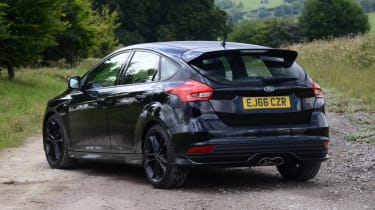
The first examples of the Mk3 Focus ST were delivered in September 2012. Buyers could pick from ST-1, ST-2 and ST-3 trims, all with a 247bhp 2.0-litre four-cylinder petrol turbo engine and a six-speed manual box. There were hatchback or estate body styles, priced from £21,995 and £23,095 respectively.
Used - available now

2025 Land Rover
Defender 110
21,963 milesAutomaticDiesel3.0L
Cash £62,000
2024 Land Rover
Defender 110
45,014 milesAutomaticPetrol5.0L
Cash £73,000
2024 Land Rover
Discovery Sport
17,000 milesAutomaticPetrol2.0L
Cash £39,350
2019 Mercedes
E-Class Estate
29,008 milesAutomaticDiesel2.0L
Cash £27,990A facelifted Focus ST reached showrooms in February 2015, bringing with it a 182bhp 2.0 TDCi diesel-powered option. At first this was available only with a six-speed manual transmission, but from spring 2016 the ST TDCi could be hooked up to Ford’s PowerShift dual-clutch gearbox.
In January 2015 independent specialist Graham Goode Racing had introduced a package of performance upgrades, but eight months later Mountune released a Ford-approved kit (which didn’t affect the warranty) that took power to 271bhp.
Ford Focus ST reviews
- Ford Focus ST Diesel review
- Ford Focus ST-1 review
- Ford Focus ST Mountune review
- Ford Focus ST Estate in-depth review
- Ford Focus ST Estate review
Which one should I buy?
There are no STs to avoid; the manual and automatic boxes work superbly, while the petrol and diesel engines offer decent performance and refinement. Their driving characteristics are very different, and the diesel is slower (8.1 vs 6.5 seconds from 0-62mph), but the TDCi is far cheaper to run.
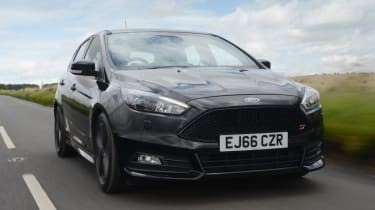
The entry-level ST-1 comes with 18-inch alloys, air-con, keyless go, DAB radio and Bluetooth. ST-2 spec adds part-leather seats, upgraded Sony hi-fi, automatic lights and wipers, a heated windscreen and auto-dimming rear-view mirror. The range-topping ST-3 features full leather trim, rear parking sensors, heated front seats, bi-xenon headlamps, power-folding mirrors and LED daytime running lights.
Option packs when the ST-2 and ST-3 were new included Style (bringing red brake calipers and illuminated scuff plates) and Driver Assistance (AEB, blind-spot monitoring and lane-departure warning).
Alternatives to the Ford Focus ST
The Volkswagen Golf GTI is the closest rival. This petrol hot hatch comes in manual or automatic form, while there’s also a diesel GTD that’s offered as an estate, too. Skoda’s Octavia vRS is also available in all of these guises, so that’s worth a look as well. While the Skoda is great value and a bit bigger than the Focus, the Golf is very polished, and thus desirable – but prices are high. Neither is as much fun to drive as the Ford.
SEAT’s Leon Cupra is related to the Golf and comes in similarly varied guises, except there is no diesel. If you’re after a petrol hot hatch, the Renault Megane R.S. might suit. It’s a riot to drive and looks great, although it’s harder to find on the used market.
What to look for
Tyres
Standard-fit tyres are Goodyear Eagle F1s; Michelin Pilot Sport 3s are a popular swap, and are generally regarded as preferable.
Chassis
The ST’s suspension is firmer than the standard Focus’s, and the wheels are bigger; check that you don’t find it too uncomfortable.
Lighting
When fitted, the illuminated sill plates can be more trouble than they’re worth. The bulbs fail too readily, and this is likely to irritate.
Brake light
Check that the high-level brake light isn’t full of water. Condensation is a problem. If you spot this issue, a new light will be needed.
Interior
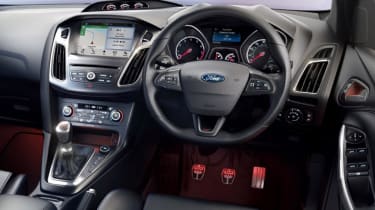
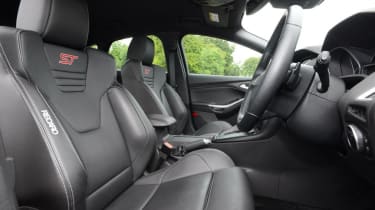
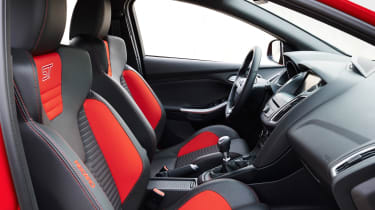
The ST isn’t much different inside from a regular Focus, so quality and visual appeal are okay, but nothing special. The Recaro sports seats are a highlight; they’re comfortable and supportive, but not great if you have a fuller figure. And while the rear is fine for three children, the rising waistline can make it feel cramped. Boot space stands at only 316 litres, or 1,101 litres with the seats down.
Running costs
Regardless of the engine fitted, the Focus ST needs servicing every 12 months or 12,500 miles. Its check-ups are sequential: Minor, Intermediate and Major (. The last of these is due every third year/37,500 miles. After 10 years/125,000 miles, fresh coolant is needed, as is a new cambelt .
Ford offers monthly payment plans to help spread the cost of maintenance. However, because it doesn’t sell packs that allow several years’ worth of discounted servicing to be paid for at the time of purchase, no used STs will come with pre-paid maintenance.
Recalls
The third-generation Focus has been recalled five times, but only two included the ST. The first, in September 2017, was for side and knee airbags potentially failing to deploy; the fix involved new airbags and sensors.
Diesel STs could suffer from a damaged oil sump and consequent leaks due to an incorrectly calibrated engine control module. A software update in March 2018 fixed it.
Driver Power owner satisfaction
For a model that’s recently been replaced, the standard Focus impressed with 33rd place in the Driver Power 2018 new car satisfaction survey, although it did less well in the used poll, coming 60th. While both surveys were for the Mk3 as a whole, nearly all owners reviewing the ST on carbuyer.co.uk gave it five stars, thanks to its performance, usability, affordability, reliability and value.
Ford Focus ST (Mk3, 2012-2019) review: What we said
Extracts from our 2018 in-depth review of the Mk3 Focus ST...
If you believe motoring is meant to be enjoyed, then the Ford Focus ST could be the family hatchback for you. There are faster hot hatches, but few share the Ford’s mix of great handling, punchy performance, and affordable practicality. It’s an accessible confection of family-friendly fun that has made the Focus ST a winner in previous guises, and the latest update has done nothing to dampen our enthusiasm.
New engines – including a punchy diesel – add a new dimension to performance, while styling, suspension and interior upgrades bring a little more sophistication to the party. There are compromises, of course, but Ford’s hottest Focus demands fewer of these than most of its rivals.
With fast Fords like the GT supercar, Focus RS hatch and even the F-150 Raptor pick-up earning plaudits, it's easy to forget about Ford's ST range. The Fiesta ST is a cracking hot hatch, while the Focus ST is also worth considering if you want a great-value fast family car.
We say fast family car rather than hot hatch, because the Focus ST is offered as a five-door hatch or an estate. Both can be had with either a 247bhp 2.0-litre four-cylinder turbo petrol or a 185bhp TDCi diesel, while the latter can be had with either a six-speed manual gearbox or Ford's Powershift auto.
• Ford Focus ST vs Skoda Octavia vRS 245
As you would expect, the petrol ST is the faster of the two, with a 0-62mph time of 6.5 seconds, which is competitive with most of its front-wheel drive hot hatch rivals, while the TDCi manages the same sprint in 8.1 seconds (the auto model is faster, at 7.7 seconds).
In corners, the Focus ST handles well, although it's not quite as enthralling as some of Ford's other performance models. There's lots of grip, decent feedback through the wheel and a torque vectoring system helps keep torque steer at bay and helps the ST in corners.
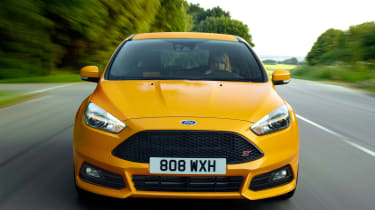
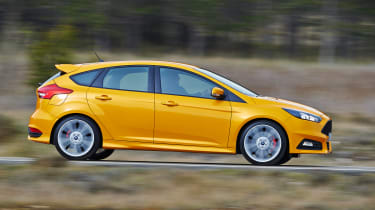
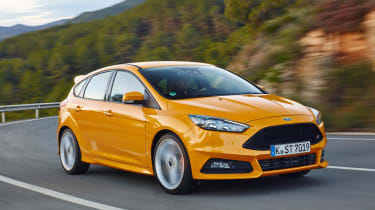
The ST gets sportier bodykit than the standard Focus, although Ford does offer ST-Line trim on the standard range to give it a bit of a visual boost. The key identifiers of the full-fat ST are the honeycomb grille up front, 18-inch wheels and centre-exit exhaust sticking out of the back bumper. There's also an exclusive colour on the options list, and choosing Tangerine Scream (above) really helps the ST shout about its performance. If you don't want to draw attention, then there are the usual white, black, red and blue options, while standard colours are either red or grey.
As well as having a choice of body styles and engines available, the ST also comes in different numbered trim levels. There used to be a Focus ST-1, but now only ST-2 and ST-3 are offered. Both versions feature 18-inch alloys, Ford SYNC infotainment with voice control and DAB radio, plus sports suspension and Recaro seats. On top of this, the ST 3 adds leather electrically adjustable seats, eight-inch touchscreen and xenon lights.
The Focus ST has been around for a little while, and there are a number of rivals out there that either have more power, handle more sharply or manage both. Our favourite front-wheel drive hot hatchbacks are the Honda Civic Type R, Hyundai i30 N and SEAT Leon Cupra, while the VW Golf GTI is also still a strong contender in the class. Elsewhere, the Peugeot 308 GTi is back on form, while the Skoda Octavia vRS offers more practicality to go with similar performance.
If you're looking at the Focus ST Estate, then its rivals are estate versions of the Leon Cupra and Octavia vRS, while the diesel ST again sees the Octavia vRS TDI go up against it, while the VW Golf GTD is also worth considering. Like the Focus, both of these models come as hatchbacks or estates, too.
Engines, performance and drive
Ford's ST badge carries a lot of weight for hot hatch fans, especially here in the UK thanks to a back catalogue of high-performance hits. In recent years, the Focus ST has been overshadowed by the excellent Focus RS – but it’s still one of the best front-wheel-drive five-doors on sale.
The Ford’s steering has lots of feel, and it’s fast. Every corner is a delight; you feel connected to the road and in touch with how the car is moving around beneath you. The chassis set-up contributes to that, too, and lets you control the car’s line with the throttle. While some rivals are engaging and fun to drive, the Ford has the edge if you’re an enthusiast – but it loses out in other areas.
The trade-off for this detailed communication is a harsh ride, because big bumps crash through the suspension (not helped if you add the optional 19-inch wheels), so it doesn’t feel quite as composed on rougher roads. It’s much firmer and less forgiving than some rivals, and adaptive dampers aren’t available to dial this back.
Yet despite its extremely reactive steering and sporting credentials, the Focus ST is also a remarkably capable long distance cruiser, thanks to its quiet cabin and hugely supportive Recaro seats. If a criticism had to be made, it'd be that the low-speed ride is a tad too firm, especially on the larger 19-inch alloys. Other hot hatches are even firmer, though – the Megane Renaultsport will jiggle your fillings out – so it’s not too much of a grumble.
If you like the sound of the petrol model, but 247bhp is not enough, Ford's official tuner, Mountune, can bolt on a performance upgrade that boosts the car’s power to 272bhp and torque to 400Nm.
The Mountune upgrade is an official upgrade, so it won't void the Focus ST’s warranty. However, while the kit gives the hot hatch plenty of mid-range grunt, the additional boost in power is a little too much for the chassis to handle.
MPG, CO2 and running costs
It may be fast and fun, but the day-to-day cost of enjoying the Focus ST shouldn’t be too high. The petrol model returns decent economy figures and the diesel option is incredibly frugal (when driven gently, of course).
The new 2.0-litre EcoBoost engine returns a 41.5mpg economy and emits 159g/km of CO2 – both improvements over the pre-facelift model thanks to the addition of a stop-start system. However, these improvements still can't quite match those of the Golf GTI, which returns 47.1mpg and emits 139g/km.
The diesel Focus ST fares better, though, delivering 67.3mpg and 110g/km CO2 emissions – identical figures to a VW Golf GTD fitted with a manual gearbox. That means you have a potential range of over 850 miles on its 60-litre tank, if you can resist the urge to put your foot down.
Interior, design and technology
The Focus ST couldn't be more different from one of its main rivals – the Golf GTI – when it comes to styling. While the VW is subtle about its sporting credentials, the Focus ST is everything you'd expect from a fast Ford. It certainly looks the part thanks to a gaping mesh grille, 19-inch alloy wheels and a wide range of colours, including Tangerine Scream orange available on ST-2 and ST-3 models. It's by no means understated, but that's what this type of car is all about. For the facelift, Ford has updated the front end with a wider grille, slimmer headlights, rectangular foglights and a more sculpted bonnet.
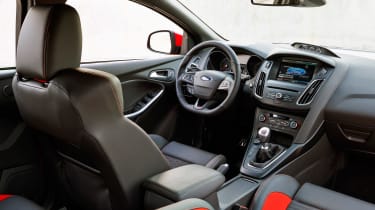
The sporty theme is continued inside. Every car is kitted out with front Recaro sports seats, contrast piping, carbon fibre trim, extra gauges on the dash, a sports steering wheel, metal pedals, a metal gear lever and a generous distribution of ST badges as standard. Again, it doesn’t look as classy or understated as the Golf GTI’s cabin, and it’s not as clearly laid out, either – although the quality and feel of the Ford’s plastic parts isn’t far off the VW’s.
Moving up the range, Ford gives the Focus ST-2 half-leather trim, dual climate control and a heated windscreen, while the range-topping ST-3 is further softened by luxuries such as heated seats, full leather trim and bi-xenon headlamps. In line with the rest of the Focus range, Ford has redesigned the interior with fewer buttons for a classier look.
Sat-nav, stereo and infotainment
An eight-inch touchscreen is now available fitted with Ford's latest SYNC3 sat-nav and infotainment system as standard. It’s easy enough to use; it just feels clunky next to some rival set-ups.
Practicality, comfort and boot space
While the Ford definitely delivers driving thrills, it’s not as versatile as some rivals. The 316-litre boot is small, plus passengers in the rear will feel more cramped due to the more compromised packaging. The Ford’s displays look and feel old, too.
Ford's decision to make the Focus ST available in five-door hatch or estate bodystyles means a welcome dose of versatility has been brought to the hot hatch class. The ST also shares the same platform architecture as the rest of the Focus range. That means it’s roomy up front and, with sufficient adjustability in the low-set Recaro sports seats, most drivers should find a comfortable position. The pedals are well spaced out, too, so enthusiastic drivers can practice a bit of heel-and-toeing.
Happily for more pragmatic owners, the Focus ST’s interior maintains the practicality of the standard hatchback’s. This means general family paraphernalia can be kept in check, with a large glovebox, deep door bins and plenty of cup-holders.
Size
The family hatchback class is pretty well defined across rival manufacturer offerings, so it’s no surprise that the Focus fits right in. The ST, at 4,358mm nose-to-tail, is a little longer than a five-door Golf GTI, at 4255mm. However, both are shorter than Vauxhall’s Astra VXR, which, in spite of only having three doors, is 4,419mm overall.
Yet the Ford is the widest of the trio. Its 1,858mm girth is 59mm and 44mm wider than the Golf and Astra respectively. The Focus splits its rivals on height, standing 1,461mm tall against the 1,452mm VW and 1,510mm Vauxhall.
Legroom, headroom & passenger space
In spite of its five-door configuration, the Focus ST isn't quite the perfect family car. Due to the heavily sculpted nature of the Recaro bench seat in the rear of ST-3 models, three adults can only fit in the back at a squeeze – although the extra doors make getting in easier, if you’re looking at three-door rivals. There is a proper seatbelt for each of the three rear passengers, and isofix child seat mounting points are standard in the rear.
Boot
While the Focus ST is definitely more practical than the Renaultsport Megane 265 and Vauxhall Astra VXR, it still has less boot space than the Volkswagen Golf GTI - the two cars offering 316-litre and 380-litre load bays respectively.
Folding the rear seats down boosts capacity to 1,101 litres – still some way short of the class best, but the Estate version remains an option if that’s a problem. The seats themselves are easy to collapse and leave a decent load area, which is easily accessible via the wide tailgate.
If your dynamic/sporty lifestyle extends beyond driving to – say – owning a jet-ski, it’s worth remembering that the Focus ST has a towing capacity of precisely zero kilograms. The central exhaust tailpipe means there’s nowhere to put a tow bar.
Buy a car with Auto Express. Our nationwide dealer network has some fantastic cars on offer right now with new, used and leasing deals to choose from...