Honda ZR-V review
Honda’s answer to the Nissan Qashqai features a slick hybrid setup and generous cabin space, but it’s not without its flaws

Our opinion on the Honda ZR-V
The Honda ZR-V shows an understanding of what a lot of people want from a mid-size SUV. It’s very spacious, well-built, and offers impressive real-world fuel economy thanks to its hybrid powertrain. The simple, logical cabin and infotainment set-up are also plus points, as is the generous amount of standard equipment.
However, the ZR-V is more expensive to buy than hybrid versions of several family SUV rivals. We also can’t help but feel that most buyers would be better served by the highly acclaimed Honda Civic hatchback, because it uses the same hybrid setup and is better value for money.
About the Honda ZR-V
The Honda ZR-V is, in effect, a larger version of the Honda Civic. This SUV uses the same platform as its family hatchback counterpart, so it’s only available with Honda’s e:HEV hybrid powertrain. This combines a four-cylinder petrol engine under the bonnet with two electric motors, all working together to drive the front wheels.
The engine is mainly used as a generator to power its 1.05kWh battery pack, which in turn feeds the electric motors, but it can drive the front wheels directly at high speeds. It’s a complex system on paper, but on the road, it’s extremely smooth and allows the ZR-V to drive like an EV, just with a petrol engine whirring away in the background.
Used - available now


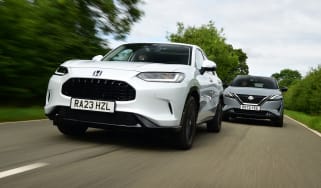
We’ve tried a number of versions of the ZR-V over the years, and we’ve even pitted a Honda ZR-V Advance against the Nissan Qashqai Tekna+ in a twin test.
Honda ZR-V prices and latest deals
The ZR-V line-up consists of one powertrain and three trim levels, so it’s an easy one to get to grips with. The base Elegance model starts from around £35,000, rising to just under £37,500 for the mid-range Sport. Finally, the poshest Advance sits around £39,500.
You can save by building your perfect Honda ZR-V with the Auto Express Buy A Car service. We also have a selection of ZR-V leasing deals and used ZR-V models to choose from.
Performance & driving experience

Pros |
|
Cons |
|
Honda’s e:HEV powertrain is set up to primarily use the 2.0-litre petrol engine as a generator for the on-board battery. While this is mainly for boosting efficiency, it also results in pleasingly smooth power delivery.
| Model | Power | 0-62mph | Top speed |
| ZR-V 2.0 e:HEV | 181bhp | 7.9 seconds | 108mph |
Performance, 0-60mph acceleration and top speed
Honda says 0-62mph in the ZR-V takes 7.9 seconds, and that seems about right. If you’re already going fast enough and the engine is driving the wheels, throttle response is keen. But when you’re cruising on battery power and boot it, there’s a long pause as the petrol engine wakes from its slumber. When it does, the four-cylinder engine is a little droney, but not overly loud. Top speed stands at 108mph.
Town driving, visibility and parking
Driving the ZR-V at low speeds feels like you’re actually piloting an EV, as the electric motors are doing all the work. It’s incredibly smooth, easy to control and far more responsive than a combustion-engined SUV. Precise steering and good visibility also make the Honda easy to place on the road, but we find the ride a little fidgety over smaller bumps.
The ZR-V’s variable brake regeneration settings are easy to adjust on the move thanks to the paddles behind the steering wheel, but after you touch the accelerator, it resets back to the default level. We’d rather it stayed how we left it.
Country road driving and handling
Leave the hustle and bustle of town for a B-road, and it’s soon apparent the ZR-V is not particularly fun to drive. That’s because it’s been set up to be safe and predictable, and it’s exactly that. However, there’s still a reasonable amount of grip through corners, and the feeling of a low centre of gravity is reassuring on those occasions when you need to brake hard.
Motorway driving and long-distance comfort
The ZR-V’s ride comfort improves once you’re on the motorway, where it feels stable. However, the road noise, particularly from the back axle, is a little more audible than we’d hope for. The lane-departure and blind-spot warning beeps are also too excitable for our liking.
MPG & running costs
Pros |
|
Cons |
|
Depending on which trim level you pick, Honda says the ZR-V produces 130g/km of CO2, and can return 49.6mpg on the WLTP test cycle. During our twin test against the Nissan Qashqai, the ZR-V managed to achieve 45.6mpg. This is respectably close to the brand’s claims, and similar to the hybrid-powered Nissan’s 45.3mpg.
One of the advantages of getting a ZR-V over a Civic is the fuel tank. At 57 litres, it’s 27 litres larger than the hatchback’s, so even if it’s a slightly thirstier car, the ZR-V’s range is much better.
| Model | MPG | CO2 | Insurance group |
| ZR-V 2.0 eHEV Elegance | 49.6mpg | 130g/km | 35 |
| ZR-V 2.0 eHEV Sport | 48.7mpg | 131g/km | 35 |
| ZR-V 2.0 eHEV Advance | 48.7mpg | 132g/km | 35 |
Insurance groups
Regardless of trim, the ZR-V sits in insurance group 35 (out of 50). That’s very high for a mid-size SUV, especially as neither the Kia Sportage nor Nissan Qashqai attracts a rating beyond group 26. In fact, the ZR-V will also be more expensive to insure than some all-electric SUVs that cost about the same, such as the Skoda Enyaq and Nissan Ariya.
Check if your car needs an MoT and view its complete history with our MoT History Checker...
Tax
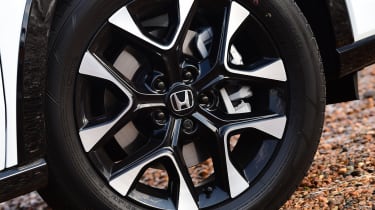
Move towards the higher end of the line-up, and the ZR-V flies perilously close to the £40,000 combustion luxury car tax limit. Add an expensive paint finish or a flashier set of alloy wheels, and you’ll soon find yourself paying an additional £440 on top of your annual VED road tax bill, which applies from the second time the vehicle is taxed until it is six years old.
Although this SUV is efficient, company car buyers will be far better off opting for a fully electric car instead, as these attract the very lowest Benefit-in-Kind (BiK) tax rates. At the time of writing, Honda doesn’t sell an electric SUV in the UK with the demise of the Honda e:NY1, so you’ll need to look elsewhere at rivals like the Nissan Ariya, Skoda Enyaq, or Volkswagen ID.4.
Depreciation
Our market data shows that the ZR-V maintains its value pretty well after a period of three years or 36,000 miles. At 49 to 50 per cent, Honda’s SUV holds on to its value better than the Nissan Qashqai, as this only manages 47 to 49 per cent. The Kia Sportage is ever so slightly stronger, though, at between 47 and 51 per cent.
To get an accurate valuation on a specific model check out our free car valuation tool...
Interior, design & technology
Pros |
|
Cons |
|
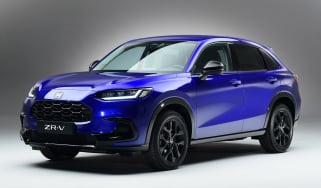
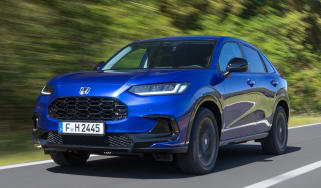
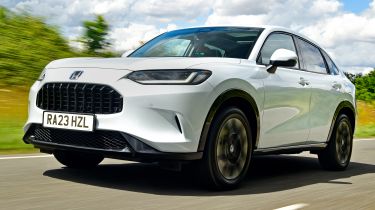
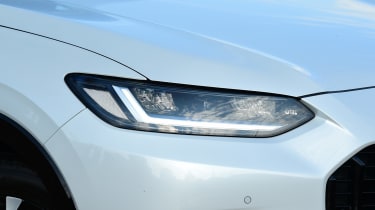
Honda’s engineers have worked hard not to make the ZR-V simply look like a jacked-up version of the Honda Civic, and it has certainly succeeded. However, this is not a car we expect will be bought on looks alone: the beak-like nose in particular, with its slatted grille, isn’t nearly as subtle as other Hondas. The Kia Sportage and Hyundai Tucson are more handsome and striking, while the Nissan Qashqai has a rather understated look.
Interior and dashboard design
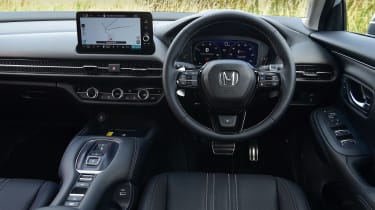
Inside, the ZR-V’s cabin looks almost identical to the Civic’s, but that’s not a bad thing because it’s sensibly thought out. There are lots of soft-touch materials too, with artificial leather covering much of the dashboard.
The floating centre console is a flamboyant touch, and houses an array of buttons for selecting gears and drive modes, a pair of USB ports for charging mobile devices, plus a wireless charging pad on Sport trim and above.
Materials and build quality
As is very often the case with Honda, the ZR-V’s build quality is excellent. We’re also particularly pleased to see conventional rotary controls for heating and ventilation that click satisfyingly as you turn them, along with plenty of proper buttons.
Infotainment, sat-nav and stereo
By today’s standards, the ZR-V’s nine-inch screen is fairly small. However, it’s more than large enough to cover most buyers’ needs. It’s a very simple, intuitive system to use, with the main home page consisting of two rows of shortcut tiles for the main functions. Physical buttons to the side include a back key, a home key, plus a volume dial.
On-screen shortcuts make the Honda’s interface easy to figure out, even if you’re buried in a sub-menu about hybrid powertrain stats. The on-screen mapping is also clear. While the interface is easy to figure out, it’s not the quickest system when loading up a different menu or responding to your inputs. The wireless Apple CarPlay works fine, but we struggled to establish a connection with Android Auto when we tested the ZR-V; it either dropped instantly or failed to connect at all, even with various USB cables.
Boot space & practicality

Pros |
|
Cons |
|
The ZR-V slots neatly in between the compact Honda HR-V and larger Honda CR-V in the brand’s line-up. But despite it being an SUV, the driver’s seat is only mounted 30mm higher than in a Civic hatchback, so the driving position isn’t as commanding as in rivals. It still feels great, though, offering plenty of comfort and lots of adjustment.
Storage in the ZR-V’s cabin is a decidedly mixed bag. The central storage is deep, and the glovebox is quite large, too. On the other hand, the door bins are small; the front ones are narrow and short, while the back pockets will only hold a small bottle.
There’s also a small shelf beneath the floating section of the centre console, which houses two USB ports. Rear passengers get a set of air vents, along with two USB-C ports of their own in all but the base model. The optional rubber boot mat is ideal for carrying muddy boots, and will protect the carpeted floor when loading a bike, for instance.
Dimensions and size
The Honda ZR-V is a bit longer than both the Nissan Qashqai and Kia Sportage, but it isn't quite as high off the ground as its rivals, resulting in a lower driving position.
| Dimensions comparison | |||
| Model | Honda ZR-V | Nissan Qashqai | Kia Sportage |
| Length | 4,568mm | 4,425mm | 4,540mm |
| Width | 1,840mm | 1,835mm | 1,865mm |
| Height | 1,620mm | 1,625mm | 1,645mm |
| Wheelbase | 2,657mm | 2,665mm | 2,680mm |
| Boot space | 380 litres | 479 litres | 587 litres |
Seats & passenger space
Rear passenger space in the ZR-V is very generous, with a simply fantastic amount of legroom available in the back, topping pretty much any other rival in the mid-size SUV segment. We also found during our twin test between the ZR-V and Nissan Qashqai that the Honda’s cabin is wider, though the headroom on offer in the ZR-V is just fine rather than spectacular.
Boot space
It’s clear that cabin space was the bigger priority for Honda with the ZR-V, because this mid-size SUV has a 380-litre boot (including the underfloor storage). That’s not just smaller than many of its rivals’, but also 30 litres less than the Civic’s. However, the ZR-V’s luggage capacity shrinks by another 10 litres if you upgrade to one of the higher trim levels, because more space is taken up by the Bose subwoofer.
The folding parcel shelf is sturdy and incredibly easy to remove, plus the boot lip is impressively low, making it easy to load heavy items into the car. The rear seat cushions also slide down and forward when you fold them away, which sees the space on offer grow to 1,301 litres and makes things nice and level. There are also two bag hooks (rated at 3kg each) and a 12-volt socket in the boot.
Towing
The ZR-V won’t find much appeal among caravanners because it has a maximum towing capacity of 750kg, if you’re pulling a braked trailer. For context, a typical two to four-bed caravan weighs in the region of 1,000kg, and both the Kia Sportage and Nissan Qashqai have towing capacity well in excess of that.
Reliability & safety
Pros |
|
Cons |
|
Euro NCAP tested the ZR-V in December 2023 but denied it a five-star safety rating, mainly due to the side-impact test result, in which the heads of the driver and front passenger struck each other. The report also noted that the driver monitoring system detected driver fatigue but not driver distraction.
Every ZR-V comes as standard with Honda’s ‘Sensing’ range of safety and driver-assistance features, which includes lane departure warning, lane-keeping assist, traffic sign recognition, driver attention monitoring and ‘Traffic Jam Assist’. Adaptive cruise control, front and rear parking sensors, and a reversing camera are also standard-fit across the range.
The ZR-V didn’t appear in the latest Driver Power owner satisfaction survey, but the Honda brand landed in a rather appealing 10th place out of 31 in the best manufacturer rankings. Owners reported being particularly happy with their cars’ build quality and reliability.
| Euro NCAP safety ratings | |
| Euro NCAP safety rating | Four stars (2023) |
| Adult occupant protection | 79% |
| Child occupant protection | 86% |
| Vulnerable road user protection | 81% |
| Safety assist | 68% |
Buying and owning
- Best buy: Honda ZR-V e:HEV Sport
The mid-range Sport model doesn’t add a silly amount to the ZR-V’s price, but it does add some useful additional kit that makes this mid-size SUV feel a little bit more prestigious. Go easy on the options, though, otherwise you’ll be forced to endure the financial pain that is the luxury car tax.
Honda ZR-V alternatives
There’s no shortage of mid-size hybrid SUVs to rival the ZR-V, which include the Kia Sportage, Hyundai Tucson, MG HS, Nissan Qashqai, and Renault Austral.
Key updates of the Honda ZR-V review
20 May 2026: Latest driving impressions and pricing information.
Frequently Asked Questions
Deals on the ZR-V and alternatives