How to save fuel: top tips for improving MPG fuel economy
We explore the best ways to improve our MPG and get the maximum mileage from every tank of fuel

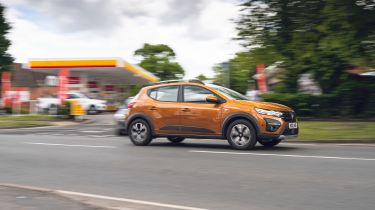
We, as a nation, love to grumble about fuel prices, but you could argue we’re justified in doing so given how high they always seem to be. Geopolitics, trade disputes, pandemics and more can all influence oil prices and ultimately drive the cost of petrol and diesel up or down, so the average UK driver doesn’t really have much say in what they pay at the pumps. What we can all do, however, is use a few clever tricks to save fuel and reduce visits to the filling station in the first place.
Not only does driving economically do its bit for your bank account, but it helps the environment, too. While you might already know some of the fuel saving methods we explain below, there might just be one or two that you never even thought of.
Whether you’re a brand-new driver trying to save a few pennies or a seasoned veteran looking to boost your green credentials, keep reading to learn how to save fuel before, during and after your drive.
Before you drive: fuel saving checklist
Saving fuel begins before you even start your car. Here’s how to prepare for an efficient journey.
Check your tyre pressures regularly
Typically, one fifth of a car’s fuel consumption is a result of its tyres’ rolling resistance. If their pressures are wrong, it can have a huge impact on your fuel economy. Having the incorrect tyre pressure is not only unsafe, it can also wear out your tyres prematurely.
Check your oil level
Engines are at their most efficient when they’re working properly, and keeping the oil at the correct level is crucial, for both maximising the engine’s life and fuel efficiency. In cars without a dipstick under the bonnet, you may have to search for engine oil information within a touchscreen menu.
Remove weight
That kids’ buggy, those work boots, the big bottle of screen wash in the boot? All of those items and other odds and ends we keep in our cars add weight, and weight increases fuel consumption. Leave things at home if you don’t need them.
Remove roof bars, bike racks, roof boxes
A roof rack with your bike holder or roofbox is perfectly positioned to create drag, and that significantly impacts on fuel consumption. If you’re not using it, remove it.
Plan your route
Avoid driving further or for longer than you have to by planning the most direct route and avoiding traffic wherever you can. Satellite navigation is great, mostly, but if you have a quick look at the news before starting a long journey, you might be able to avoid a 25-mile detour that’s not necessary. Google Maps is a superb system, because it updates traffic information quickly and accurately. If your car has Apple CarPlay or Android Auto connectivity, or you have a mount that lets you use your smartphone safely and legally, you are likely to avoid more jams than if you were using an in-built sat-nav system.
Consider alternatives
Is your journey really crucial? Could you walk or cycle instead? Short trips in particular are detrimental to your fuel economy, because engines work more efficiently when they’re fully warmed up, and shorter journeys rarely allow this.
On the road: fuel saving checklist
These simple fuel saving tips will help you get more from every tank and spend less on petrol, diesel or even electricity.
Look, Assess, Decide and Act (LADA)
This is about assessing the road and traffic around you, as well as things like crossings and junctions, and deciding on how to deal with them. If you’ve assessed and acted correctly, you should be able to ease your way down the road at an appropriate speed, minimising stopping, and keeping moving.
Scanning and planning
Look far, mid, near and rear to plan your driving to help keep you moving. If you’re scanning everywhere, you can adapt your speed and driving to suit the traffic to keep moving.
Be smooth
Gentle throttle and brake inputs, together with smooth steering and selecting the right gear keep your car stable and take the strain off the engine. It’ll be more comfortable for you and your passengers too.
Get in gear
In cars with a manual gearbox, you don’t need to use every single gear when accelerating or upshifting. Try skipping third and going from second to fourth, or from first to third and so on. With an automatic transmission, it’s best to let the gearbox do the work for you, although gentle use of the throttle will mean it’ll automatically shift up earlier, and the engine will burn less fuel as a result.
Slow down
Reducing your speed can also give decent savings. You’ll find all sorts of estimates out there, partly because the results can vary greatly depending on the car, but as a rule of thumb it’s safe to expect a 10 per cent increase in economy if you cruise on a motorway or dual carriageway at 60mph rather than 70mph. If you drive a fully electric car, the savings for cruising at 60mph rather than 70mph are often even greater.
The increase in travel time isn’t as great as you may think, and you might even reach your destination feeling a little less stressed. Meanwhile, the fuel savings compared with driving at more than 70mph – which, according to surveys, many drivers do despite it being illegal – are even larger.
Maintain momentum
If you’ve ever pushed a car, you’ll know how difficult it is to get it moving. The same is true for the engine; it works its hardest, and least efficiently, when pulling away. Keep rolling whenever possible to improve your economy.
Slow to flow
Slowing down well in advance of junctions, roundabouts and crossings allows you to reach them without traffic obstructing you, and lets you flow through them, rather than stopping.
Position for Vision
Give yourself the best chance of adopting these measures by positioning your car for the best view of the road ahead.
Use gradients
Use downhill stretches to your advantage and stay off the accelerator when descending hills.
Climate control
When the air conditioning is on, use recirculated air to cool the air in the cabin, rather than cooling the air coming into the car. When it's cold, park the car into the sun so that its rays defrost the windscreen, rather than using the heaters.
Park smart
Find a parking space that you can drive forwards out of, saving fuel by avoiding reversing manoeuvres.
How to drive more economically
By Auto Express contributor and expert driver, Steve Sutcliffe
Changing your driving style is the obvious way to achieve fuel savings, and for the price of a couple of tanks of fuel, Red Driver Training reckons its FuelSave training can give you the tools you need to improve your miles per gallon.
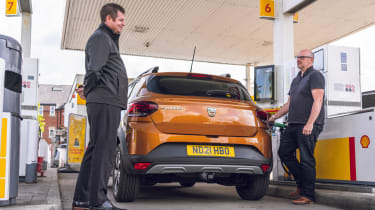
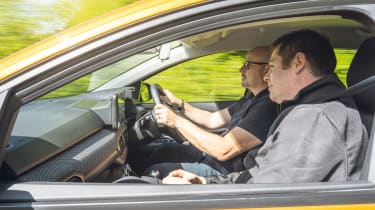
We wanted to try exactly that, which is why Red Driver Training instructor Evan Morris is joining me in a Dacia Sandero Stepway – a car that is perfectly suited to these cost-of-living crisis times. His goal is to teach me how to save fuel on familiar roads around my home in Stratford-upon-Avon, making this test highly representative of what may or may not be possible with Evan’s help.
In the weeks leading up to this experience, the Sandero’s trip computer had typically been showing 42-44mpg. Perhaps as a result of Evan sitting alongside me, even without his assistance I achieved a fairly respectable 48mpg on our first 17.1-mile trip.
Evan is unperturbed by this increase, however. He claims some clients gain as much as 50 per cent, although he typically sees improvements of around 11 per cent. As soon as we set off, he gets to work, having me adopt the techniques we explore below, and providing a running commentary of what’s ahead on the road.
Within the first 100 metres, he had me position myself for vision to see around the van parked outside the local shop, allowing me not just to see the road and traffic ahead, but also if there’s anyone approaching the pedestrian crossing shortly after. He’s told me to get off the accelerator and allow the Dacia to roll, using no fuel when doing so.

By scanning and planning we’ve amended my speed to maintain progress, but also to reach the roundabout at the end of my road when all the traffic that was ahead of me has moved on. During my approach to the roundabout I’m assessing and deciding what to do, picking an appropriate speed to enter and exit the roundabout, watching for any approaching traffic and clearly signalling my actions, which allows other motorists to react accordingly.
I’ve barely touched the brakes during all of this, and have been gentle with my acceleration and quick to change up through the gears. Even so, we’re travelling at a speed that’s not holding anyone up, nor does it feel slow.
It’s an immersive and enjoyable experience, and it soon becomes natural, scanning the road and the surroundings for clues as to what’s coming, picking the correct speed, and using gradients for free downhill energy, getting off the accelerator as quickly as possible and rolling up to clear junctions to keep momentum. We barely, if ever need to stop; our planning means we’ve reached red lights once they’ve changed to green, kept rolling past roadworks, managed movements through traffic, all to the benefit of consumption.
Evan tells us that studies reveal modern motorists only concentrate on driving about 20 per cent of the time, so adopting these techniques not only reduces consumption, but enhances safety, too. And the results? Improved economy.
How much fuel could you save?
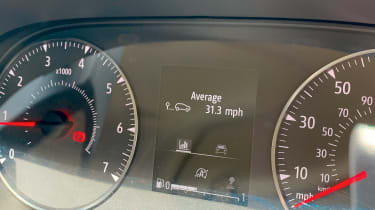
We drove a Dacia Sandero Stepway TCe 90 around a 17.1-mile route, on familiar local roads, which are representative of his typical school run and daily driving. The first ‘lap’ was driven without Evan’s assistance, and we achieved 48mpg. That’s not a bad figure considering the Dacia’s official WLTP combined consumption figure is 50.2mpg.
In the weeks prior to our first lap, the average mpg readout on the Sandero’s computer was around 42-44mpg. Using Red Driver Training’s FuelSave techniques and Evan’s guidance, on the second lap we achieved fuel consumption of 60.4mpg. That’s an impressive 10.2mpg improvement over the Dacia’s official WLTP combined consumption figure, and a 25 per cent increase over his first lap (and about 37 per cent over that 44mpg average previously). Interestingly, the average speed on both runs was within 0.1mph of each other, with the second lap marginally faster at a recorded 31.3mph average speed.
Adding an economy improvement of 25 per cent to a typical fill of around £60 means you’re in effect getting £75 worth of fuel for each fill. If you fill your tank on average every two weeks, that’s around £390 of ‘free’ fuel a year, which is a sizable amount by anyone’s reckoning.
A few weeks after our training, our average fuel economy in the same car is typically in the mid-50mpg range. That’s a drop over the ultimate potential economy, but still a useful 20 per cent improvement over the previous average. Following the FuelSave driving techniques can make you a more economical, considerate and safer motorist.
Does Cruise Control help you save fuel?
You’d think your car would be at its most fuel-efficient on the motorway when its cruise control system is engaged, especially if you have an adaptive system. But by motoring smoothly without using cruise control, most good drivers will be able to better the economy of an automated system.
In fact, speed-sensitive systems are actually the easiest to improve upon because they tend to overreact when braking, and can be surprisingly clumsy when getting you back up to your selected speed. We reckon our testers can beat such systems by at least 2mpg on a busy motorway.
That adds up on a long drive. So how do you do that? Again, it comes down to anticipation. A simple cruise control system will maintain that constant speed regardless of circumstances; it won’t anticipate that the truck a quarter of a mile ahead is about to move into your lane.
The same applies to adaptive cruise control, too. Rather than wait for the car to apply the brakes you can come off the throttle to slow down, which should mean you’ll give more time for the truck to move out of your way, reducing the amount of accelerating you’ll need to do. If you do use adaptive cruise, then setting the biggest gap possible will maximise your economy.
What is hypermiling?
Hypermiling is an exceptionally meticulous method of squeezing every last mile out of each drop of fuel. It takes the measures listed above to the extreme.
Before even setting off, a hypermiling driver will consider whether they even need to drive at all. In other words, if a shorter journey can be covered on foot, or by bicycle or public transport, they’ll do that instead.
If a hypermiler does take the car, every single fuel-burning factor is taken into account ranging from regular maintenance to aerodynamic tweaks and the position they park in. No detail is too small here, so be sure to take a look at our in-depth guide to hypermiling if you really want to pinch those pennies.
Did you know you can sell your car with Auto Express? Get the highest bid from our network of over 5,500 dealers and we'll do the rest. Click here to try Auto Express Sell My Car now...