New Hyundai Tucson SUV revealed in UK spec and targeting a massive impact
As before, the UK and Europe will get a slightly shorter, more dynamic version of Hyundai’s Nissan Qashqai rival

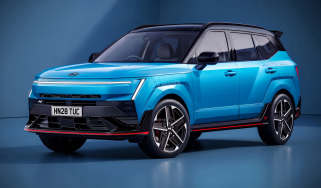
While you may be looking at these images and thinking they feel familiar, the car you see here is subtly different. This is the all-new, UK and Europe-friendly Hyundai Tucson, and as before, it’s ever so slightly shorter than the global car, offered in markets such as South Korea and the US.
Aesthetically identical to the car revealed in August, the European Hyundai Tucson gets the same ‘H-Edge’ lighting layout with up to 25,600 individual LED pixels on top-spec cars. To the rear you’ll find Hyundai’s ‘Prism’ tail-lamps, arranged in a similar formation. Defined creases and pronounced edges give the car what Hyundai calls an “inherent tension” and a more muscular appearance, inspired by the brand’s ‘Art of Steel’ design philosophy.
How big is the new Tucson?
Despite being 139mm shorter than the domestic and US-market Tucson, the new model is 35mm longer, 35mm wider and 20mm taller than its predecessor. An extra 20mm has been added to the front overhang to support pedestrian-protection requirements; at 4,560mm bumper to bumper, the new Tucson is around 225mm longer than a Nissan Qashqai, making it more spacious for front and rear-seat passengers.
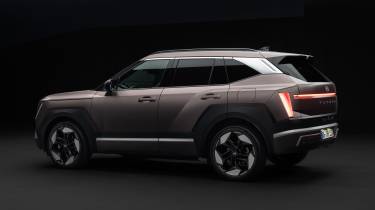
Speaking of practical features, Hyundai has increased the door-opening angle from 73 to 83 degrees; by creating almost a complete right-angle, the maker has dramatically improved ingress and egress, as well as the ease with which you can fit a child seat in the back.
Also improved is the car’s head, leg and shoulder room, with plenty of space to stretch out in the back. The rear seats recline, and on certain models slide back and forth. The seatbacks fold in a 40:20:40 formation, increasing boot space from an already generous 695 litres, to a maximum 1,910 litres all in.
What about the interior design and tech?
Up front, Hyundai claims the Tucson offers a “furniture-inspired comfort” and “intuitive controls” for its occupants – something we can vouch for having experienced the car in a closed studio ahead of the world premiere. Soft cushioning features on the dashboard, and a bank of physical switches sits beneath the huge central screen.
That screen – available in two sizes: 12.9 inches or 17 inches – runs Hyundai’s new Android-based Pleos Connect infotainment software, with AI-enhanced voice recognition and access to third-party apps and connected services. Other tech highlights include four 100-watt USB-C ports, a 15-watt wireless charging pad, a smartphone-operated digital key, and a 12-speaker Bang & Olufsen stereo, plus “interactive” ambient lighting that spans from the dashboard to the doors.
Complementing the main display is a slimline 9.9-inch instrument cluster, viewed over the steering wheel rather than through it. Unlike with Peugeot’s polarising i-Cockpit layout, you don’t need to lower the wheel into your lap to see key driving information, so ergonomics are unaffected.
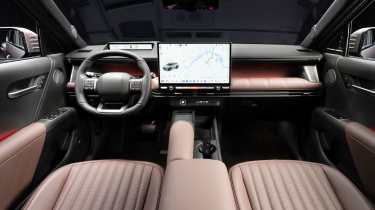
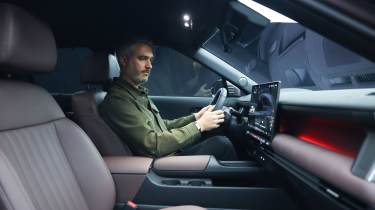
Ahead of the driver, you’ll find the Tucson’s most unassuming but intriguing feature: a 13.5v metal-coated, heated windscreen. Hyundai says it offers “15-minute full de-icing capability for harsh winter conditions”, while in the summer, it allegedly keeps the cabin two degrees cooler than conventional glass – lessening strain on the climate control, and reducing fuel consumption.
Other practical features include a Skoda-style umbrella in the front door, integrated cupholders in the rear, and an ‘AddGear’ connector, which allows those in the back to clip accessories such as phone holders, tablet mounts and even fragrance diffusers to the car for a “more personalised interior environment.”
What powertrains are offered in the Tucson?
Under the sculpted metal sits a familiar line-up of petrol, full-hybrid and plug-in hybrid powertrains, plus a choice of front and four-wheel drive. Base cars get a 148bhp 1.6-litre T-GDI engine and a six-speed manual gearbox; cars fitted with the seven-speed DCT also benefit from a 48V mild-hybrid system.
Above this sits the Hybrid with 242bhp and 380Nm of torque. There’s no meaningful electric range for this variant, but with the standard-fit six-speed auto gearbox, CO2 emissions drop as low as 118g/km (compared with 145g/km in the MHEV). The hybrid 4x4 has the largest towing capacity of any new Tucson, at 1,910kg.
Completing the range is a new, longer-range plug-in hybrid (PHEV), which matches the same 1.6 T-GDI petrol engine with a 17.1kWh battery and a larger electric motor for a combined 288bhp and up to 50 miles of EV range.
New for the 2027 Tucson is ‘HEV Stay Mode’ which allows “selected vehicle functions, including climate control, audio and device charging to remain available while the combustion engine is switched off”. Hyundai says this feature provides a “quieter and more comfortable cabin environment during stops or breaks”.
A full suite of Hyundai SmartSense driver-assistance systems is also available, including the brand’s latest, second-generation Highway Driving Assist functionality, and “navigation-based” Smart Cruise Control. The Tucson hasn’t yet been tested, but Hyundai will be aiming for a full five-star score in the latest and most stringent Euro NCAP crash tests.
What are the options and prices?
The trim structure for the new Tucson won’t be confirmed for some time, as cars aren’t due in the UK until the spring. What we do know is that a total of 11 colours will be offered, including two matte hues and five shades new for the 2027 Tucson. Inside, buyers will get a choice of monotone, or two-tone trim, in cloth, leather, or a mixture of the two.
The off-road-inspired XRT version, shown recently in Korea, won’t be brought here, though Hyundai has hinted at a “further, dynamically-styled version” set for the Paris Motor Show in a couple of weeks – teeing up a successor to the previously popular Tucson N-Line model, complete with sportier exterior styling and dark interior trim elements.
Expect the new Tucson to command a small premium over the current car, which starts at just under £31,000 in petrol guise and £34,875 as a Hybrid. Either way, several models are certain to come in under the £40,000 threshold for luxury-car VED.
Don't miss the best of Auto Express on Google! Make us a preferred source. Click here...