UK car manufacturing is on life support and EV laws could pull the plug
Brexit, EU and ZEV Mandate laws are preventing investment in UK automotive manufacturing, says head of trade body

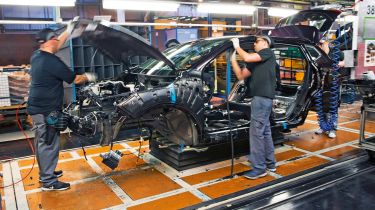
Andy Burnham is on the clock to save the UK car industry; British car production fell by almost eight per cent in the first half of 2026, with output less than half of what it was a decade ago. Now a new EU law, set to come into force at the end of 2026, as well as ongoing complaints surrounding the UK’s own EV legislation, could be the final nails in the coffin.
As such, the new PM has a job on his hands to get laws rewritten fast in order to avoid manufacturers shifting production outside of the UK – something that would not only come at the expense of jobs and the economy, but push up showroom prices, too.
Brexit laws could worsen car manufacturing slump
In the first half of this year, just under 372,000 cars were manufactured in the UK, compared to 386,000 in 2025 and almost 900,000 in 2016. These figures, released by the Society of Motor Manufacturers and Traders are, at least in part, the knock-on effect of several factory closures over the past few years, notably Honda’s plant in Swindon, as well as Vauxhall’s historic factory in Luton – although the latter admittedly only produced commercial vehicles in the latter stages of its operation.

Things could soon get a whole lot worse, as new EU-UK Rules of Origin (RoO) laws have the potential to disrupt sales and, in turn, production. Under this post-Brexit trade agreement, EVs exported between the UK and EU must, from January 2027, have at least 55 per cent of their parts manufactured locally – while the battery pack contents must comprise 70 per cent UK-EU materials. Those that do not comply will be hit with 10 per cent tariffs, effectively wiping out any profit margins. Those that do not comply will be hit with 10 per cent tariffs, effectively wiping out any profit margins.
This is especially concerning for the UK, as the EU is our biggest export market and four out of every 10 cars built here are EVs. In fact, the SMMT estimates that 70 per cent of vehicles passing both ways between the UK and EU won’t comply with RoO regulations, equating to £1.4 billion in tariffs. Such a colossal financial burden would likely be passed onto the consumer, with sales of these models taking a hit as a result as once competitive models become more expensive to buy.
“It’s in neither market’s interests to have the levy of such tariffs,” Hawes said. As manufacturers continue to shift their supply chains away from the far east and closer to home, Hawes called for “a more pragmatic approach”.
He stated: “We’re advocating for a phased application of these tariffs, because we can see greater compliance in 2028 and beyond.”
Other problems facing UK manufacturing
Burnham and his newly re-appointed Business Secretary, Jonathan Reynolds, have between now and the end of this year to land a new agreement with the EU, but this only addresses one of several factors stifling the UK’s manufacturing industry.
The major sticking point is the ZEV Mandate, which requires brands to ensure a proportion of their cars sold are fully electric, or risk huge fines of up to £15,000 per non-compliant vehicle. Carmakers complain that the additional cost of manufacturing in the UK (i.e high labour and energy prices) isn’t worth the trade-off when they are being penalised on what they sell. “Why would you [build cars] here if it’s uneconomic to sell here – especially if 80 per cent of what you make will be shipped abroad?”, asked Hawes.

In fact, he even hinted that "there’s [brownfield] investment decisions on [the] next model, next generation, which are waiting for the Mandate review”, although he refused to divulge what these are.
Finally, there are also calls for UK-built vehicles to be included within the new ‘Made in Europe’ rules. Designed to boost European manufacturing, these effectively offer tax breaks and incentives for vehicles built in the EU. The result of the UK not being covered by these rules would be to make British-built models less competitive and provide carmakers with very little incentive to invest here, putting existing and future jobs at risk.
Can China save the day?
Given that cars are the UK’s third-largest export in terms of value, it’s crucial that production is ramped up from its current level if the country wishes to avoid a sizable hit to the economy.
It appears, however, the answer may lie with China, as a newly-signed Memorandum of Understanding could see Chinese conglomerate Chery, the builder of the popular Jaecoo 7 ‘Temu Range Rover’, make use of spare manufacturing capacity at Nissan’s plant in Sunderland – the home of Auto Express’ 2026 Car of the Year, the Nissan Leaf.
While there are concerns about China already undercutting European brands and using UK manufacturing as a means to dodge import tariffs, Hawes says the benefits to the British job market and economy outweigh the cons. “You’ve seen the numbers and they’re really low,” he told Auto Express. “So if a company’s intention is to utilise capacity and safeguard employment, that’s very much to be welcomed from an industrial perspective.”
The SMMT believes that Chinese brands embracing UK production could be key to getting annual output back over one million units – something that hasn’t been seen since the COVID-19 pandemic. In the meantime, as for those brands forced to compete for market share against the much cheaper Chinese competition, Hawes commented that the UK “can only absorb so much”.
He explained: “There are more brands coming, but they’ll start fighting each other in terms of market share. We [also] have plenty of pre-existing brands with loyal customers…The UK market has always been open.”
Now you can buy a car through our network of top dealers around the UK. Search for the latest deals…