What is Euro NCAP? Latest safety updates, star ratings and crash test scores explained
Euro NCAP is the independent body behind new car crash safety scores – here's everything you need to know
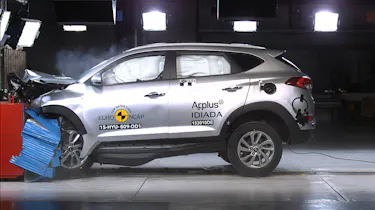
While modern in-car safety may feel a bit overbearing for some people, there’s no denying that drivers and passengers are far safer today than they were even just a few years ago. Euro NCAP is partly to thank when it comes to car safety, and its thorough crash testing can literally make or break a car’s reputation.
Since 1997, Euro NCAP has been independently rating the crash protection offered by most of the cars on sale, and its tests have resulted in improved standards across the board – saving thousands of lives on UK roads alone, and many more across Europe.

But as technology has moved on, so have the NCAP test requirements. In recent years, there’s been greater emphasis on complicated (and often expensive) electronic assistance, mitigation and prevention technology, all required to get the full five-star rating, leading some to suggest things have gone too far.
So what is Euro NCAP and how does the testing process work? We explain everything you need to know below.
What does Euro NCAP’s testing involve?
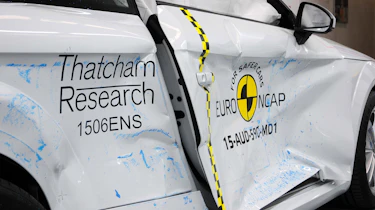
From the very beginning, the core of Euro NCAP’s safety testing has been the crash test. It’s here where a test car is unceremoniously ploughed into an obstacle at 40mph in order to simulate how well the car would hold up in a real-life collision. A side impact test is also carried out where a deformable barrier is hurtled towards the driver’s door at 30mph.
These tests are designed to show exactly how a car holds up to catastrophic crash damage, and how well it protects the occupants. Sophisticated test dummies are placed inside the car during testing to see how badly any human occupants would be injured, or if the collision would potentially prove fatal.
As well as testing the structural integrity of a car, NCAP also uses this opportunity to test the effectiveness of its on-board systems.
Pedestrian and cyclist safety is taken into consideration, too. In these tests, a car is driven into a dummy and the damage to areas like the head, pelvis and legs are evaluated.
How has Euro NCAP’s testing evolved?
The latest testing criteria was introduced in 2023, and this demands sensors which will call the police if drivers have mistakenly left their kids in the car. There’s also a requirement that the windows and doors can still be opened if the car is submerged in water. The latest upgrades also include more rigorous testing to new Active Safety scenarios, measuring system responses to the most challenging car-to-motorcycle, car-to-car crossing and car-to-car head-on collision dangers.
The tests are set to evolve again with sensors needed to detect fires and assess the driver’s vital signs, automatically alerting emergency services if they sense a problem.
The next stage will need in-car cameras to monitor the driver’s face for tiredness or distraction, while Autonomous Emergency Braking systems will need to detect motorcycles.
What do carmakers think of the Euro NCAP standards?
Euro NCAP’s ever-evolving testing criteria has met with some resistance. For example, Luke Broad, Dacia UK’s Brand Director, told Auto Express: “We know that our cars are safe. They meet or exceed all of the necessary requirements and will continue to develop as technology improves, with features you would not expect to see at the price level. But adding safety technology adds cost, and there is a balance to be made. It’s up to the customer to decide if they want to pay extra for these features.”
How to read the Euro NCAP stars
- 5 stars: This is the best possible score. The car has demonstrated excellent overall performance across all testing, and is fitted with the best crash avoidance technology.
- 4 stars: The car generally performed well during testing, but fell short in one or more key assessment areas.
- 3 stars: Only an average level of safety performance was observed during testing, with no area standing out.
- 2 stars: Nominal crash protection is offered, but the car demonstrated a below-average performance in one or more key assessment areas.
- 1 star: Only marginal crash protection is offered, although the car’s standard crash-avoidance technology goes beyond the legal minimum.
- 0 stars: The car meets the approval-type standards so it can legally go on sale, but modern safety technology is lacking.

The current Euro NCAP safety regime includes a dual rating, with some cars tested both with and without various high-tech safety features. This means some cars may get five stars if they are configured with autonomous emergency braking, for example, but drop to four stars for the second rating if this feature is not standard.
To get a second optional star rating on a car, manufacturers just have to confirm that they expect the extra safety technology (defined as a ‘safety pack’) to be fitted on at least 25 per cent of models sold.
In 2023, Euro NCAP introduced extra safety tests that require child presence detection, specifications for vehicle submergence and more technologies for detecting motorcyclists and other vulnerable road users to achieve a full-five-star safety score. Prior to this in May 2020, Euro NCAP added a new moving, deformable barrier test to assess whether larger, heavier cars such as big EVs put occupants of smaller vehicles at significant risk – an idea known as ‘compatibility’.
At the same time as the compatibility test was rolled out, more advanced assessments of autonomous emergency braking systems were introduced, while a new £600,000 crash-test dummy called THOR (Test device for Human Occupant Restraint) is now being used in Euro NCAP tests for the first time in order to better represent how human bodies behave in collisions – an idea known as 'biofidelity'.
With manufacturers employing more active safety tech in their cars, Euro NCAP has also introduced a new set of safety tests that assess how well systems such as adaptive cruise control and lane-keep guidance work, while the body also assesses systems that come into effect after a crash, from automated calling of emergency services, to manufacturers providing documents to assist with first responders.
Euro NCAP safety ratings
- Adult occupant protection: This score shows how well a car protects adult drivers and passengers from frontal impacts, lateral impacts and whiplash.
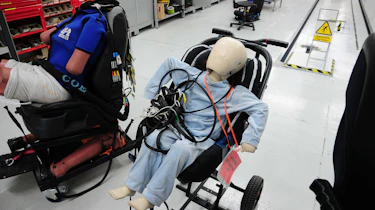
- Child occupant protection: Three aspects are covered by this score: the protection provided by child restraint systems, the car’s ability to accommodate child restraints, and the availability of provisions for safe transportation of children.
- Vulnerable road user protection: This score accounts for those outside of the car (i.e. pedestrians and cyclists). Potential injuries to a pedestrian’s head, pelvis, upper and lower leg are analysed during testing, and cars can gain additional points when fitted with pedestrian- and cyclist-detecting AEB technology.
- Safety assist: The availability and effectiveness of a car's advanced safety and driver-assistance systems contribute to this score.
Euro NCAP’s assessment areas
| Vehicle assistance | How effectively the systems work during normal operation. |
| Driver engagement | How accurately systems are marketed; how well the car monitors if the driver is paying attention (EG hands on the steering wheel); how intuitive systems are; and how clear it is if the system is active or inactive. |
| Safety back-up | How well the systems perform in an emergency, such as if the driver loses consciousness, if the system fails, or if a collision is about to occur. |
How to compare the Euro NCAP test scores
Just as cars are evolving the Euro NCAP crash tests are regularly updated to keep pace and give the most useful results to consumers. This can create some problems when comparing cars tested under different Euro NCAP regimes.
Euro NCAP crash test scores remain valid for six years from the year the car was rated. After that, the organisation says the testing system will have moved on to such an extent that “its assessment is largely irrelevant in comparison with cars tested more recently.”
However during the six year period a rating remains valid, the test body says it does perform reviews to ensure their continued validity. Manufacturers must confirm each year that the same level of safety tech is fitted, and also submit details of any model facelift changes that might affect their ratings.
As results are currently configured, you can look at the overall star rating for a swift comparison between models, but also make a more detailed comparison of percentage scores in each of the four main test categories. The Euro NCAP website also provides detailed breakdowns of how those category results were determined and videos of the crash tests themselves.
Euro NCAP’s history
| 1997 | First results released. Before this, all you had was crash into a wall head on with no need for a dummy. |
| 2001 | Pole impact test introduced. |
| 2001 | Seat belt reminder assessment brought in and Renault Laguna becomes the first five-star car in Adult Occupant Protection. |
| 2003 | Euro NCAP launches Child Protection Rating. |
| 2007 | First ever Europe-wide ESC fitment survey released. |
| 2008 | Testing pick-ups begins and Euro NCAP releases results of first whiplash protection tests. |
| 2009 | New overall star rating including Safety Assist introduced. |
| 2011 | Euro NCAP begins testing electric vehicles and makes ESC tests mandatory in the star rating. |
| 2014 | AEB included in the rating and safety tests on Heavy Quadricycles begin. |
| 2015 | Euro NCAP introduces new full width frontal test. |
| 2016 | Safety rating expanded by including AEB technology for pedestrians. Dual rating introduced as well as two new child dummy sizes in the crash tests representing a six and a 10 year old child. |
| 2020 | New tests introduced to check heavy cars don't damage lighter ones too much; AEB checks toughened up; new crash-test dummy used; driver monitoring systems assessed. |
| 2023 | Safety ratings updated with new child presence detection systems, vehicle submergence standards, and motorcycle and vulnerable road user response technologies; Euro NCAP tests also now include HGV ratings |
Expert insights from Euro NCAP Technical Director, Richard Schram
Q. How does Euro NCAP decide what new criteria should be involved in the tests?
A. We look at the accident data and evaluate current vehicle performance. In addition, Euro NCAP consults all interested manufacturers and suppliers to see what is technologically feasible.
Q. Why was it decided to insist on Child Detection Systems and the underwater door functionality? Are these significant problems globally?
A. Decisions are made on the technology available and accident data. In these specific cases, the number of incidents is not many, but they can be avoided with existing technology.
Q. Consumers seem to dislike features such as lane keep assist and speed limit warnings. Have you had any push back against these?
A. We do acknowledge that, unfortunately, consumers can be annoyed by the warnings and intervention of some systems. Therefore, Euro NCAP will focus on the performance and consumer acceptance for the next rating updates in 2026.
Q. Is NCAP’s expectation that all car makers will still strive to achieve 5-stars, or do you expect manufacturers and consumers will accept lower ratings?
A. The new 2026 ratings will ensure it’s not only the high-end car makers achieving 5 stars. Some OEMs (car makers), like Dacia, might go for lower ratings to make more profits. We were extremely disappointed that Renault decided to de-spec basic safety equipment like the curtain airbag to increase profitability. OEMs that are not striving for 5 stars will still need to go beyond the regulatory requirements to stay away from 0 stars. Then, ultimately, it’s the consumer that decides what to buy.
Did you know you can buy a used car with Auto Express? Choose from tens of thousands of cars with trusted dealers around the UK. Click here to buy used with Auto Express now...