Stunning Toyota GR GT arrives to shake up the supercar elite with 641bhp V8 power
After months of unsubtle teasing, Toyota has finally revealed its new GR GT supercar

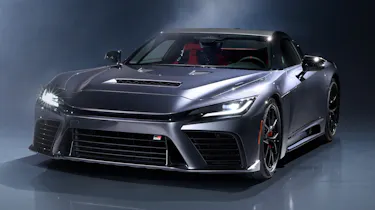
Toyota is about to rejoin the high-performance major league with an all-new V8-powered supercar that’ll rival the McLaren Artura, Mercedes-AMG GT, Aston Martin Vantage S and Porsche 911 GT3.
Called the GR GT, this bespoke coupé features a fresh engine, chassis, transmission and hybrid system that won’t just do battle with Europe’s finest on the road, but also on the world’s racing circuits, because a GT3 version has been developed, too.

Toyota hasn’t revealed pricing or availability for the UK yet, but this should be a global model thanks to a CO2-friendly hybrid system. We also don’t know whether the total number built will be limited, but for now we can revel in its high-performance specs until we drive the car next year.
Are you looking for your next V8 supercar? Check out the Auto Express Buy A Car service to find a high performance bargain!
Engine, chassis and drivetrain
Just like it did with the Lexus LFA supercar 15 years ago, Toyota began this project with a clean sheet, designing pretty much every part of its chassis, engine and drivetrain from scratch. The fundamental chassis is built from aluminium, with large-scale castings for the subframes reducing weight and helping increase stiffness.
To this, carbon fibre-reinforced plastic (CFRP) panels are used to keep weight down, but there’s no intricate carbon-fibre tubs or casting as seen in the previous LFA – this should see the price tag come down from hypercar levels of the Lexus, to something approaching the cost of a supercar.
The suspension is a double-wishbone design at all four corners with coil springs, each with a special design to keep the bodywork as low as possible. There are 20-inch wheels front and rear, with Brembo carbon-ceramic brakes mounted behind.
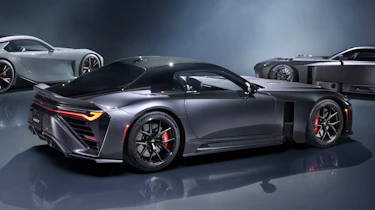
The engine is brand new and totally bespoke for this project, taking the form of a cross-plane 4.0-litre V8 with two turbochargers mounted within the cylinder banks. This ‘hot-vee’ set-up is similar to what you’ll see on most modern V8 engines, but gets a dry-sump lubrication system. This allows the engine to be mounted low in the chassis, helping keep the centre of gravity down, which was a core engineering principle across the whole car.
Power is then sent to the rear wheels via a hybridised transaxle that incorporates a small electric motor, limited-slip differential and new eight-speed automatic transmission with a wet-clutch set-up in place of a traditional torque converter. This is a similar gearbox design to that found on various Mercedes-AMG models, and provides faster shifts without the added weight or complexity of a dual-clutch design.
The electric motor sits ahead of the gearbox in this scenario, and Toyota says this helps reduce any delay or lag from the engine, while adding extra power and torque to the overall system. The manufacturer hasn’t officially announced any more information on the hybrid powertrain, but looking at the interior pictures we can see a ‘Boost’ mode on the driving mode switch, suggesting there will be a way of unleashing the full performance from both the petrol engine and the electric motor. There’s also no detail on the type or size of battery fitted, but we expect this to be a fairly small unit that operates chiefly for performance, rather than offer much pure-electric drive.
Final performance figures have yet to be fully confirmed, but Toyota is quoting a 641bhp peak power figure and 850Nm of torque. The transaxle layout also helps provide a 45-55 front-to-rear weight balance, which is very impressive considering the engine is front-mid mounted.
At 4,820mm long, this is also a relatively large supercar. For comparison, a Mercedes-AMG GT 63 S E Performance is nearly 100mm shorter and slightly narrower, but to highlight the extreme proportions Toyota has given the GR GT, it’s also 159mm taller. No specific weight figure has been released, but the brand is targeting a maximum weight of 1,750kg. This is a lot by supercar standards, but when compared with hybrid-assisted rivals like the AMG mentioned above, is still around 200kg lighter.
Design, aero and interior
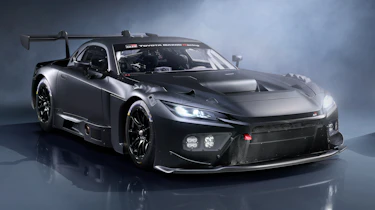
Rather than a pure road-car development, the GT3 racer has been an integral part of the program, with certain decisions around proportions, packaging and design centred around what’s also best for the racing version. This is clear to see with the GR GT’s design, which is somewhat function-over-form.
The front-mid layout of the engine gives the GT a very long bonnet and short tail, with the two-seater cabin in effect mounted on the rear axle. The nose has intakes and vents in strategic places for the technical package underneath, not for the sake of style.
There’s little in the way of active aero, and Toyota hasn’t elaborated on the aerodynamic performance of the road-going model yet, but a top speed of 198mph suggests this is a slippery car, without too many drag-inducing elements slowing it down.
Inside, this theme of form following function continues, with a restrained interior that leads on good sight-lines for the driver. This explains the low dashboard and simple layout.
The driver gets a unique steering wheel with controls for the driving modes and traction control, with a digital display mounted behind. The dash is fairly simple in layout, with a main touchscreen joined by some physical controls for the air-conditioning, plus a few more buttons on the centre console. This is strictly a two-seater, and the seats look to be carbon-framed buckets from Recaro.
Luggage space is destined to be small, because the transaxle will encroach on boot space behind the two seats. However, there does appear to be some interior storage between the seats.
Now you can buy a car through our network of top dealers around the UK. Search for the latest deals…