New BMW iX5 Hydrogen 2023 review
The new BMW iX5 Hydrogen SUV shows off the potential of fuel-cell power


Verdict
The iX5 Hydrogen proves the viability of fuel-cell technology in passenger cars. It feels just as you would expect any electric BMW SUV to, and the refuelling process couldn’t be quicker or simpler. The infrastructure needs expanding if this technology is to succeed – the UK is a long way behind countries such as Germany and Belgium – but there’s no reason that can’t be changed in time. This feels like a glimpse of the future.
Hydrogen fuel-cell technology seems to have been on the cusp of breaking through into the world of passenger cars
for a while. But aside from a few forays, manufacturers haven’t exactly leapt at the chance to put the tech into series production, as they have with full EVs.
However, BMW has bucked this trend and will build a run (albeit a limited one, of just 100 units) of iX5 Hydrogen models, which will be going into service this spring, partly as a rolling laboratory to see if hydrogen could be viable in the future.

The basic recipe packages two carbon-fibre-reinforced plastic hydrogen tanks within the standard X5’s chunky body, which hold almost 6kg of hydrogen at a pressure of 700 bar. These feed a hydrogen fuel cell mounted under the bonnet, which is rated to produce 168bhp – although this is not the car’s actual power output.
Used - available now


Instead, through a chemical reaction, the fuel cell converts the hydrogen into electricity, which is stored in a power battery. This can be charged by either the fuel cell or kinetic energy recovery when the car is slowing down, and the electricity from this battery supplies a fifth-generation eDrive motor on the rear axle, which has a total power output of 396bhp. The only emissions from the fuel cell are water vapour and heat, with the latter captured to warm the car’s interior.
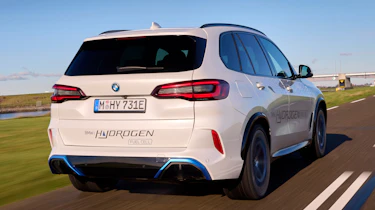
On the move, the iX5 Hydrogen behaves similarly to its smaller iX3 EV sibling, as well as the iX SUV – no surprise given there are some carryover parts. The iX5 moves off silently and swiftly thanks to a strong surge of torque. Due to the limited-run car not being on sale to the public, BMW hasn’t revealed its full specifications, but the firm has said it’s lighter than an equivalent battery-electric model. Instead, it weighs a similar amount to a plug-in hybrid X5 xDrive45e, placing it at around 2,500kg. As such, the BMW is swift enough; 0-62mph is completed in less than six seconds.
However, it’s the refinement that grabs you. The X5 xDrive45e is superbly smooth and quiet, so moving to full electric propulsion in the X5’s well insulated body means that things are even quieter. The ride is a match for the refinement, with supple suspension that smooths out bumps and cracks in the road well, giving the iX5 Hydrogen a luxurious feel on the move.
Of course, this is a big SUV and while BMW is known for its driver involvement, the iX5 feels just a little cumbersome at times, even though its steering is light and precise, grip is good and the weight is well contained by the chassis. All despite the softer, more comfort-focused set-up.
BMW says the iX5 Hydrogen’s range is around 311 miles. This is not the greatest, but it’s roughly equal to claims by full EVs of a similar size, and of course the process of refilling the car with hydrogen is just as swift as topping up with petrol or diesel. However, finding a filling station could prove tricky, because the hydrogen infrastructure in the UK is limited at the moment. Only 15 filling stations are available, which explains why only a very small handful of iX5 Hydrogens from the pilot scheme will be sent here.
The refuelling port is located behind the same filler door as in a combustion-engined X5, so it’s a simple exercise. You simply click the filler nozzle into place, locking it with a lever, and press a start button on the pump. Three to five minutes later, the process is complete – you just unlock the nozzle and remove it.
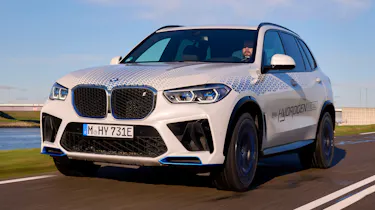
There are only a few visual changes compared with the regular, pre-facelift X5. Of course, the blue flashes and faired-in grille denote propulsion by electricity, with the former improving aerodynamic efficiency and range, too. Many of the lower body and bumper add-ons are 3D-printed.
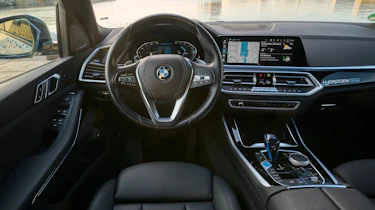
There are new, aerodynamic 22-inch alloy wheels, again with blue flashes, while inside, the blue detailing and Hydrogen Fuel Cell badging are repeated, subtly distinguishing the car from a regular X5.
Practicality is unchanged, so the iX5 is roomy. This is thanks to one of the hydrogen tanks being positioned in the transmission tunnel and the other mounted underneath the rear seat bench. Even with the power battery located at the rear, boot capacity doesn’t appear badly affected, although no official figure is available.
This X5 is a test bed for future fuel cell-powered BMWs, and with the brand’s new Neue Klasse platform under development, this limited production run of iX5 Hydrogen models shows that – integrated into future models from the beginning – the tech could have genuine worth in a big, premium SUV like this. Even here, it’s not the car that’s lacking, just the infrastructure.
| Model: | BMW iX5 Hydrogen |
| Price: | TBC |
| Powertrain: | Hydrogen fuel cell/1x e-motor |
| Power: | 396bhp |
| Transmission: | Single-speed automatic, rear-wheel drive |
| 0-62mph: | < 6.0 seconds |
| Top speed: | 115mph |
| Range: | 311 miles |
| CO2: | 0g/km |
| On sale: | N/A |