BMW iX review
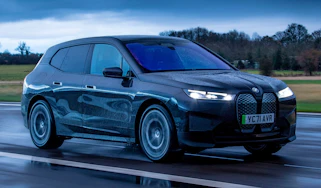
The BMW iX may be expensive and controversially styled, but it’s still a deeply impressive electric SUV

Our opinion on the BMW iX
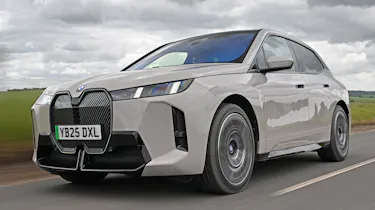
The BMW iX is a seriously impressive achievement from the German manufacturer. Famed for its engineering prowess, BMW has developed a large, electric SUV that is supremely comfortable, great to drive, leads the way with first-rate on-board technology and claims an impressive range of up to 426 miles, depending on the spec.
Luxury levels of ride and refinement add to the sense of occasion, as does the interior quality, although the obvious catch is that you will have to pay handsomely for the privilege of owning one. One of our minor grumbles is that the iX’s boot is a touch too small compared to some rivals. Other than that, the BMW iX is a superb EV and one we definitely recommend, if your pockets are deep enough.
About the BMW iX
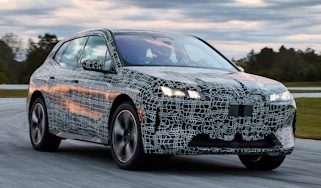
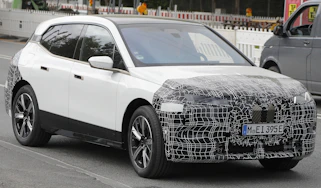
The BMW iX was the Bavarian automaker’s first all-electric car since the BMW i3 when it was launched back in 2013, and is regarded in some circles as a surefire future classic. Since the iX first arrived, the brand’s electric portfolio has expanded rapidly. So, in order to keep up with its younger siblings, the iX was treated to a revamp in 2025.
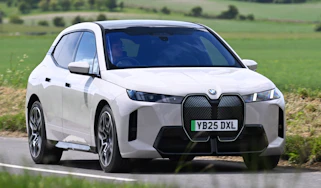
Look past the bold design that won’t be to all tastes and the iX has never been short of talent. It’s not just the driver who’ll enjoy travelling in this SUV, either, as passengers also benefit from the supreme levels of comfort and on-board tech, not to mention the whisper-quiet electric powertrain and luxury cabin feel: the interior is swathed in soft-touch fabrics, while the futuristic dash design is a standout feature.
Used - available now


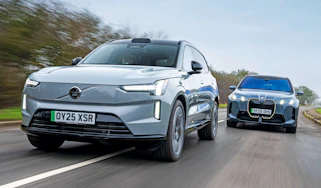
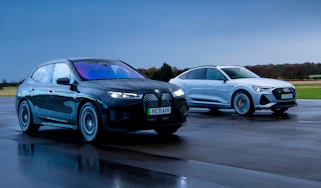
We've driven several variants of this BMW, and we've also tested the pre-facelift BMW iX as part of a six-month, long-term test. Our most recent group test lined up the iX against a Volvo EX90, and it's here where the electric BMW took the win thanks to its superior performance, handling and efficiency.
Performance & driving experience
Pros |
|
Cons |
|
Unlike the brand’s smaller electric SUVs which share components with combustion-engined counterparts, the iX uses a dedicated EV platform using plenty of weight-reducing materials. This is a big car, though, and the fact that it weighs in at 2.4 tonnes certainly raises a question over the ride and handling.
Well, you needn’t worry, because the iX is superb to drive; surprisingly agile through the twisty stuff and providing decent steering feel, it offers bags of grip and fills you with confidence as you turn into a corner. The throttle is easy to modulate, too, whether you’re in slower town traffic or travelling more quickly down an A- or B-road.
The iX isn’t too shabby on longer motorway journeys, either, where you’ll notice just how quiet the cabin is. We didn’t hear any of the typical electric motor whine and only noticed the faintest undertone of wind noise at motorway speed. All this, coupled with the iX’s ability to soak up almost any bump in the road, makes it difficult to find a negative aspect of how BMW’s flagship electric car drives.
While not a full-blown M division product, the iX M70 gets revised air suspension, anti-roll bars and brakes. In fast, sweeping bends, it has an impervious level of grip and keeps tight control on body movements, but sharper hairpins do expose the iX’s size and sheer weight.
The M70’s steering responds quickly, and the standard integral active four-wheel steering (a £1,400 option on 45 and 60 versions) further improves the car's agility in tight corners. It’s not overly firm in Sport mode - some added edge over the regular iX may even be welcome – while the Efficiency drive mode setting is soft enough that the BMW squats on its rear under hard acceleration.
Electric motors, 0-60mph acceleration and top speed
BMW has completely overhauled the iX range’s powertrain line-up, diving into the nitty-gritty of what makes it tick to deliver improvements in both performance and efficiency. For the facelift, new power-inverter tech, tweaked motors and revised software all feature, as does a revised capacity battery pack for the entry-level model.
The results are fairly profound, particularly at the entry point of the range; the xDrive45 replaces the previous 40 model, gaining 87bhp to take total power to 408bhp. The result is a 5.1-second 0-62mph time – a full second quicker than its predecessor. Better still, its battery has grown larger, to 94.8kWh, which means that range – previously a weaker factor in the old base model – is now so good that we think it’s the pick of the new line-up.
If you do want to go further between charges, then the xDrive60 can offer just that, thanks to a 111.5kWh battery. At 544bhp, it’s quick, too, with 0-62mph taking a mere 4.6 seconds. The most potent version is the M70. Here, there’s 650bhp and over 1,000Nm of torque, propelling this 2.6-tonne beast from 0-62mph in 3.8 seconds using its dedicated launch control mode.
| Model | Power | 0-62mph | Top speed |
| iX xDrive45 Sport | 408bhp | 5.1 seconds | 124mph |
| iX xDrive60 M Sport | 544bhp | 4.6 seconds | 124mph |
| iX M70 xDrive | 650bhp | 3.8 seconds | 155mph |
Town driving, visibility and parking
There’s no debate when it comes to refinement: the iX is staggeringly good. At low town speeds, tyre noise is almost imperceptible from inside the cabin, giving the car a hushed environment that is normally the preserve of full-blown luxury saloons.
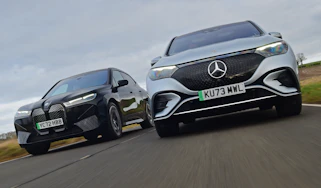
The ride for the most part is sublime, too, but the few niggles we have here present themselves at low speeds; there’s a tendency to thump into larger bumps, which betrays the car’s weight, and there’s just a touch more fidgeting over smaller bumps than you’ll find in rivals such as the Mercedes EQE SUV.
Country road driving and handling
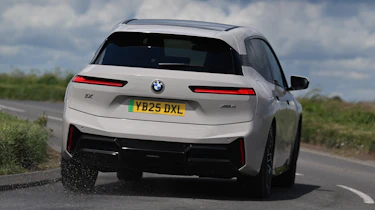
The iX’s steering is light and direct, which does a superb job of hiding the car’s mass. At least until you start to push the tyres to the limits of their grip, that is – at this point, the front tyres begin to squeal and then gently wash wide. Work within that limit, and its road manners are deeply impressive.
It’s an achievement for any car to both ride and handle so competently, let alone one as large as this. With the mass of the big battery located low in the iX’s body, and between the front and rear axles, it feels very predictable, stable and easy to drive.
Motorway driving and long-distance comfort
Long, high-speed cruises are when the iX settles into its best work. Stability is unflappable, while any fidgeting that can be felt at low speed completely vanishes, revealing an utterly superb ride quality. Combined with the still-eerie lack of road noise and minimal wind rustle, there is little else on the market that feels so relaxing.
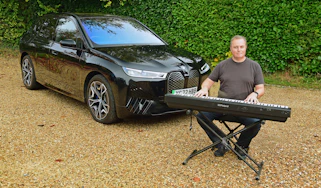
“The ‘Expressive’ set-up features audio created by composer Hans Zimmer that is a substitute for an engine note. When cruising, there’s background noise that sounds like an orchestra warming up, but it turns into a more futuristic mix of strings and bass that brings visions of a spaceship hitting warp speed.” - Dean Gibson, senior road test editor.
Range, charging & running costs
Pros |
|
Cons |
|
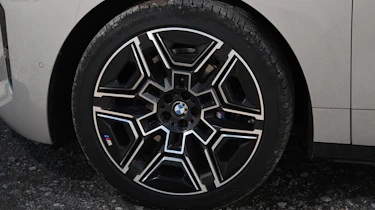
A big part of the effort made to improve the iX in its mid-life updates has focused on one of the car’s previous weaknesses: its so-so efficiency. All of the brand’s changes to the electrical system, plus other improvements such as lower-resistance wheel bearings, have generated very strong results.
The xDrive45’s battery is larger than the xDrive40’s that it replaced, with a capacity of 101kWh, of which 95kWh is used for driving range. A longer range means that we think this version is the pick of the iX line-up.
Our most recent test returned an average of 3.5 miles/kWh from the xDrive60 model, which is very good for a car of this size, and a significant improvement on earlier iXs. What was more impressive is that on long motorway runs, where many EVs tend to increase their energy consumption, the iX continued to perform strongly in this regard.
The sportier M70 takes a slight hit in range compared with the xDrive60 with the same battery size, with a WLTP figure of up to 365 miles. During testing in milder autumn weather, we saw an efficiency of 2.4 miles/kWh or 261 miles to a charge, based on its 108.9kWh usable battery capacity.
Charging speeds are strong, too. The xDrive45 models can be replenished at up to 175kW, while the xDrive60 and M70 variants can be refreshed at up to 195kW. Further advanced cooling and software tweaks ensure that this power is delivered more consistently and closer to the maximum level than before.
| Model | Battery size | Range | Insurance group |
| iX xDrive45 Sport | 94.8kWh | 374 miles | 50 |
| iX xDrive60 M Sport | 112kWh | 424 miles | 50 |
| iX M70 xDrive | 112kWh | 365 miles | 50 |
Insurance groups
Nobody is realistically expecting a flagship BMW to be cheap to insure, and it’s a good job as every variant sits in insurance group 50 out of 50. This isn’t a unique situation in the premium electric SUV market, though, as both the Polestar 3 and Volvo EX90 also sit at the very top of the insurance cost tree.
Tax
VED road tax rates are consistent with any electric car costing more than £50,000, but a higher annual bill from years two to six is unlikely to deter buyers who can afford to buy a BMW iX in the first place. However, it’s still worth being aware that EVs are likely to be subject to a future eVED pay-per-mile tax if that comes into force in 2028 as planned.
If you're fortunate enough to be able to run one as a company car, the iX’s low Benefit-in-Kind (BiK) tax rate makes it far more affordable than a traditionally powered petrol or diesel SUV.
Depreciation
Our market data indicates that the BMW iX will retain between 41 and 44 per cent of its original value after a period of three years or 36,000 miles. This is quite a bit less than the 51 to 57 per cent the Volvo EX90 manages. However, the BMW is slightly ahead of the Polestar 3, at 38 per cent, while the Lotus Eletre faces a similar fate at 38 to 42 per cent.
Interior, design & technology
Pros |
|
Cons |
|
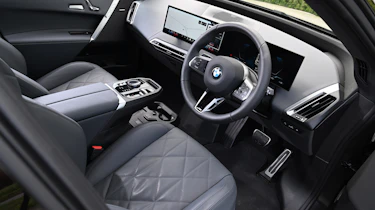
As well as feeling suitably luxurious, the BMW iX is also a practical family SUV. There are big door bins to store any odds and ends, while the sizable wireless smartphone charging pad is handily located below the iDrive controller, making it easy to access.
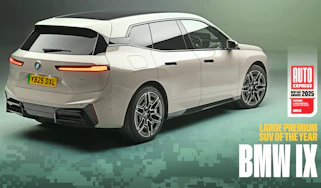
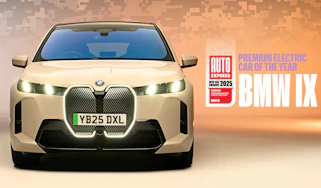
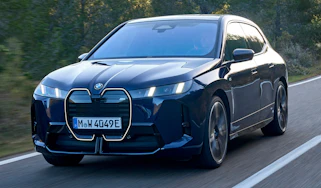
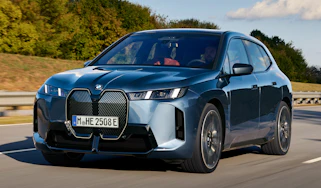
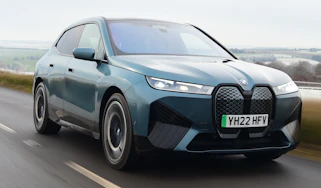
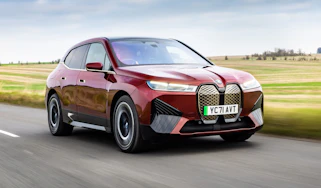
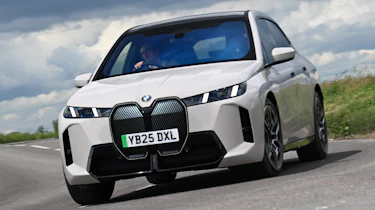
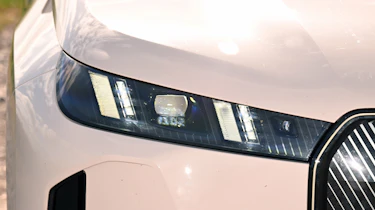
The cabin is a comfortable place in which to spend time, too, and all versions of the iX are laden with standard kit. BMW has also revised the M Sport models to cement their position as the most popular options with anthracite headlining and M Sport-specific interior trim pieces. The midlife facelift also added a new exterior look, which is most distinctive for the M Sport; deeper front bumpers with new side vents emphasise the car’s width, while the headlights and grille have been reprofiled – the latter is now available with illumination around its border.
The BMW’s refresh also introduced a more standard-looking three-spoke steering wheel in M Sport models, plus a more subdued colour scheme than earlier cars. We think that’s a bit of a shame, because the colours and quirkiness of the pre-updated models set it apart from the competition even more.
However, these features are still available on the Sport trim, although the more assertive exterior look of the M Sport cars will likely see them find more buyers.
Interior and dashboard design
A peek inside the cabin highlights why the iX is BMW’s all-electric flagship SUV – it oozes quality, with an ultra-modern feel and lots of soft-touch, suede-like materials in use across the dash and door cards. At first glance the seats look relatively flat, but soft centre padding means they’re both comfortable and supportive, while both the driver and passengers will appreciate the full-length ‘Sky Lounge’ panoramic sunroof that floods the cabin with light when fitted.
Materials and build quality
Step inside the iX, and it’s clear this is a BMW range-topper: the design, finish and quality are all truly fantastic. The materials – whether you consider the suede-like or leather finishes – feel expensive, and the overall look is like nothing else in the class.
Infotainment, sat-nav and stereo
At a time when almost every other car maker is moving exclusively to touchscreen inputs, BMW has chosen to keep the iDrive clickwheel input for its eighth-generation infotainment system. That’s a very good thing – it was, and still is, much easier to make adjustments on the move with these physical controls.
The displays themselves look spectacular. Two vast screens sit side by side within a gently curved pane that appears to float above the dash. The graphics are bright and stylish, loading times are incredibly quick, and the full-screen integration of Android Auto and Apple CarPlay is one of the best we’ve seen.
One of the few criticisms we can level is down to key sizes. The main menu lists all of the functions on one screen; despite the huge screen size, the sheer number of sub-menus means that each is reduced to a small, fiddly icon. We’d prefer that less important functions be relegated to a separate page.
Boot space, comfort & practicality
Pros |
|
Cons |
|
There are some rivals that offer even more space in one or two areas, but there’s little to complain about with the enormous levels of room that the iX provides for occupants.
Dimensions and size
The iX is a large SUV that’s a touch bigger overall than a BMW X5. Interestingly, while the mid-size BMW iX3 is a smaller car all-round, it actually has a bigger boot.
Dimensions comparison | |||
| Model | BMW iX | Volvo EX90 | Lotus Eletre |
| Length | 4,965mm | 5,037mm | 5,103mm |
| Width | 1,970mm | 2,039mm | 2,019mm |
| Height | 1,695mm | 1,747mm | 1,636mm |
| Wheelbase | 3,000mm | 2,985mm | 3,019mm |
| Boot space | 500 to 1,750 litres | 310 to 1,915 litres | 688 to 1,532 litres (to roof) |
Seats & passenger space
The seats look wide and flat – almost as if they might be short on side support – but sink into them and they are very comfortable. The fixed headrest on M Sport cars is nicely judged, because it doesn’t push the driver’s head too far forwards, unlike some models with a similar design.
Both the seat and the steering wheel offer lots of adjustment, and the dashboard line is relatively low for a big SUV, so the view ahead is good, too. A deep central bin sits at the rear end of the high floating centre console, but the door pockets aren’t particularly large.
The heavy quilting of the fabric and the wide, flat bench mean that the back of the iX looks somewhere between a car seat and a sofa – and is pretty close to the latter in terms of comfort, too. A completely flat floor means that it’s easy for a full complement of three passengers to sink into the forgiving seat cushioning and enjoy the generous head and knee room on offer here. It isn't quite as limo-like as an Lotus Eletra, though, which offers between 682 to 947mm of knee room according to our measurements, but the 635 to 885mm of space the iX offers certainly isn't anything to be sniffed at. For example, a Range Rover Sport (a typical big SUV) has between 635 and 898mm of knee room.
Headroom in particular is absolutely vast, with 1,006mm of headroom eclipsing the svelte Electra by over 50mm. The large windows in the iX make the rear of the cabin a very light and airy place to sit, too – especially when a panoramic sunroof is fitted.
Boot space
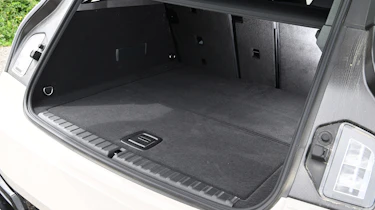
There aren’t many buyers who will complain about a 500-litre boot, but that figure means that the iX isn’t at the head of its class when it comes to load capacity. The Mercedes EQE SUV, for example, offers 545 litres. The BMW’s rear seats fold almost flat in a three-way split, though, and in this configuration the iX offers a very generous 1,750-litre volume. One thing that’s missing is storage under the bonnet, so you’ll have to carry charging cables in the deep compartment under the main boot floor.
Towing
The maximum braked trailer towing capacity for the xDrive40 is 2,100kg, although if you need to hitch up a bigger caravan, you may find that the xDrive50 or high-performance M60 versions are the better option as they're rated to tow up to 2,500kg.
There’s no doubting the BMW iX’s towing credentials, either, as it was officially named as 2025’s best electric tow car. We found our iX xDrive60 test car was able to tow a 2,000kg caravan with very little disturbance in terms of ride quality or power distribution.
“A common theme with all of the EVs that I tested was the sheer ease with which they handled the extra weight of a caravan. It’s testament to the BMW iX’s all-round ability that it felt just as responsive, comfortable and refined as it does when unhitched.” - Dean Gibson, senior road test editor.
Reliability & safety
Pros |
|
Cons |
|
Euro NCAP assessed the iX in 2021, and it achieved a maximum five-star rating. Scores were solid across the board, with its highest rating coming in the adult occupant protection category, where the car’s eight airbags contributed to a 91 per cent mark.
All versions have adaptive cruise control as standard, while the optional Technology Pack adds a smart-parking feature that allows the user to direct the car out of a space via a smartphone app. This is ideal if you’re boxed into a tight spot where the doors can’t open.
BMW’s Active Driving Assistant Pro package is offered as standard, and includes a host of semi-autonomous driving assistance aids. There is also a driver Attentiveness Assistant which monitors driver inputs for signs of fatigue and will flag a warning to take a break if necessary, while speed limit recognition technology is also part of the standard kit. Additional safety features are also available as part of the optional Visibility and Technology Plus packs, but these come as standard on the top-of-the-range M60 model.
The iX didn’t appear in the most recent Driver Power owner satisfaction survey, but the BMW brand managed a respectable fifth place out of 30 in the manufacturer rankings. Owners have been particularly pleased with their cars’ quality and on-board tech but, perhaps predictably, running costs were a sore topic. However, while this score is undoubtedly a good one, Mercedes and Alfa Romeo performed even better by taking first and second place, respectively.
| Euro NCAP safety ratings | |
| Euro NCAP safety rating | Five stars (2021) |
| Adult occupant protection | 91% |
| Child occupant protection | 87% |
| Vulnerable road user protection | 73% |
| Safety assist | 81% |
Buying and owning
- Best buy: BMW iX xDrive45 M Sport
There’s plenty of power on offer if you’re willing to work your way up through the BMW iX line-up, but we’re not really convinced that you need to fork out the mega bucks to get the best from this SUV. The base xDrive45 model offers a healthy amount of shove and a solid WLTP combined battery range of over 350 miles. It’s still pricey, but you’ll at least be paying the lowest starting price of around £75,500. Options and more power are undeniably tempting, but working your way through the line-up can breach the £100,000 mark, so we’d recommend approaching with caution.
We do think one additional investment is worth the cash, though - M Sport trim. This provides all the kit you'll actually need and gets the sportier exterior looks that car buyers are after with a modern BMW. in xDrive45 form, this starts from around £78,500.
We’d also recommend the well-priced Comfort Pack, which adds ventilated seats, rear-seat heating and more for £1,650 (£2,900 on entry-level Sport trim).
You can save on the list price by building your new BMW iX with the Auto Express Buy A Car service. We also have a selection of iX leasing deals and used iX models available, and can even help you to sell your car.
BMW iX alternatives
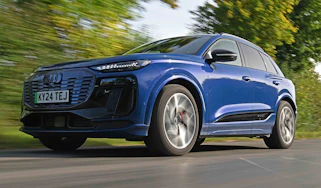
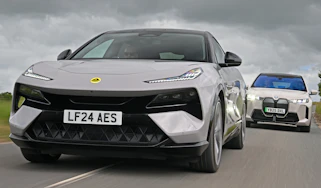
While two of the more obvious BMW iX rivals come in the shape of the Audi Q6 e-tron and Mercedes EQE SUV, the BMW has an edge over these competitors in terms of luxury. However, an equally plush but lesser known rival is the Lotus Eletre, which is one of the very few SUVs that can give the iX a real run for its money in the driver engagement department. There are also two premium contenders from Sweden; the Volvo EX90 and Polestar 3.
Key updates of the BMW iX review
8 September 2026: General update to include driving impressions and latest depreciation data.
17 March 2026: Updated to include the latest driving impressions from our BMW iX vs Volvo EX90 twin test.
23 January 2026: Updated to reflect the increased expensive car supplement threshold and mention the proposed pay-per-mile tax for EVs from 2028.
Frequently Asked Questions
BMW gives a three-year, unlimited-mileage warranty, which includes free roadside assistance for the duration, while the high-voltage battery is covered for eight years or 100,000 miles, whichever comes first.
Deals on the iX and alternatives
Audi Q6
Lotus Eletre