BMW iX vs Volvo EX90: which premium electric SUV will prevail?
Volvo’s new EX90 has arrived to take on the BMW iX. Which of these £100k premium electric SUVs is our pick?


While German firms dominate the premium sectors of the market, you aren’t limited to Audi, BMW or Mercedes if you want a posh machine. One maker that has stepped up to take on the big three is Volvo, and in the large electric SUV segment it has launched the EX90, a bespoke seven-seater designed to sit alongside the long-lived XC90.
The EX90 shares many aspects with the XC90, including a strong emphasis on design-led luxury, a seven-seat layout and, of course, Volvo’s commitment to class-leading safety.
We had to wait a little while for the EX90 to hit showrooms, so much so that it has already been subject to a range of updates for what Volvo calls its 2027 model year. These largely focus on new powertrains with improved efficiency and performance, leaving the luxury and safety broadly unchanged.
So how does the Volvo EX90 measure up? There aren’t many seven-seat premium EVs on sale, so for this test we’ve lined up our favourite five-seat electric SUV, the BMW iX.
An update in 2025 saw the car given a visual makeover and powertrain updates, too, but as with the Volvo, its core qualities of modern luxury and decent efficiency remained unchanged, as did the BMW’s fine mix of ride and handling. So how does the EX90 fare against this tough opponent?
Used - available now

2023 Ford
Kuga
11,115 milesAutomaticPetrol2.5L
Cash £19,488
2017 Vauxhall
Mokka
60,805 milesManualPetrol1.4L
Cash £7,495
2020 MG
ZS ELECTRIC
51,055 milesAutomaticElectric
Cash £8,950
2023 Ford
Puma
851 milesAutomaticPetrol1.0L
Cash £15,999Did you know you can sell your car through Auto Express? We’ll help you get a great price and find a great deal on a new car, too.
Volvo EX90
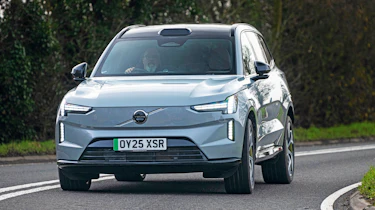
| Model: | Volvo EX90 Twin Motor Ultra |
| Price: | £93,860 |
| Powertrain: | 106kWh battery, 2x e-motors, 450bhp |
| 0-62mph: | 5.5 seconds |
| Test efficiency: | 2.7 miles/kWh |
| Official range: | 375 miles |
| Annual VED: | £620 |
Rather than electrifying its existing models, Volvo is launching bespoke EVs to sell alongside its combustion-engined cars. The EX90 has similar proportions to the XC90, and retains its seven-seat layout.
There are three variants available, a 92kWh Single Motor, 106kWh Twin Motor and 106kWh Performance, with Plus trim offered on the first two and Ultra trim for the latter pair. Prices range from £80,160 to £97,460, although standard equipment is generous across the board.
Tester’s notes
We’re used to large SUVs such as the EX90 delivering surreal acceleration, but at least the Volvo has the braking power to get you back to a standstill quickly. More importantly, the safety systems are designed to optimise everything in an emergency stop.
But a kerbweight in excess of 2.5 tonnes will put strain on the system, and too many hard braking events are likely to heat things up quickly. It’s also quite disconcerting because this large SUV pitches on its nose when you’re using the full force of the discs and pads – we wouldn’t want to make a habit of it.
Volvo uses the same Android Automotive operating system as Polestar, so includes an auto-start function that means the car switches on as soon as you sit behind the wheel. It’s similar to the system found in Teslas, and means you don’t need to fumble around with a key or starter button. You can even use a smartphone to lock and unlock the car.
Other Tesla-style tech includes adjustment of the mirrors via the touchscreen and steering wheel buttons, and you can adjust the wheel itself in the same way.
BMW iX
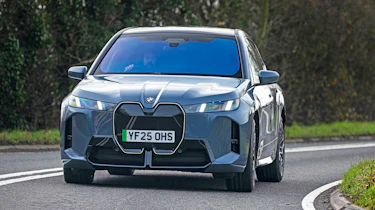
| Model: | BMW iX xDrive60 M Sport |
| Price: | £93,205 |
| Powertrain: | 111.5kWh battery, 2x e-motors, 537bhp |
| 0-62mph: | 4.6 seconds |
| Test efficiency: | 3.5 miles/kWh |
| Official range: | 426 miles |
| Annual VED: | £620 |
The BMW iX is currently our favourite premium electric SUV, and a range of updates in 2025 have only helped to cement its position. While the looks are divisive, there’s no arguing with its performance, tech and quality.
There are three versions offered with two battery sizes: a 101kWh xDrive45, then xDrive60 and M70 models with a 11.5kWh pack. The M70 is a standalone model, while the 45 and 60 versions come in Sport and M Sport guises.
Tester’s notes
There’s plenty to like about the BMW iX on the road, but you can make things even better by adding rear-wheel steering. BMW calls it Integral Active Steering and it comes as standard on the top-spec M70 model and is a £1,400 option on the xDrive versions.
As with many other rear-steer set-ups, the wheels turn in the same direction as the fronts at higher speeds to reduce steering effort. But the real benefit is when parking, where the rear wheels turn in the opposite direction to the fronts, which gives the iX a super-tight turning circle.
Rather than having different drive settings, BMW offers ‘My Modes’ in its cars. These do more than just adjust the drivetrain, and in the iX they also change the interior lighting and audio settings for different moods.
A highlight is the Expressive set-up, which features audio created by composer Hans Zimmer that is a substitute for an engine note. When cruising, there’s background noise that sounds like an orchestra warming up, but it turns into a more futuristic mix of strings and bass that brings visions of a spaceship hitting warp speed.
Head-to-head
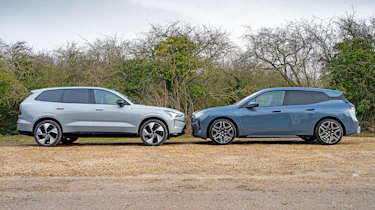
On the road
There’s a focus on comfort in the EX90, while a 2.7-tonne kerbweight limits its ability in corners. There’s enough grip, but body roll is evident even at moderate speeds. In contrast, the BMW iX is still one of the best-handling electric SUVs around, but it doesn’t come at the expense of comfort. Both cars deliver rapid acceleration, with the BMW offering a futuristic soundtrack depending on the selected drive mode.
Tech highlights
Volvo’s large 14.5-inch portrait touchscreen runs Google-sourced software, so it’s responsive and packed with features. Some of the on-screen shortcut buttons are surprisingly small, though.
BMW’s panoramic screen is intuitive to use and an iDrive control wheel and shortcut buttons help with its ease of use. Both cars have climate controls across the bottom of their displays.
Safety
With four years between these two cars’ Euro NCAP tests, the results for the Volvo and BMW can’t be directly compared, but they both come with a long list of safety kit, including the latest driver-assistance technology.
Early versions of the EX90 carry a suite of sensors in the taxi-style hump above the windscreen, but the 2027 car has a more conventional roofline while still retaining the same features.
Ownership
Both makers delivered above-average results in the most recent Driver Power survey, with BMW rated eighth out of 31 manufacturers – a marked improvement on previous showings – and Volvo 13th.
Warranty cover for these cars is largely average, with the BMW edging ahead thanks to having no mileage restriction. Both models come with three years of roadside assistance as standard.
Price and running
Neither car is cheap to buy, but you get a lot of equipment and plenty of luxury finishes for the money. Large batteries offer generous range, but the BMW edges ahead for efficiency and can go further on a charge.
We saw better efficiency from the iX on test with a return of 3.5 miles per kWh, compared with a rather inefficient 2.7mi/kWh for the Volvo. The EX90 has faster DC charging speeds, though.
Practicality
There’s more versatility on offer in the Volvo, courtesy of its standard seven-seat layout. The rearmost seats are best reserved for kids, who will be able to get in and out easily. There’s more boot space in the Volvo in five-seat mode than the BMW offers, although both are roomy. A low window line boosts visibility in the iX, but both cars have a full suite of cameras to help with low-speed manoeuvrability.
Verdict
Winner: BMW iX
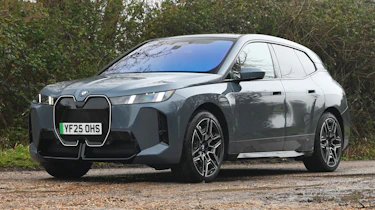
Revisions to the BMW iX have made an already impressive electric SUV even stronger, and if you don’t need a seven-seat layout, it’s our leading choice in this part of the market. No rival offers the same balance between performance, handling and efficiency, while the premium interior offers the kind of luxury that only limousines can emulate.
You don’t even need to pay top dollar for the experience, because while the xDrive60 is great, the xDrive45 offers more than enough performance while still delivering the same upmarket and tech-laden features.
Runner-up: Volvo EX90
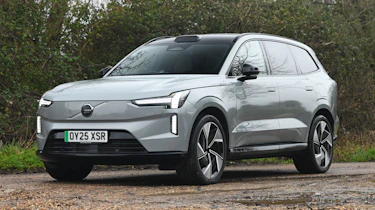
There’s a lot to like about the Volvo EX90, and if you’re in need of seven seats, then it’s largely in a class of one at this price point. The plush cabin offers something different from the tech-laden norm, and when specified in lighter colours, the interior feels fresh.
Cabin comfort is excellent at higher speeds, but low-speed refinement is a little behind the class best, while the heavy kerbweight makes its presence felt on twistier roads. Then there’s its lower efficiency when compared with the BMW here: we’d happily sacrifice the car’s performance for a longer range.
Prices and specs
| Model tested | Volvo EX90 | BMW iX |
| Price from/as tested | £80,160/£93,860 | £75,405/£93,205 |
| Powertrain and performance | ||
| Powertrain | 2x electric motors | 2x electric motors |
| Power | 450bhp | 537bhp |
| Torque | 670Nm | 765Nm |
| Transmission | Single-speed/4WD | Single-speed/4WD |
| 0-62mph/top speed | 5.5 seconds/112mph | 4.6 seconds/124mph |
| Battery capacity/usable | 106/102kWh | 111.5/109.1kWh |
| Official range | 375 miles | 426 miles |
| Test efficiency/range | 2.7 mi/kWh/275 miles | 3.5 mi/kWh/382 miles |
| Charging | 350kW (10-80% in 22 mins) | 195kW (10-80% in 35 mins) |
| Dimensions | ||
| Length/wheelbase | 5,037/2,985mm | 4,965/3,000mm |
| Width/height | 2,039/1,747mm | 1,970/1,695mm |
| Rear headroom/elbow room | 975/1,575mm | 1,006/1,580mm |
| Third row knee/head/elbow room | 600-680/850/1,275mm | N/A |
| Boot space (7/5/2 seats) | 324/697/2,135 litres | N/A/500/1,750 litres |
| Boot length/width/lip | 1,245/1,130/675mm | 1,055/1,106/762mm |
| Boot length/width (7 seats) | 575/1,400mm | N/A |
| Kerbweight/payload/towing weight | 2,689/651/2,200kg | 2,525/640/2,500kg |
| Turning circle | 11.8 metres | 12.8 metres |
| Costs/ownership | ||
| Residual value (after 3yrs/36,000 miles) | £50,027/53.3% | £42,035/45.1% |
| Depreciation | £30,133 | £33,370 |
| Ins. group (from AA.com)/quote/VED | 50/£1,578/£620 | 50/£1,668/£620 |
| Three-year service cost | £0 | £910 |
| Annual tax liability std/higher rate | £563/£1,126 | £559/£1,118 |
| Annual fuel cost (10,000 miles) | £952 | £734 |
| Basic warranty (miles)/recovery | 3yrs (60,000)/3yrs | 3yrs (unlimited)/3yrs |
| Driver Power manufacturer position | 13th | 8th |
| NCAP Adult/child/ped./assist/stars | 92/93/82/86/5 _ (2025) | 91/87/73/81/5_ (2021) |
| Equipment | ||
| Metallic paint/wheel size | £895/22 inches | £900-£3,300/21 inches |
| Parking sensors/camera | Front & rear/360-degree | Front & rear/360-degree |
| Spare wheel/Isofix points | Repair kit/two | Repair kit/two |
| Keyless entry & go/powered tailgate | Yes/yes | Yes/yes |
| Leather/heated seats/wheel | Artificial/climate/yes | Yes/climate/yes |
| Screen size/digital dashboard | 14.5/9.0 inches | 14.9/12.3 inches |
| Climate control/panoramic sunroof | Four-zone/yes | Three-zone/£3,200 |
| USBs/wireless charging | Six/yes | Four/yes |
| Wireless CarPlay/Android Auto | Yes/yes | Yes/yes |
| Blind-spot warning/head-up display | Yes/yes | Yes/yes |
| Adaptive cruise/steering assist | Yes/yes | Yes/yes |
What we would choose
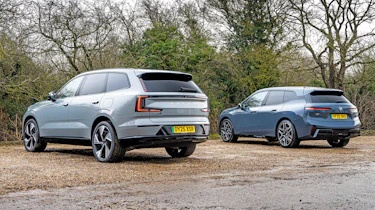
Volvo EX90
Metallic paint adds £895 to the list price. Vapour Grey is the standard colour, while Mulberry Red stands out from a palette of silvers, whites and blacks. An integrated child seat is £295, while the retractable towbar is £1,600.
BMW iX
That £3,300 price for paint is for BMW’s ‘Frozen’ matt finishes, while 20-23-inch wheels and different upholstery colours are available, including a distinctive red leather. Panoramic glass is a useful option, at £3,200.
Looking for your next car? You can now search our nationwide dealer network for a choice of great cars on offer right now with new, used and leasing deals to choose from...