Ford Edge
Edge HySeries Drive boosts Ford's green credentials
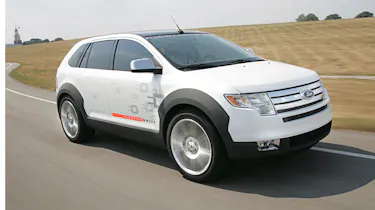

Ford has chosen this system because it believes hydrogen fuel cells are more suited to being generators for other sources, rather than directly supplying the power themselves. And it has done a good job of proving it. The Edge is fun to drive, with sufficient performance and a long enough range to be a credible petrol alternative. And, of course, it’s totally environmentally friendly.
The future of gas-guzzling SUVs could be under threat – although not for the reason the anti-off-road brigade might like you to expect.
Ford knows that if it’s to continue making 4x4s, it’s got to work on more ecologically sound ways of powering them: and so it’s turned its attention to some seriously hi-tech solutions.
The most interesting of these is the HySeries Drive – or in non-Ford speak, the electric-hydrogen fuel cell hybrid. And we have driven it, before it’s distributed to a select group of US customers next year.
The theory behind the technology is relatively simple. The car has two motors – one on each axle. These are powered by under-floor lithium ion batteries, and when they drain to 40 per cent of their charge, the hydrogen fuel cell kicks in to replenish them. It gives the car a range of 225 miles – but the best bit is that the only emission is water deposited beneath.
Ford has fitted the HySeries drivetrain in its new Edge SUV, although the technology can be applied to any vehicle. And this is the first hybrid that you simply plug in to charge.
While eco-friendly driving is rarely associated with power, the new system gives the Edge the equivalent of 250bhp. The flat shape of the hydrogen fuel cells and batteries also enhances cornering ability, as they can be fitted in the base of the car. This means most of the Edge’s weight is under the seats – giving responsive handling.
Price is the big problem, though. Ford says the drivetrain is four times more expensive than a regular petrol engine – and that even with advances in technology, in a decade, it will still have to sell for twice as much.